Event submissions
Published
This submission belongs to the session S5. Neurodegenerative Diseases of the event The 4th International Electronic Conference on Brain Sciences
Published date
22 Oct, 2024
Academic Editor
'%3e%3cpath%20d='M12.6657%2010.9104C12.4185%2010.325%2012.0599%209.79327%2011.6097%209.34482C11.1609%208.89508%2010.6293%208.5365%2010.0442%208.28888C10.0389%208.28626%2010.0337%208.28495%2010.0285%208.28233C10.8446%207.69279%2011.3752%206.73249%2011.3752%205.64904C11.3752%203.8542%209.92103%202.39999%208.1262%202.39999C6.33136%202.39999%204.87715%203.8542%204.87715%205.64904C4.87715%206.73249%205.40774%207.69279%206.22393%208.28364C6.21869%208.28626%206.21345%208.28757%206.20821%208.29019C5.62129%208.5378%205.09463%208.89284%204.64265%209.34613C4.1929%209.79493%203.83432%2010.3266%203.58671%2010.9117C3.34345%2011.4845%203.21226%2012.0987%203.20023%2012.7209C3.19988%2012.7349%203.20233%2012.7488%203.20744%2012.7619C3.21255%2012.7749%203.22022%2012.7867%203.22998%2012.7968C3.23975%2012.8068%203.25142%2012.8147%203.26431%2012.8202C3.2772%2012.8256%203.29105%2012.8284%203.30504%2012.8284H4.09109C4.14874%2012.8284%204.19459%2012.7825%204.1959%2012.7262C4.2221%2011.7148%204.62823%2010.7676%205.34617%2010.0497C6.08899%209.30683%207.0755%208.89808%208.1262%208.89808C9.17689%208.89808%2010.1634%209.30683%2010.9062%2010.0497C11.6242%2010.7676%2012.0303%2011.7148%2012.0565%2012.7262C12.0578%2012.7838%2012.1037%2012.8284%2012.1613%2012.8284H12.9474C12.9613%2012.8284%2012.9752%2012.8256%2012.9881%2012.8202C13.001%2012.8147%2013.0126%2012.8068%2013.0224%2012.7968C13.0322%2012.7867%2013.0398%2012.7749%2013.0449%2012.7619C13.0501%2012.7488%2013.0525%2012.7349%2013.0522%2012.7209C13.0391%2012.0947%2012.9094%2011.4855%2012.6657%2010.9104ZM8.1262%207.9024C7.52486%207.9024%206.9589%207.6679%206.53312%207.24211C6.10733%206.81633%205.87283%206.25037%205.87283%205.64904C5.87283%205.0477%206.10733%204.48174%206.53312%204.05596C6.9589%203.63018%207.52486%203.39567%208.1262%203.39567C8.72753%203.39567%209.29349%203.63018%209.71927%204.05596C10.1451%204.48174%2010.3796%205.0477%2010.3796%205.64904C10.3796%206.25037%2010.1451%206.81633%209.71927%207.24211C9.29349%207.6679%208.72753%207.9024%208.1262%207.9024Z'%20fill='%235D1EE1'/%3e%3c/g%3e%3c/svg%3e) Carla Masala
Carla MasalaCitation
Antonio Peña-Fernández, Santiago Angulo, Mark D. Evans, Chris NJ. Young, María José González-Muñoz, Maria del Carmen Lobo-Bedmar, María de los Ángeles Peña, The effect of silicic acid and alcoholic beer intake on the excretion of chromium and vanadium and their deposition in the brains of mice chronically exposed to aluminium nitrate, in Proceedings of The 4th International Electronic Conference on Brain Sciences, 23 October–25 October 2024, MDPI: Basel, Switzerland
Share
Email
Facebook
Twitter
LinkedIn
The effect of silicic acid and alcoholic beer intake on the excretion of chromium and vanadium and their deposition in the brains of mice chronically exposed to aluminium nitrate

Antonio Peña-Fernández 1
'%3e%3cpath%20d='M12.6647%2010.9104C12.4176%2010.325%2012.0589%209.7933%2011.6088%209.34485C11.16%208.89511%2010.6283%208.53653%2010.0432%208.28891C10.038%208.28629%2010.0327%208.28498%2010.0275%208.28236C10.8437%207.69282%2011.3743%206.73252%2011.3743%205.64907C11.3743%203.85423%209.92005%202.40002%208.12522%202.40002C6.33038%202.40002%204.87618%203.85423%204.87618%205.64907C4.87618%206.73252%205.40677%207.69282%206.22296%208.28367C6.21772%208.28629%206.21248%208.2876%206.20724%208.29022C5.62031%208.53783%205.09365%208.89287%204.64167%209.34616C4.19192%209.79496%203.83334%2010.3266%203.58573%2010.9117C3.34247%2011.4846%203.21128%2012.0987%203.19925%2012.721C3.1989%2012.735%203.20135%2012.7489%203.20646%2012.7619C3.21157%2012.7749%203.21924%2012.7868%203.22901%2012.7968C3.23877%2012.8068%203.25045%2012.8148%203.26334%2012.8202C3.27623%2012.8256%203.29007%2012.8284%203.30406%2012.8284H4.09012C4.14776%2012.8284%204.19362%2012.7825%204.19493%2012.7262C4.22113%2011.7148%204.62726%2010.7676%205.34519%2010.0497C6.08802%209.30686%207.07452%208.89811%208.12522%208.89811C9.17592%208.89811%2010.1624%209.30686%2010.9052%2010.0497C11.6232%2010.7676%2012.0293%2011.7148%2012.0555%2012.7262C12.0568%2012.7839%2012.1027%2012.8284%2012.1603%2012.8284H12.9464C12.9604%2012.8284%2012.9742%2012.8256%2012.9871%2012.8202C13%2012.8148%2013.0117%2012.8068%2013.0214%2012.7968C13.0312%2012.7868%2013.0389%2012.7749%2013.044%2012.7619C13.0491%2012.7489%2013.0515%2012.735%2013.0512%2012.721C13.0381%2012.0947%2012.9084%2011.4856%2012.6647%2010.9104ZM8.12522%207.90243C7.52388%207.90243%206.95792%207.66793%206.53214%207.24215C6.10636%206.81636%205.87185%206.2504%205.87185%205.64907C5.87185%205.04773%206.10636%204.48177%206.53214%204.05599C6.95792%203.63021%207.52388%203.3957%208.12522%203.3957C8.72655%203.3957%209.29252%203.63021%209.7183%204.05599C10.1441%204.48177%2010.3786%205.04773%2010.3786%205.64907C10.3786%206.2504%2010.1441%206.81636%209.7183%207.24215C9.29252%207.66793%208.72655%207.90243%208.12522%207.90243Z'%20fill='%235D1EE1'/%3e%3c/g%3e%3c/svg%3e)
Santiago Angulo 2
Mark D. Evans 3
Chris NJ. Young 4
María José González-Muñoz 5
Maria del Carmen Lobo-Bedmar 6

María de los Ángeles Peña 5
1. Department of Surgery, Medical and Social Sciences, Faculty of Medicine and Health Sciences, University of Alcalá, Ctra. Madrid-Barcelona, Km. 33.600, 28871 Alcalá de Henares, Madrid, Spain.
2. Facultad de Farmacia, Universidad San Pablo-CEU, CEU Universities, Urbanización Montepríncipe, 28660 Boadilla del Monte, Spain.
3. Leicester School of Allied Health Sciences, De Montfort University, Leicester, LE1 9BH, UK.
4. Leicester School of Allied Health Sciences, De Montfort University, Leicester, LE1 9BH, UK
5. Departamento de Ciencias Biomédicas, Universidad de Alcalá, Crta. Madrid-Barcelona Km, 33.6, 28871 Alcalá de Henares, Madrid, Spain
6. Departamento de Investigación Agroambiental. IMIDRA. Finca el Encín, Crta. Madrid-Barcelona Km, 38.2, 28800 Alcalá de Henares, Madrid, Spain.
Abstract
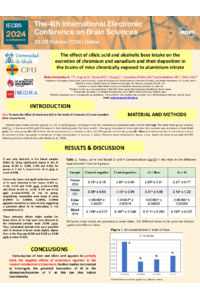
The effect of aluminium (Al) exposure and silicon (Si) intake on the levels of chromium (Cr) and vanadium (V) in mouse brains was studied. Six-week-old male NMRI mice were divided into four groups. Three groups received Al(NO3)3 at a dose of 450 μg/ml for three months; meanwhile, the fourth group only received deionised water. The first group received aluminium nitrate (Al group); the second group aluminium nitrate and silicic acid (50 mg/ml); and the third group aluminium nitrate and commercial beer. Metals were monitored by ICP-OES in the right hemibrain, faeces, urine and blood. V was only detected in the faecal samples, being significantly higher in the Al group (4.132 vs. 3.383, 3.100 and 3.315; groups 4, 2 and 3, respectively; all in μg/g; p-value=0.038). Conversely, lower and significantly lower levels of Cr were detected in the faeces (2.867 vs. 3.155, 2.270 and 2.550 μg/g; p-value=0.296) and blood (0.187 vs. 0.158, 0.197 and 0.211 μg/l; p-value=0.013) in the Al group, respectively, as well as in the urine (0.00047 vs. 0.00069, 0.00060, 0.00065 μg/μmol creatinine; p-value=0.311), suggesting a potential effect of Al intoxication on the metabolism of Cr. These unknown effects might explain the lower levels of Cr that were detected in the intoxicated animals’ brains (0.346 μg/g). Thus, the intoxicated animals that were provided with Si showed Cr brain levels slightly higher than those in the Al group (0.360 and 0.352 vs. 0.346 μg/g; p-value=0.552). The consumption of beer/silicic acid appears to partially block the negative effects of aluminium ingestion on the normal metabolism of chromium.
Keywords
Chromium
vanadium
aluminium intoxication
silicon
brain accumulation.
Poster
MDPI IECBS 2024 _beer brain Cr V_APF.pdf
Applications of terbium halide-filled single-walled carbon nanotubes in biomedicine
Advancements in Neuroimaging Techniques: A Window into the Brain's Complexity