Event submissions
Published
This submission belongs to the session S6. Cognitive Neuroscience of the event The 4th International Electronic Conference on Brain Sciences
Published date
22 Oct, 2024
Academic Editor
'%3e%3cpath%20d='M12.6657%2010.9104C12.4185%2010.325%2012.0599%209.79327%2011.6097%209.34482C11.1609%208.89508%2010.6293%208.5365%2010.0442%208.28888C10.0389%208.28626%2010.0337%208.28495%2010.0285%208.28233C10.8446%207.69279%2011.3752%206.73249%2011.3752%205.64904C11.3752%203.8542%209.92103%202.39999%208.1262%202.39999C6.33136%202.39999%204.87715%203.8542%204.87715%205.64904C4.87715%206.73249%205.40774%207.69279%206.22393%208.28364C6.21869%208.28626%206.21345%208.28757%206.20821%208.29019C5.62129%208.5378%205.09463%208.89284%204.64265%209.34613C4.1929%209.79493%203.83432%2010.3266%203.58671%2010.9117C3.34345%2011.4845%203.21226%2012.0987%203.20023%2012.7209C3.19988%2012.7349%203.20233%2012.7488%203.20744%2012.7619C3.21255%2012.7749%203.22022%2012.7867%203.22998%2012.7968C3.23975%2012.8068%203.25142%2012.8147%203.26431%2012.8202C3.2772%2012.8256%203.29105%2012.8284%203.30504%2012.8284H4.09109C4.14874%2012.8284%204.19459%2012.7825%204.1959%2012.7262C4.2221%2011.7148%204.62823%2010.7676%205.34617%2010.0497C6.08899%209.30683%207.0755%208.89808%208.1262%208.89808C9.17689%208.89808%2010.1634%209.30683%2010.9062%2010.0497C11.6242%2010.7676%2012.0303%2011.7148%2012.0565%2012.7262C12.0578%2012.7838%2012.1037%2012.8284%2012.1613%2012.8284H12.9474C12.9613%2012.8284%2012.9752%2012.8256%2012.9881%2012.8202C13.001%2012.8147%2013.0126%2012.8068%2013.0224%2012.7968C13.0322%2012.7867%2013.0398%2012.7749%2013.0449%2012.7619C13.0501%2012.7488%2013.0525%2012.7349%2013.0522%2012.7209C13.0391%2012.0947%2012.9094%2011.4855%2012.6657%2010.9104ZM8.1262%207.9024C7.52486%207.9024%206.9589%207.6679%206.53312%207.24211C6.10733%206.81633%205.87283%206.25037%205.87283%205.64904C5.87283%205.0477%206.10733%204.48174%206.53312%204.05596C6.9589%203.63018%207.52486%203.39567%208.1262%203.39567C8.72753%203.39567%209.29349%203.63018%209.71927%204.05596C10.1451%204.48174%2010.3796%205.0477%2010.3796%205.64904C10.3796%206.25037%2010.1451%206.81633%209.71927%207.24211C9.29349%207.6679%208.72753%207.9024%208.1262%207.9024Z'%20fill='%235D1EE1'/%3e%3c/g%3e%3c/svg%3e) Gerry Leisman
Gerry LeismanCitation
Elena Rodríguez-Rodríguez, Francisco Nieto-Escámez, A Single Session of the Beat Saber VR Exergame Does Not Improve Selective Attention or Attentional Blink: A Pre–Post Study, in Proceedings of The 4th International Electronic Conference on Brain Sciences, 23 October–25 October 2024, MDPI: Basel, Switzerland
Share
Email
Facebook
Twitter
LinkedIn
A Single Session of the Beat Saber VR Exergame Does Not Improve Selective Attention or Attentional Blink: A Pre–Post Study
'%3e%3cpath%20d='M12.6647%2010.9104C12.4176%2010.325%2012.0589%209.7933%2011.6088%209.34485C11.16%208.89511%2010.6283%208.53653%2010.0432%208.28891C10.038%208.28629%2010.0327%208.28498%2010.0275%208.28236C10.8437%207.69282%2011.3743%206.73252%2011.3743%205.64907C11.3743%203.85423%209.92005%202.40002%208.12522%202.40002C6.33038%202.40002%204.87618%203.85423%204.87618%205.64907C4.87618%206.73252%205.40677%207.69282%206.22296%208.28367C6.21772%208.28629%206.21248%208.2876%206.20724%208.29022C5.62031%208.53783%205.09365%208.89287%204.64167%209.34616C4.19192%209.79496%203.83334%2010.3266%203.58573%2010.9117C3.34247%2011.4846%203.21128%2012.0987%203.19925%2012.721C3.1989%2012.735%203.20135%2012.7489%203.20646%2012.7619C3.21157%2012.7749%203.21924%2012.7868%203.22901%2012.7968C3.23877%2012.8068%203.25045%2012.8148%203.26334%2012.8202C3.27623%2012.8256%203.29007%2012.8284%203.30406%2012.8284H4.09012C4.14776%2012.8284%204.19362%2012.7825%204.19493%2012.7262C4.22113%2011.7148%204.62726%2010.7676%205.34519%2010.0497C6.08802%209.30686%207.07452%208.89811%208.12522%208.89811C9.17592%208.89811%2010.1624%209.30686%2010.9052%2010.0497C11.6232%2010.7676%2012.0293%2011.7148%2012.0555%2012.7262C12.0568%2012.7839%2012.1027%2012.8284%2012.1603%2012.8284H12.9464C12.9604%2012.8284%2012.9742%2012.8256%2012.9871%2012.8202C13%2012.8148%2013.0117%2012.8068%2013.0214%2012.7968C13.0312%2012.7868%2013.0389%2012.7749%2013.044%2012.7619C13.0491%2012.7489%2013.0515%2012.735%2013.0512%2012.721C13.0381%2012.0947%2012.9084%2011.4856%2012.6647%2010.9104ZM8.12522%207.90243C7.52388%207.90243%206.95792%207.66793%206.53214%207.24215C6.10636%206.81636%205.87185%206.2504%205.87185%205.64907C5.87185%205.04773%206.10636%204.48177%206.53214%204.05599C6.95792%203.63021%207.52388%203.3957%208.12522%203.3957C8.72655%203.3957%209.29252%203.63021%209.7183%204.05599C10.1441%204.48177%2010.3786%205.04773%2010.3786%205.64907C10.3786%206.2504%2010.1441%206.81636%209.7183%207.24215C9.29252%207.66793%208.72655%207.90243%208.12522%207.90243Z'%20fill='%235D1EE1'/%3e%3c/g%3e%3c/svg%3e)
Elena Rodríguez-Rodríguez 1

Francisco Nieto-Escámez 1,2
1. Dept. Psychology, University of Almeria, Almeria, 04120, Spain
2. Research Center for Wellbeing and Social Inclusion, University of Almeria, Almeria, 04120, Spain
Abstract
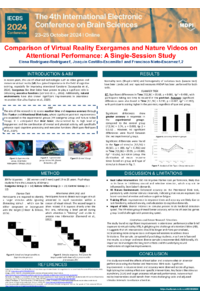
Background: Several studies highlight the relevance of video games and virtual reality (VR) training in enhancing various attentional processes, specifically selective attention, cognitive flexibility, and attentional blink. Beat Saber, an action virtual reality game, has been used in previous studies to train visual attention, reporting significant effects on visual attention task scores. In our laboratory, we previously obtained significant improvements in dynamic visual acuity performance following one training session with Beat Saber.
Method: Thirty-nine university students were divided into three groups: (1) those trained with the Beat Saber VR exergame, (2) those exposed to a relaxing video using VR, and (3) a control group without any intervention. All the interventions lasted 20 minutes. A pre–post-intervention study design was implemented, applying two attentional tests: the Flanker task and the attentional blink task.
Results: The factorial ANOVA showed no significant differences between the groups in terms of improvement in the attentional tasks. However, significant differences were observed between the pre- and post-intervention assessments within each group, indicating some overall changes in performance over time, irrespective of the type of intervention. Training duration differences could be the reason for the discrepancies in the visual attention improvements between other studies and ours.
Conclusions: A single session of Beat Saber training does not produce an improvement in selective attention or attentional blink. Despite these results, it is important to continue studying the potential of VR in different contexts and with varied durations and frequencies of training sessions.
Keywords
Virtual Reality
Selective Attention
Attentional Blink
Exergame
Beat Saber
Poster
sciforum-097898_FranciscoAntonioNietoEscamez.pdf
Detection of Alzheimer's Disease from EEG Signals Using Machine Learning: A Comparative Study with XGBoost, SVM, and Naive Bayes
Impact of Emotional Arousal and Stimulus Processing on Inhibitory Control: Insights from Virtual Reality