Event submissions
Published
This submission belongs to the session S6. Cognitive Neuroscience of the event The 4th International Electronic Conference on Brain Sciences
Published date
22 Oct, 2024
Academic Editor
'%3e%3cpath%20d='M12.6657%2010.9104C12.4185%2010.325%2012.0599%209.79327%2011.6097%209.34482C11.1609%208.89508%2010.6293%208.5365%2010.0442%208.28888C10.0389%208.28626%2010.0337%208.28495%2010.0285%208.28233C10.8446%207.69279%2011.3752%206.73249%2011.3752%205.64904C11.3752%203.8542%209.92103%202.39999%208.1262%202.39999C6.33136%202.39999%204.87715%203.8542%204.87715%205.64904C4.87715%206.73249%205.40774%207.69279%206.22393%208.28364C6.21869%208.28626%206.21345%208.28757%206.20821%208.29019C5.62129%208.5378%205.09463%208.89284%204.64265%209.34613C4.1929%209.79493%203.83432%2010.3266%203.58671%2010.9117C3.34345%2011.4845%203.21226%2012.0987%203.20023%2012.7209C3.19988%2012.7349%203.20233%2012.7488%203.20744%2012.7619C3.21255%2012.7749%203.22022%2012.7867%203.22998%2012.7968C3.23975%2012.8068%203.25142%2012.8147%203.26431%2012.8202C3.2772%2012.8256%203.29105%2012.8284%203.30504%2012.8284H4.09109C4.14874%2012.8284%204.19459%2012.7825%204.1959%2012.7262C4.2221%2011.7148%204.62823%2010.7676%205.34617%2010.0497C6.08899%209.30683%207.0755%208.89808%208.1262%208.89808C9.17689%208.89808%2010.1634%209.30683%2010.9062%2010.0497C11.6242%2010.7676%2012.0303%2011.7148%2012.0565%2012.7262C12.0578%2012.7838%2012.1037%2012.8284%2012.1613%2012.8284H12.9474C12.9613%2012.8284%2012.9752%2012.8256%2012.9881%2012.8202C13.001%2012.8147%2013.0126%2012.8068%2013.0224%2012.7968C13.0322%2012.7867%2013.0398%2012.7749%2013.0449%2012.7619C13.0501%2012.7488%2013.0525%2012.7349%2013.0522%2012.7209C13.0391%2012.0947%2012.9094%2011.4855%2012.6657%2010.9104ZM8.1262%207.9024C7.52486%207.9024%206.9589%207.6679%206.53312%207.24211C6.10733%206.81633%205.87283%206.25037%205.87283%205.64904C5.87283%205.0477%206.10733%204.48174%206.53312%204.05596C6.9589%203.63018%207.52486%203.39567%208.1262%203.39567C8.72753%203.39567%209.29349%203.63018%209.71927%204.05596C10.1451%204.48174%2010.3796%205.0477%2010.3796%205.64904C10.3796%206.25037%2010.1451%206.81633%209.71927%207.24211C9.29349%207.6679%208.72753%207.9024%208.1262%207.9024Z'%20fill='%235D1EE1'/%3e%3c/g%3e%3c/svg%3e) Gerry Leisman
Gerry LeismanCitation
Manon Sáez-Gillet, Francisco Nieto-Escámez, Impact of Emotional Arousal and Stimulus Processing on Inhibitory Control: Insights from Virtual Reality, in Proceedings of The 4th International Electronic Conference on Brain Sciences, 23 October–25 October 2024, MDPI: Basel, Switzerland
Share
Email
Facebook
Twitter
LinkedIn
Impact of Emotional Arousal and Stimulus Processing on Inhibitory Control: Insights from Virtual Reality
'%3e%3cpath%20d='M12.6647%2010.9104C12.4176%2010.325%2012.0589%209.7933%2011.6088%209.34485C11.16%208.89511%2010.6283%208.53653%2010.0432%208.28891C10.038%208.28629%2010.0327%208.28498%2010.0275%208.28236C10.8437%207.69282%2011.3743%206.73252%2011.3743%205.64907C11.3743%203.85423%209.92005%202.40002%208.12522%202.40002C6.33038%202.40002%204.87618%203.85423%204.87618%205.64907C4.87618%206.73252%205.40677%207.69282%206.22296%208.28367C6.21772%208.28629%206.21248%208.2876%206.20724%208.29022C5.62031%208.53783%205.09365%208.89287%204.64167%209.34616C4.19192%209.79496%203.83334%2010.3266%203.58573%2010.9117C3.34247%2011.4846%203.21128%2012.0987%203.19925%2012.721C3.1989%2012.735%203.20135%2012.7489%203.20646%2012.7619C3.21157%2012.7749%203.21924%2012.7868%203.22901%2012.7968C3.23877%2012.8068%203.25045%2012.8148%203.26334%2012.8202C3.27623%2012.8256%203.29007%2012.8284%203.30406%2012.8284H4.09012C4.14776%2012.8284%204.19362%2012.7825%204.19493%2012.7262C4.22113%2011.7148%204.62726%2010.7676%205.34519%2010.0497C6.08802%209.30686%207.07452%208.89811%208.12522%208.89811C9.17592%208.89811%2010.1624%209.30686%2010.9052%2010.0497C11.6232%2010.7676%2012.0293%2011.7148%2012.0555%2012.7262C12.0568%2012.7839%2012.1027%2012.8284%2012.1603%2012.8284H12.9464C12.9604%2012.8284%2012.9742%2012.8256%2012.9871%2012.8202C13%2012.8148%2013.0117%2012.8068%2013.0214%2012.7968C13.0312%2012.7868%2013.0389%2012.7749%2013.044%2012.7619C13.0491%2012.7489%2013.0515%2012.735%2013.0512%2012.721C13.0381%2012.0947%2012.9084%2011.4856%2012.6647%2010.9104ZM8.12522%207.90243C7.52388%207.90243%206.95792%207.66793%206.53214%207.24215C6.10636%206.81636%205.87185%206.2504%205.87185%205.64907C5.87185%205.04773%206.10636%204.48177%206.53214%204.05599C6.95792%203.63021%207.52388%203.3957%208.12522%203.3957C8.72655%203.3957%209.29252%203.63021%209.7183%204.05599C10.1441%204.48177%2010.3786%205.04773%2010.3786%205.64907C10.3786%206.2504%2010.1441%206.81636%209.7183%207.24215C9.29252%207.66793%208.72655%207.90243%208.12522%207.90243Z'%20fill='%235D1EE1'/%3e%3c/g%3e%3c/svg%3e)
Manon Sáez-Gillet 1

Francisco Nieto-Escámez 1,2
1. Dept. Psychology, University of Almeria, Almeria, 04120, Spain
2. Research Center for Wellbeing and Social Inclusion, University of Almeria, Almeria, 04120, Spain
Abstract
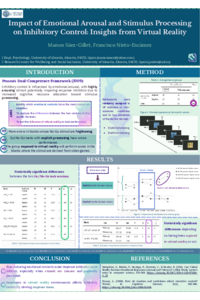
Background: According to the dual-competition framework, inhibitory control is influenced by emotional arousal, with highly arousing stimuli potentially impairing response inhibition due to increased cognitive resource allocation toward stimulus processing. This study aimed to investigate how stimuli depicting fearful scenes affected inhibitory processing compared to non-fearful stimuli. Virtual reality (VR) was utilized to enhance emotional intensity, and two versions of the Go/No-Go task were employed: one with explicit processing of stimuli and another with masked stimuli requiring implicit processing.
Methods: Stimuli selection involved an image evaluation process, resulting in two task versions for the Go/No-Go paradigm. Sixty-four participants were randomly assigned to conditions involving exposure or no exposure to VR, combined with task version variations. Participants performed inhibitory tasks under these conditions to assess differences in inhibitory control influenced by stimulus type and processing method.
Results: Fear stimuli with higher arousal levels significantly impaired response inhibition compared to non-fearful stimuli. Explicit stimulus processing in the Go/No-Go task also showed greater inhibition impairment than implicit processing. Additionally, prior exposure to stimuli in VR conditions affected response times, indicating extended processing demands for inhibitory tasks.
Conclusions: This study confirmed that stimulus intensity, particularly emotional arousal, played a critical role in modulating inhibitory control. Fearful stimuli and explicit stimulus processing significantly reduced the ability to inhibit responses. Moreover, VR-induced stimulus exposure extended processing times, highlighting implications for understanding inhibitory processes under varying emotional and environmental conditions.
Keywords
Emotional arousal
Inhibitory control
Virtual reality
Go/No-Go task
Poster
sciforum-097906_Manon Sáez-Gillet.pdf
A Single Session of the Beat Saber VR Exergame Does Not Improve Selective Attention or Attentional Blink: A Pre–Post Study
ANTI-DEMENTIA EFFECTS OF MANSORIN A, MANSONONE G, AND 6-PARADOL IN THE OKADAIC ACID-INDUCED ZEBRAFISH MODEL OF ALZHEIMER’S DISEASE