Event submissions
Published
This submission belongs to the session S8. Molecular and Cellular Neuroscience of the event The 4th International Electronic Conference on Brain Sciences
Published date
22 Oct, 2024
Academic Editor
'%3e%3cpath%20d='M12.6657%2010.9104C12.4185%2010.325%2012.0599%209.79327%2011.6097%209.34482C11.1609%208.89508%2010.6293%208.5365%2010.0442%208.28888C10.0389%208.28626%2010.0337%208.28495%2010.0285%208.28233C10.8446%207.69279%2011.3752%206.73249%2011.3752%205.64904C11.3752%203.8542%209.92103%202.39999%208.1262%202.39999C6.33136%202.39999%204.87715%203.8542%204.87715%205.64904C4.87715%206.73249%205.40774%207.69279%206.22393%208.28364C6.21869%208.28626%206.21345%208.28757%206.20821%208.29019C5.62129%208.5378%205.09463%208.89284%204.64265%209.34613C4.1929%209.79493%203.83432%2010.3266%203.58671%2010.9117C3.34345%2011.4845%203.21226%2012.0987%203.20023%2012.7209C3.19988%2012.7349%203.20233%2012.7488%203.20744%2012.7619C3.21255%2012.7749%203.22022%2012.7867%203.22998%2012.7968C3.23975%2012.8068%203.25142%2012.8147%203.26431%2012.8202C3.2772%2012.8256%203.29105%2012.8284%203.30504%2012.8284H4.09109C4.14874%2012.8284%204.19459%2012.7825%204.1959%2012.7262C4.2221%2011.7148%204.62823%2010.7676%205.34617%2010.0497C6.08899%209.30683%207.0755%208.89808%208.1262%208.89808C9.17689%208.89808%2010.1634%209.30683%2010.9062%2010.0497C11.6242%2010.7676%2012.0303%2011.7148%2012.0565%2012.7262C12.0578%2012.7838%2012.1037%2012.8284%2012.1613%2012.8284H12.9474C12.9613%2012.8284%2012.9752%2012.8256%2012.9881%2012.8202C13.001%2012.8147%2013.0126%2012.8068%2013.0224%2012.7968C13.0322%2012.7867%2013.0398%2012.7749%2013.0449%2012.7619C13.0501%2012.7488%2013.0525%2012.7349%2013.0522%2012.7209C13.0391%2012.0947%2012.9094%2011.4855%2012.6657%2010.9104ZM8.1262%207.9024C7.52486%207.9024%206.9589%207.6679%206.53312%207.24211C6.10733%206.81633%205.87283%206.25037%205.87283%205.64904C5.87283%205.0477%206.10733%204.48174%206.53312%204.05596C6.9589%203.63018%207.52486%203.39567%208.1262%203.39567C8.72753%203.39567%209.29349%203.63018%209.71927%204.05596C10.1451%204.48174%2010.3796%205.0477%2010.3796%205.64904C10.3796%206.25037%2010.1451%206.81633%209.71927%207.24211C9.29349%207.6679%208.72753%207.9024%208.1262%207.9024Z'%20fill='%235D1EE1'/%3e%3c/g%3e%3c/svg%3e) Stefano Casalotti
Stefano CasalottiCitation
Margarita Chigriai, Vesna Pešić, Miloš Stanojlović, Ema Lupšić, Marija Grozdanić, Ana Podolski-Renić, Milica Pešić, The impact of a protein phosphatase 2A inhibitor on glioblastoma and neurodegeneration, in Proceedings of The 4th International Electronic Conference on Brain Sciences, 23 October–25 October 2024, MDPI: Basel, Switzerland
Share
Email
Facebook
Twitter
LinkedIn
The impact of a protein phosphatase 2A inhibitor on glioblastoma and neurodegeneration
'%3e%3cpath%20d='M12.6647%2010.9104C12.4176%2010.325%2012.0589%209.7933%2011.6088%209.34485C11.16%208.89511%2010.6283%208.53653%2010.0432%208.28891C10.038%208.28629%2010.0327%208.28498%2010.0275%208.28236C10.8437%207.69282%2011.3743%206.73252%2011.3743%205.64907C11.3743%203.85423%209.92005%202.40002%208.12522%202.40002C6.33038%202.40002%204.87618%203.85423%204.87618%205.64907C4.87618%206.73252%205.40677%207.69282%206.22296%208.28367C6.21772%208.28629%206.21248%208.2876%206.20724%208.29022C5.62031%208.53783%205.09365%208.89287%204.64167%209.34616C4.19192%209.79496%203.83334%2010.3266%203.58573%2010.9117C3.34247%2011.4846%203.21128%2012.0987%203.19925%2012.721C3.1989%2012.735%203.20135%2012.7489%203.20646%2012.7619C3.21157%2012.7749%203.21924%2012.7868%203.22901%2012.7968C3.23877%2012.8068%203.25045%2012.8148%203.26334%2012.8202C3.27623%2012.8256%203.29007%2012.8284%203.30406%2012.8284H4.09012C4.14776%2012.8284%204.19362%2012.7825%204.19493%2012.7262C4.22113%2011.7148%204.62726%2010.7676%205.34519%2010.0497C6.08802%209.30686%207.07452%208.89811%208.12522%208.89811C9.17592%208.89811%2010.1624%209.30686%2010.9052%2010.0497C11.6232%2010.7676%2012.0293%2011.7148%2012.0555%2012.7262C12.0568%2012.7839%2012.1027%2012.8284%2012.1603%2012.8284H12.9464C12.9604%2012.8284%2012.9742%2012.8256%2012.9871%2012.8202C13%2012.8148%2013.0117%2012.8068%2013.0214%2012.7968C13.0312%2012.7868%2013.0389%2012.7749%2013.044%2012.7619C13.0491%2012.7489%2013.0515%2012.735%2013.0512%2012.721C13.0381%2012.0947%2012.9084%2011.4856%2012.6647%2010.9104ZM8.12522%207.90243C7.52388%207.90243%206.95792%207.66793%206.53214%207.24215C6.10636%206.81636%205.87185%206.2504%205.87185%205.64907C5.87185%205.04773%206.10636%204.48177%206.53214%204.05599C6.95792%203.63021%207.52388%203.3957%208.12522%203.3957C8.72655%203.3957%209.29252%203.63021%209.7183%204.05599C10.1441%204.48177%2010.3786%205.04773%2010.3786%205.64907C10.3786%206.2504%2010.1441%206.81636%209.7183%207.24215C9.29252%207.66793%208.72655%207.90243%208.12522%207.90243Z'%20fill='%235D1EE1'/%3e%3c/g%3e%3c/svg%3e)
Margarita Chigriai 1
Vesna Pešić 2
Miloš Stanojlović 2
Ema Lupšić 2
Marija Grozdanić 2

Ana Podolski-Renić 2

Milica Pešić 2
1. Advitam Laboratory, Mihaila Šuškalovića 13, 11030, Belgrade, Serbia
2. Department of Neurobiology, Institute for Biological Research “Siniša Stanković” – National Institute of the Republic of Serbia, University of Belgrade, Despota Stefana 142, 11108 Belgrade, Serbia
Abstract
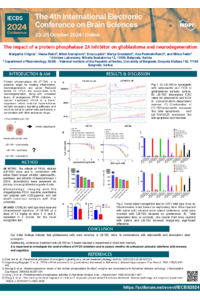
Introduction: Protein phosphatase 2A (PP2A) is a potential target for treating inflammation, neurodegeneration, and cancer. Reduced levels of PP2A are associated with neurodegeneration, along with increased levels of endogenous PP2A inhibitors. In cancer treatment, PP2A is a tumor suppressor, the inhibition of which hyperactivates multiple oncogenic signaling pathways and could be lethal to cancer cells particularly in combination with other anticancer drugs.
Methods: The effects of PP2A inhibitor (LB-100) alone and in combination with either Wee1 kinase inhibitor (adavosertib), paclitaxel, or doxorubicin were assessed on primary human glioblastoma grade 4 cells. The methodology included high-throughput imaging with ImageExpress PICO, real-time quantitative cell analysis with xCELLigence, and cell death induction analysis with flow cytometry. We conducted a behavioral study using C57BL/6J mice to assess cognitive deficiencies after treatment with LB-100. The mice received intraperitoneal injections of LB-100 at a dose of 1.5 mg/kg on days 1, 3, and 5, repeated in 5 cycles.
Results: Our initial findings indicate that glioblastoma cells were sensitive to LB-100, while its combinations with adavosertib and doxorubicin were synergistic. Additionally, continuous LB-100 treatment for 3 weeks resulted in significant body weight loss but did not show any noticeable cognitive changes.
Conclusions: It is important to investigate the effects of PP2A inhibition on neurodegeneration to assess its potential as a cancer therapy with minimal impact on cognition.
Keywords
PP2A
neuro-oncology
glioblastoma
neurodegeneration
Parkinson's disease
Poster
sciforum-098281 Chigriai Margarita (revised).pdf
A meta-analysis on the influence of transcranial direct current stimulation (tDCS) on the processing of implicit associations (IATs)
The precuneus is tuned to words that refer to time, not to space, whereas the IPS has no preferences