Event submissions
Published
This submission belongs to the session S8. Molecular and Cellular Neuroscience of the event The 4th International Electronic Conference on Brain Sciences
Published date
22 Oct, 2024
Academic Editor
'%3e%3cpath%20d='M12.6657%2010.9104C12.4185%2010.325%2012.0599%209.79327%2011.6097%209.34482C11.1609%208.89508%2010.6293%208.5365%2010.0442%208.28888C10.0389%208.28626%2010.0337%208.28495%2010.0285%208.28233C10.8446%207.69279%2011.3752%206.73249%2011.3752%205.64904C11.3752%203.8542%209.92103%202.39999%208.1262%202.39999C6.33136%202.39999%204.87715%203.8542%204.87715%205.64904C4.87715%206.73249%205.40774%207.69279%206.22393%208.28364C6.21869%208.28626%206.21345%208.28757%206.20821%208.29019C5.62129%208.5378%205.09463%208.89284%204.64265%209.34613C4.1929%209.79493%203.83432%2010.3266%203.58671%2010.9117C3.34345%2011.4845%203.21226%2012.0987%203.20023%2012.7209C3.19988%2012.7349%203.20233%2012.7488%203.20744%2012.7619C3.21255%2012.7749%203.22022%2012.7867%203.22998%2012.7968C3.23975%2012.8068%203.25142%2012.8147%203.26431%2012.8202C3.2772%2012.8256%203.29105%2012.8284%203.30504%2012.8284H4.09109C4.14874%2012.8284%204.19459%2012.7825%204.1959%2012.7262C4.2221%2011.7148%204.62823%2010.7676%205.34617%2010.0497C6.08899%209.30683%207.0755%208.89808%208.1262%208.89808C9.17689%208.89808%2010.1634%209.30683%2010.9062%2010.0497C11.6242%2010.7676%2012.0303%2011.7148%2012.0565%2012.7262C12.0578%2012.7838%2012.1037%2012.8284%2012.1613%2012.8284H12.9474C12.9613%2012.8284%2012.9752%2012.8256%2012.9881%2012.8202C13.001%2012.8147%2013.0126%2012.8068%2013.0224%2012.7968C13.0322%2012.7867%2013.0398%2012.7749%2013.0449%2012.7619C13.0501%2012.7488%2013.0525%2012.7349%2013.0522%2012.7209C13.0391%2012.0947%2012.9094%2011.4855%2012.6657%2010.9104ZM8.1262%207.9024C7.52486%207.9024%206.9589%207.6679%206.53312%207.24211C6.10733%206.81633%205.87283%206.25037%205.87283%205.64904C5.87283%205.0477%206.10733%204.48174%206.53312%204.05596C6.9589%203.63018%207.52486%203.39567%208.1262%203.39567C8.72753%203.39567%209.29349%203.63018%209.71927%204.05596C10.1451%204.48174%2010.3796%205.0477%2010.3796%205.64904C10.3796%206.25037%2010.1451%206.81633%209.71927%207.24211C9.29349%207.6679%208.72753%207.9024%208.1262%207.9024Z'%20fill='%235D1EE1'/%3e%3c/g%3e%3c/svg%3e) Stefano Casalotti
Stefano CasalottiCitation
Svetlana Olegovna Svitko, Anton Sergeevich Ananev, Egor Sergeevich Nevsky, Kseniia Sergeevna Shaidullova, Guzel Faritovna Sitdikova, Excitability of meningeal trigeminal nerve afferents in Dopamine-transporter knock-out (DAT-KO) rats, in Proceedings of The 4th International Electronic Conference on Brain Sciences, 23 October–25 October 2024, MDPI: Basel, Switzerland
Share
Email
Facebook
Twitter
LinkedIn
Excitability of meningeal trigeminal nerve afferents in Dopamine-transporter knock-out (DAT-KO) rats
'%3e%3cpath%20d='M12.6647%2010.9104C12.4176%2010.325%2012.0589%209.7933%2011.6088%209.34485C11.16%208.89511%2010.6283%208.53653%2010.0432%208.28891C10.038%208.28629%2010.0327%208.28498%2010.0275%208.28236C10.8437%207.69282%2011.3743%206.73252%2011.3743%205.64907C11.3743%203.85423%209.92005%202.40002%208.12522%202.40002C6.33038%202.40002%204.87618%203.85423%204.87618%205.64907C4.87618%206.73252%205.40677%207.69282%206.22296%208.28367C6.21772%208.28629%206.21248%208.2876%206.20724%208.29022C5.62031%208.53783%205.09365%208.89287%204.64167%209.34616C4.19192%209.79496%203.83334%2010.3266%203.58573%2010.9117C3.34247%2011.4846%203.21128%2012.0987%203.19925%2012.721C3.1989%2012.735%203.20135%2012.7489%203.20646%2012.7619C3.21157%2012.7749%203.21924%2012.7868%203.22901%2012.7968C3.23877%2012.8068%203.25045%2012.8148%203.26334%2012.8202C3.27623%2012.8256%203.29007%2012.8284%203.30406%2012.8284H4.09012C4.14776%2012.8284%204.19362%2012.7825%204.19493%2012.7262C4.22113%2011.7148%204.62726%2010.7676%205.34519%2010.0497C6.08802%209.30686%207.07452%208.89811%208.12522%208.89811C9.17592%208.89811%2010.1624%209.30686%2010.9052%2010.0497C11.6232%2010.7676%2012.0293%2011.7148%2012.0555%2012.7262C12.0568%2012.7839%2012.1027%2012.8284%2012.1603%2012.8284H12.9464C12.9604%2012.8284%2012.9742%2012.8256%2012.9871%2012.8202C13%2012.8148%2013.0117%2012.8068%2013.0214%2012.7968C13.0312%2012.7868%2013.0389%2012.7749%2013.044%2012.7619C13.0491%2012.7489%2013.0515%2012.735%2013.0512%2012.721C13.0381%2012.0947%2012.9084%2011.4856%2012.6647%2010.9104ZM8.12522%207.90243C7.52388%207.90243%206.95792%207.66793%206.53214%207.24215C6.10636%206.81636%205.87185%206.2504%205.87185%205.64907C5.87185%205.04773%206.10636%204.48177%206.53214%204.05599C6.95792%203.63021%207.52388%203.3957%208.12522%203.3957C8.72655%203.3957%209.29252%203.63021%209.7183%204.05599C10.1441%204.48177%2010.3786%205.04773%2010.3786%205.64907C10.3786%206.2504%2010.1441%206.81636%209.7183%207.24215C9.29252%207.66793%208.72655%207.90243%208.12522%207.90243Z'%20fill='%235D1EE1'/%3e%3c/g%3e%3c/svg%3e)
Svetlana Olegovna Svitko 1
Anton Sergeevich Ananev 2
Egor Sergeevich Nevsky 2
Kseniia Sergeevna Shaidullova 2

Guzel Faritovna Sitdikova 2
1. Department of Human and Animal Biology, Institute of Fundamental medicine and biology, Kazan Federal University, Kazan, 420008, Russia
2. Department of Human and Animal Physiology, Institute of Fundamental Medicine and Biology, Kazan (Volga region) Federal University
Abstract
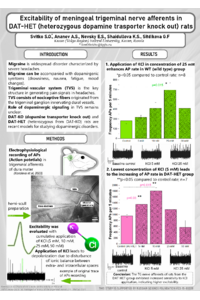
Introduction: Migraine is a disorder that comes with severe pain syndrome, and its molecular mechanisms are unstudied. The trigeminal (TG) system is considered a source of pain signals in migraine, since the activation of trigeminal nerve afferents leads to nociceptive signaling and headache. Endogenous neurotransmitters like ATP and serotonin can contribute to nociceptive signaling in this structure, but the role of dopaminergic signaling remains unclear
Methods: The activity of TG afferents was recorded using the isolated rat hemi-scull preparation (male rats, P 40-45, Wistar and DAT-KO groups). To analyze the excitability of TG afferents, we applied a high-potassium-containing solution (KCl 5 mM, 10 mM, 25 mM and 50 mM). KCl induces membrane depolarization and increases the rate of action potential (AP) generation; therefore, it can be used to evaluate the level of excitability.
Results: In rats from the control group (Wistar rats), the minimal concentration of KCl that significantly increased frequency of APs was 25 mM (from 282±60 APs per 5 min to 816±110 APs per 5 min; n= 6; p=0.009). In DAT-KO rats, the baseline frequency of APs was higher at 956±168 APs per 5 min; KCl (5 mM) significantly increased the frequency of APs up to 1349±169.5 APs per 5 min (n=6, p=0.036), as did KCL 10 mM (from 1247±112 APs per 5 min to 3364±1562 APs per 5 min, n=6, p=0.03).
Conclusion: The TG nerve of rats from the DAT-KO group exhibited increased sensitivity to KCL application, indicating higher excitability.
The study is supported by Russian Science Foundation #23-15-00328.
Keywords
nociception
migraine
trigeminal nerve
trigeminal system
dopamine
dopamine transporter knock out
Poster
sciforum-098385_Svetlana Olegovna Svitko.pdf
Mapping the effect of psycholinguistic variables on picture naming: insights from an FDG-PET study on neurodegenerative diseases
24-hydroxycholesterol prevents pronociceptive effects of ATP in the rat trigeminovascular system