Event submissions
Published
This submission belongs to the session S9. Neurorehabilitation of the event The 4th International Electronic Conference on Brain Sciences
Published date
22 Oct, 2024
Academic Editor
'%3e%3cpath%20d='M12.6657%2010.9104C12.4185%2010.325%2012.0599%209.79327%2011.6097%209.34482C11.1609%208.89508%2010.6293%208.5365%2010.0442%208.28888C10.0389%208.28626%2010.0337%208.28495%2010.0285%208.28233C10.8446%207.69279%2011.3752%206.73249%2011.3752%205.64904C11.3752%203.8542%209.92103%202.39999%208.1262%202.39999C6.33136%202.39999%204.87715%203.8542%204.87715%205.64904C4.87715%206.73249%205.40774%207.69279%206.22393%208.28364C6.21869%208.28626%206.21345%208.28757%206.20821%208.29019C5.62129%208.5378%205.09463%208.89284%204.64265%209.34613C4.1929%209.79493%203.83432%2010.3266%203.58671%2010.9117C3.34345%2011.4845%203.21226%2012.0987%203.20023%2012.7209C3.19988%2012.7349%203.20233%2012.7488%203.20744%2012.7619C3.21255%2012.7749%203.22022%2012.7867%203.22998%2012.7968C3.23975%2012.8068%203.25142%2012.8147%203.26431%2012.8202C3.2772%2012.8256%203.29105%2012.8284%203.30504%2012.8284H4.09109C4.14874%2012.8284%204.19459%2012.7825%204.1959%2012.7262C4.2221%2011.7148%204.62823%2010.7676%205.34617%2010.0497C6.08899%209.30683%207.0755%208.89808%208.1262%208.89808C9.17689%208.89808%2010.1634%209.30683%2010.9062%2010.0497C11.6242%2010.7676%2012.0303%2011.7148%2012.0565%2012.7262C12.0578%2012.7838%2012.1037%2012.8284%2012.1613%2012.8284H12.9474C12.9613%2012.8284%2012.9752%2012.8256%2012.9881%2012.8202C13.001%2012.8147%2013.0126%2012.8068%2013.0224%2012.7968C13.0322%2012.7867%2013.0398%2012.7749%2013.0449%2012.7619C13.0501%2012.7488%2013.0525%2012.7349%2013.0522%2012.7209C13.0391%2012.0947%2012.9094%2011.4855%2012.6657%2010.9104ZM8.1262%207.9024C7.52486%207.9024%206.9589%207.6679%206.53312%207.24211C6.10733%206.81633%205.87283%206.25037%205.87283%205.64904C5.87283%205.0477%206.10733%204.48174%206.53312%204.05596C6.9589%203.63018%207.52486%203.39567%208.1262%203.39567C8.72753%203.39567%209.29349%203.63018%209.71927%204.05596C10.1451%204.48174%2010.3796%205.0477%2010.3796%205.64904C10.3796%206.25037%2010.1451%206.81633%209.71927%207.24211C9.29349%207.6679%208.72753%207.9024%208.1262%207.9024Z'%20fill='%235D1EE1'/%3e%3c/g%3e%3c/svg%3e) Christina Danielli Coelho De Morais Faria
Christina Danielli Coelho De Morais FariaCitation
Paula da Cruz Peniche, Jéssica Melo dos Santos, Gisele Florentino Sant’Ana de Assunção, Laís Ferreira Marques, Beatriz Cardoso Alves Martins, Sherindan Ayessa Ferreira de Brito, Christina Danielli Coelho de Morais Faria, Knowledge of post-stroke individuals and the use of stroke as a predictor of adopting healthy lifestyle behaviors, in Proceedings of The 4th International Electronic Conference on Brain Sciences, 23 October–25 October 2024, MDPI: Basel, Switzerland
Share
Email
Facebook
Twitter
LinkedIn
Knowledge of post-stroke individuals and the use of stroke as a predictor of adopting healthy lifestyle behaviors
'%3e%3cpath%20d='M12.6647%2010.9104C12.4176%2010.325%2012.0589%209.7933%2011.6088%209.34485C11.16%208.89511%2010.6283%208.53653%2010.0432%208.28891C10.038%208.28629%2010.0327%208.28498%2010.0275%208.28236C10.8437%207.69282%2011.3743%206.73252%2011.3743%205.64907C11.3743%203.85423%209.92005%202.40002%208.12522%202.40002C6.33038%202.40002%204.87618%203.85423%204.87618%205.64907C4.87618%206.73252%205.40677%207.69282%206.22296%208.28367C6.21772%208.28629%206.21248%208.2876%206.20724%208.29022C5.62031%208.53783%205.09365%208.89287%204.64167%209.34616C4.19192%209.79496%203.83334%2010.3266%203.58573%2010.9117C3.34247%2011.4846%203.21128%2012.0987%203.19925%2012.721C3.1989%2012.735%203.20135%2012.7489%203.20646%2012.7619C3.21157%2012.7749%203.21924%2012.7868%203.22901%2012.7968C3.23877%2012.8068%203.25045%2012.8148%203.26334%2012.8202C3.27623%2012.8256%203.29007%2012.8284%203.30406%2012.8284H4.09012C4.14776%2012.8284%204.19362%2012.7825%204.19493%2012.7262C4.22113%2011.7148%204.62726%2010.7676%205.34519%2010.0497C6.08802%209.30686%207.07452%208.89811%208.12522%208.89811C9.17592%208.89811%2010.1624%209.30686%2010.9052%2010.0497C11.6232%2010.7676%2012.0293%2011.7148%2012.0555%2012.7262C12.0568%2012.7839%2012.1027%2012.8284%2012.1603%2012.8284H12.9464C12.9604%2012.8284%2012.9742%2012.8256%2012.9871%2012.8202C13%2012.8148%2013.0117%2012.8068%2013.0214%2012.7968C13.0312%2012.7868%2013.0389%2012.7749%2013.044%2012.7619C13.0491%2012.7489%2013.0515%2012.735%2013.0512%2012.721C13.0381%2012.0947%2012.9084%2011.4856%2012.6647%2010.9104ZM8.12522%207.90243C7.52388%207.90243%206.95792%207.66793%206.53214%207.24215C6.10636%206.81636%205.87185%206.2504%205.87185%205.64907C5.87185%205.04773%206.10636%204.48177%206.53214%204.05599C6.95792%203.63021%207.52388%203.3957%208.12522%203.3957C8.72655%203.3957%209.29252%203.63021%209.7183%204.05599C10.1441%204.48177%2010.3786%205.04773%2010.3786%205.64907C10.3786%206.2504%2010.1441%206.81636%209.7183%207.24215C9.29252%207.66793%208.72655%207.90243%208.12522%207.90243Z'%20fill='%235D1EE1'/%3e%3c/g%3e%3c/svg%3e)
Paula da Cruz Peniche 1
Jéssica Melo dos Santos 1
Gisele Florentino Sant’Ana de Assunção 1
Laís Ferreira Marques 1
Beatriz Cardoso Alves Martins 2
Sherindan Ayessa Ferreira de Brito 1

Christina Danielli Coelho de Morais Faria 1
1. Department of Physiotherapy, Universidade Federal de Minas Gerais, Belo Horizonte, Minas Gerais, Brazil
2. Department of Physiotherapy, Newton Paiva, Belo Horizonte, Minas Gerais, Brazil
Abstract
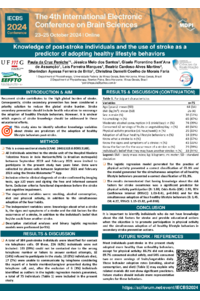
Introduction: Recurrent stroke contributes to the high global burden of stroke. Consequently, stroke secondary prevention has been considered a priority solution to reduce the global stroke burden. Stroke secondary prevention should include health education to encourage the adoption of healthy lifestyle behaviors. However, it is unclear which aspects of stroke knowledge should be addressed in these educational efforts. This study aims to identify whether knowledge variables about stroke are predictors of the adoption of healthy lifestyle behaviors post-stroke.
Methods: This is a cross-sectional study that included individuals post-stroke from a Brazilian metropolis using the Stroke RiskometerTM App. Binary logistic regression models (α=5%) were employed. Dependent variables included smoking, alcohol consumption, diet, physical activity, and the simultaneous adoption of four healthy behaviors. Independent variables included knowledge about what stroke is, its signs and symptoms, risk factors for its occurrence, and the individual's opinion that they may have a new stroke.
Results: A total of 75 individuals (63±13 years; 50% male) were included. The results demonstrated that having knowledge about the risk factors for stroke occurrence was a significant predictor for physical activity participation (B: 1.08, Odds Ratio (OR): 2.95, 95% Confidence Interval (95%CI): 1.03-8.41, p=0.043) and for the simultaneous adoption of four healthy behaviors (B: 1.45, OR: 4.27, 95%CI: 1.15-15.82, and p=0.030).
Conclusions: It is important to identify individuals who do not have knowledge about the risk factors for stroke and provide educational actions when the objective is to promote physical activity and the simultaneous adoption of all healthy lifestyle behaviors in secondary stroke prevention actions.
Keywords
Stroke
secondary prevention
knowledge
healthy behaviors
Poster
Poster 1 - paula da cruz peniche - 17-10-2024.pdf
24-hydroxycholesterol prevents pronociceptive effects of ATP in the rat trigeminovascular system
Predictors of adopting healthy lifestyle behaviors: a cross-sectional study to target secondary stroke prevention in a middle-income country