Event submissions
Published
This submission belongs to the session S9. Neurorehabilitation of the event The 4th International Electronic Conference on Brain Sciences
Published date
22 Oct, 2024
Academic Editor
'%3e%3cpath%20d='M12.6657%2010.9104C12.4185%2010.325%2012.0599%209.79327%2011.6097%209.34482C11.1609%208.89508%2010.6293%208.5365%2010.0442%208.28888C10.0389%208.28626%2010.0337%208.28495%2010.0285%208.28233C10.8446%207.69279%2011.3752%206.73249%2011.3752%205.64904C11.3752%203.8542%209.92103%202.39999%208.1262%202.39999C6.33136%202.39999%204.87715%203.8542%204.87715%205.64904C4.87715%206.73249%205.40774%207.69279%206.22393%208.28364C6.21869%208.28626%206.21345%208.28757%206.20821%208.29019C5.62129%208.5378%205.09463%208.89284%204.64265%209.34613C4.1929%209.79493%203.83432%2010.3266%203.58671%2010.9117C3.34345%2011.4845%203.21226%2012.0987%203.20023%2012.7209C3.19988%2012.7349%203.20233%2012.7488%203.20744%2012.7619C3.21255%2012.7749%203.22022%2012.7867%203.22998%2012.7968C3.23975%2012.8068%203.25142%2012.8147%203.26431%2012.8202C3.2772%2012.8256%203.29105%2012.8284%203.30504%2012.8284H4.09109C4.14874%2012.8284%204.19459%2012.7825%204.1959%2012.7262C4.2221%2011.7148%204.62823%2010.7676%205.34617%2010.0497C6.08899%209.30683%207.0755%208.89808%208.1262%208.89808C9.17689%208.89808%2010.1634%209.30683%2010.9062%2010.0497C11.6242%2010.7676%2012.0303%2011.7148%2012.0565%2012.7262C12.0578%2012.7838%2012.1037%2012.8284%2012.1613%2012.8284H12.9474C12.9613%2012.8284%2012.9752%2012.8256%2012.9881%2012.8202C13.001%2012.8147%2013.0126%2012.8068%2013.0224%2012.7968C13.0322%2012.7867%2013.0398%2012.7749%2013.0449%2012.7619C13.0501%2012.7488%2013.0525%2012.7349%2013.0522%2012.7209C13.0391%2012.0947%2012.9094%2011.4855%2012.6657%2010.9104ZM8.1262%207.9024C7.52486%207.9024%206.9589%207.6679%206.53312%207.24211C6.10733%206.81633%205.87283%206.25037%205.87283%205.64904C5.87283%205.0477%206.10733%204.48174%206.53312%204.05596C6.9589%203.63018%207.52486%203.39567%208.1262%203.39567C8.72753%203.39567%209.29349%203.63018%209.71927%204.05596C10.1451%204.48174%2010.3796%205.0477%2010.3796%205.64904C10.3796%206.25037%2010.1451%206.81633%209.71927%207.24211C9.29349%207.6679%208.72753%207.9024%208.1262%207.9024Z'%20fill='%235D1EE1'/%3e%3c/g%3e%3c/svg%3e) Christina Danielli Coelho De Morais Faria
Christina Danielli Coelho De Morais FariaCitation
Nikita Iskakov, Oleg Gerasimov, Maxim Baltin, Anton Eremeev, Artur Fedianin, The influence of neuromodulation effects on the functional state of the neuromotor apparatus of the soleus muscle in middle-aged male rats under conditions of long-term hindlimb unloading, in Proceedings of The 4th International Electronic Conference on Brain Sciences, 23 October–25 October 2024, MDPI: Basel, Switzerland
Share
Email
Facebook
Twitter
LinkedIn
The influence of neuromodulation effects on the functional state of the neuromotor apparatus of the soleus muscle in middle-aged male rats under conditions of long-term hindlimb unloading
'%3e%3cpath%20d='M12.6647%2010.9104C12.4176%2010.325%2012.0589%209.7933%2011.6088%209.34485C11.16%208.89511%2010.6283%208.53653%2010.0432%208.28891C10.038%208.28629%2010.0327%208.28498%2010.0275%208.28236C10.8437%207.69282%2011.3743%206.73252%2011.3743%205.64907C11.3743%203.85423%209.92005%202.40002%208.12522%202.40002C6.33038%202.40002%204.87618%203.85423%204.87618%205.64907C4.87618%206.73252%205.40677%207.69282%206.22296%208.28367C6.21772%208.28629%206.21248%208.2876%206.20724%208.29022C5.62031%208.53783%205.09365%208.89287%204.64167%209.34616C4.19192%209.79496%203.83334%2010.3266%203.58573%2010.9117C3.34247%2011.4846%203.21128%2012.0987%203.19925%2012.721C3.1989%2012.735%203.20135%2012.7489%203.20646%2012.7619C3.21157%2012.7749%203.21924%2012.7868%203.22901%2012.7968C3.23877%2012.8068%203.25045%2012.8148%203.26334%2012.8202C3.27623%2012.8256%203.29007%2012.8284%203.30406%2012.8284H4.09012C4.14776%2012.8284%204.19362%2012.7825%204.19493%2012.7262C4.22113%2011.7148%204.62726%2010.7676%205.34519%2010.0497C6.08802%209.30686%207.07452%208.89811%208.12522%208.89811C9.17592%208.89811%2010.1624%209.30686%2010.9052%2010.0497C11.6232%2010.7676%2012.0293%2011.7148%2012.0555%2012.7262C12.0568%2012.7839%2012.1027%2012.8284%2012.1603%2012.8284H12.9464C12.9604%2012.8284%2012.9742%2012.8256%2012.9871%2012.8202C13%2012.8148%2013.0117%2012.8068%2013.0214%2012.7968C13.0312%2012.7868%2013.0389%2012.7749%2013.044%2012.7619C13.0491%2012.7489%2013.0515%2012.735%2013.0512%2012.721C13.0381%2012.0947%2012.9084%2011.4856%2012.6647%2010.9104ZM8.12522%207.90243C7.52388%207.90243%206.95792%207.66793%206.53214%207.24215C6.10636%206.81636%205.87185%206.2504%205.87185%205.64907C5.87185%205.04773%206.10636%204.48177%206.53214%204.05599C6.95792%203.63021%207.52388%203.3957%208.12522%203.3957C8.72655%203.3957%209.29252%203.63021%209.7183%204.05599C10.1441%204.48177%2010.3786%205.04773%2010.3786%205.64907C10.3786%206.2504%2010.1441%206.81636%209.7183%207.24215C9.29252%207.66793%208.72655%207.90243%208.12522%207.90243Z'%20fill='%235D1EE1'/%3e%3c/g%3e%3c/svg%3e)
Nikita Iskakov 1
Oleg Gerasimov 1,2
Maxim Baltin 1
Anton Eremeev 2
Artur Fedianin 1
1. Scientific and Research Institute of Physical Culture and Sports, Volga Region University of Physical Culture, Sports and Tourism, Kazan, 420010, Russia
2. N.I. Lobachevsky Institute of Mathematics and Mechanics, Kazan Federal University, Kazan, 420018, Russia
Abstract
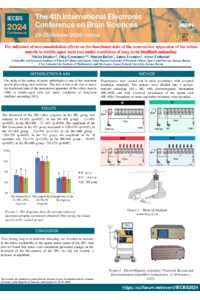
The study of the nature of motor pathologies is one of the most important areas in physiology and medicine. The purpose of this work was to assess the functional state of the neuromotor apparatus of the soleus muscle (SM) in middle-aged male rats under conditions of long-term hindlimb unloading (HU). Experiments were carried out in strict accordance with accepted bioethical standards. The animals were divided into three groups: hinlimb unloading (HU), HU with magnetic stimulation (HU+MS), and the electrical stimulation of the spinal cord (HU+ES). Parameters of motor and reflex responses were recorded. The threshold of the SM reflex response was reduced to 81±8% (p<0.05) in the HU group, 77±10% (p<0.05) in the HU+ES group, and 73±16% (p<0.05) in the HU+MS group. The amplitude of the SM H-response increased to 130±15% (p<0.05)in the HU group, 121±9% (p<0.05) in the HU+ES group, and 120±10% (p<0.05) in the HU+MS group. The amplitude of the M response was 73±11% (p<0.05) in the HU group, 76±9% (p<0.05) in the HU+ES group, and 70±15% (p<0.05) in the HU+MS group. Thus, during long-term hindlimb unloading, we recorded an increase in the reflex excitability of the spinal motor center of the SM. And we also found that spinal cord stimulation prevented changes in the threshold of the M-response of the SM, but did not exclude a decrease in amplitude. The research was funded by a grant from the Russian Science Foundation and the Academy of Sciences of the Republic of Tatarstan under project no. 23-25-10065.
Keywords
hindlimb unloading
soleus muscle
stimulation
spinal cord
Poster
Iskakov_et_al_MDPI_2024 федянин.pdf
Predictors of adopting healthy lifestyle behaviors: a cross-sectional study to target secondary stroke prevention in a middle-income country
The effects of different types of unlearning on savings following visuomotor adaptation