Event submissions
Published
This submission belongs to the session S9. Neurorehabilitation of the event The 4th International Electronic Conference on Brain Sciences
Published date
22 Oct, 2024
Academic Editor
'%3e%3cpath%20d='M12.6657%2010.9104C12.4185%2010.325%2012.0599%209.79327%2011.6097%209.34482C11.1609%208.89508%2010.6293%208.5365%2010.0442%208.28888C10.0389%208.28626%2010.0337%208.28495%2010.0285%208.28233C10.8446%207.69279%2011.3752%206.73249%2011.3752%205.64904C11.3752%203.8542%209.92103%202.39999%208.1262%202.39999C6.33136%202.39999%204.87715%203.8542%204.87715%205.64904C4.87715%206.73249%205.40774%207.69279%206.22393%208.28364C6.21869%208.28626%206.21345%208.28757%206.20821%208.29019C5.62129%208.5378%205.09463%208.89284%204.64265%209.34613C4.1929%209.79493%203.83432%2010.3266%203.58671%2010.9117C3.34345%2011.4845%203.21226%2012.0987%203.20023%2012.7209C3.19988%2012.7349%203.20233%2012.7488%203.20744%2012.7619C3.21255%2012.7749%203.22022%2012.7867%203.22998%2012.7968C3.23975%2012.8068%203.25142%2012.8147%203.26431%2012.8202C3.2772%2012.8256%203.29105%2012.8284%203.30504%2012.8284H4.09109C4.14874%2012.8284%204.19459%2012.7825%204.1959%2012.7262C4.2221%2011.7148%204.62823%2010.7676%205.34617%2010.0497C6.08899%209.30683%207.0755%208.89808%208.1262%208.89808C9.17689%208.89808%2010.1634%209.30683%2010.9062%2010.0497C11.6242%2010.7676%2012.0303%2011.7148%2012.0565%2012.7262C12.0578%2012.7838%2012.1037%2012.8284%2012.1613%2012.8284H12.9474C12.9613%2012.8284%2012.9752%2012.8256%2012.9881%2012.8202C13.001%2012.8147%2013.0126%2012.8068%2013.0224%2012.7968C13.0322%2012.7867%2013.0398%2012.7749%2013.0449%2012.7619C13.0501%2012.7488%2013.0525%2012.7349%2013.0522%2012.7209C13.0391%2012.0947%2012.9094%2011.4855%2012.6657%2010.9104ZM8.1262%207.9024C7.52486%207.9024%206.9589%207.6679%206.53312%207.24211C6.10733%206.81633%205.87283%206.25037%205.87283%205.64904C5.87283%205.0477%206.10733%204.48174%206.53312%204.05596C6.9589%203.63018%207.52486%203.39567%208.1262%203.39567C8.72753%203.39567%209.29349%203.63018%209.71927%204.05596C10.1451%204.48174%2010.3796%205.0477%2010.3796%205.64904C10.3796%206.25037%2010.1451%206.81633%209.71927%207.24211C9.29349%207.6679%208.72753%207.9024%208.1262%207.9024Z'%20fill='%235D1EE1'/%3e%3c/g%3e%3c/svg%3e) Christina Danielli Coelho De Morais Faria
Christina Danielli Coelho De Morais FariaCitation
Nuriya Nurislamovna Chershintseva, Andrei Sergeevich Nazarenko, Nikita Georgievich Iskakov, Aleksei Anatolivich Zverev, HEART RATE VARIABILITY AND ADAPTATION CAPABILITIES OF BADMINTON PLAYERS OF DIFFERENT AGES, in Proceedings of The 4th International Electronic Conference on Brain Sciences, 23 October–25 October 2024, MDPI: Basel, Switzerland
Share
Email
Facebook
Twitter
LinkedIn
HEART RATE VARIABILITY AND ADAPTATION CAPABILITIES OF BADMINTON PLAYERS OF DIFFERENT AGES
'%3e%3cpath%20d='M12.6647%2010.9104C12.4176%2010.325%2012.0589%209.7933%2011.6088%209.34485C11.16%208.89511%2010.6283%208.53653%2010.0432%208.28891C10.038%208.28629%2010.0327%208.28498%2010.0275%208.28236C10.8437%207.69282%2011.3743%206.73252%2011.3743%205.64907C11.3743%203.85423%209.92005%202.40002%208.12522%202.40002C6.33038%202.40002%204.87618%203.85423%204.87618%205.64907C4.87618%206.73252%205.40677%207.69282%206.22296%208.28367C6.21772%208.28629%206.21248%208.2876%206.20724%208.29022C5.62031%208.53783%205.09365%208.89287%204.64167%209.34616C4.19192%209.79496%203.83334%2010.3266%203.58573%2010.9117C3.34247%2011.4846%203.21128%2012.0987%203.19925%2012.721C3.1989%2012.735%203.20135%2012.7489%203.20646%2012.7619C3.21157%2012.7749%203.21924%2012.7868%203.22901%2012.7968C3.23877%2012.8068%203.25045%2012.8148%203.26334%2012.8202C3.27623%2012.8256%203.29007%2012.8284%203.30406%2012.8284H4.09012C4.14776%2012.8284%204.19362%2012.7825%204.19493%2012.7262C4.22113%2011.7148%204.62726%2010.7676%205.34519%2010.0497C6.08802%209.30686%207.07452%208.89811%208.12522%208.89811C9.17592%208.89811%2010.1624%209.30686%2010.9052%2010.0497C11.6232%2010.7676%2012.0293%2011.7148%2012.0555%2012.7262C12.0568%2012.7839%2012.1027%2012.8284%2012.1603%2012.8284H12.9464C12.9604%2012.8284%2012.9742%2012.8256%2012.9871%2012.8202C13%2012.8148%2013.0117%2012.8068%2013.0214%2012.7968C13.0312%2012.7868%2013.0389%2012.7749%2013.044%2012.7619C13.0491%2012.7489%2013.0515%2012.735%2013.0512%2012.721C13.0381%2012.0947%2012.9084%2011.4856%2012.6647%2010.9104ZM8.12522%207.90243C7.52388%207.90243%206.95792%207.66793%206.53214%207.24215C6.10636%206.81636%205.87185%206.2504%205.87185%205.64907C5.87185%205.04773%206.10636%204.48177%206.53214%204.05599C6.95792%203.63021%207.52388%203.3957%208.12522%203.3957C8.72655%203.3957%209.29252%203.63021%209.7183%204.05599C10.1441%204.48177%2010.3786%205.04773%2010.3786%205.64907C10.3786%206.2504%2010.1441%206.81636%209.7183%207.24215C9.29252%207.66793%208.72655%207.90243%208.12522%207.90243Z'%20fill='%235D1EE1'/%3e%3c/g%3e%3c/svg%3e)
Nuriya Nurislamovna Chershintseva 1
Andrei Sergeevich Nazarenko 1
Nikita Georgievich Iskakov 1
Aleksei Anatolivich Zverev 1
1. Volga Region University of Physical Culture, Sports and Tourism, Kazan, 420010, Russia
Abstract
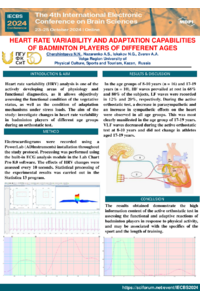
Heart rate variability (HRV) analysis is one of the actively developing areas of physiology and functional diagnostics, as it allows the functional condition of the vegetative status, as well as the condition of adaptation mechanisms under stress loads, to be objectively assessed. The aim of the study is to investigate changes in heart rate variability in badminton players of different age groups during an orthostatic test. Electrocardiograms were recorded using a PowerLab (ADInstruments) installation throughout the study protocol. Processing was performed using the built-in ECG analysis module in the Lab Chart Pro 8.0 software. The effects of HRV changes were assessed every 10 seconds. In the age groups of 8-10 years (n = 16) and 17-19 years (n = 10), HF waves prevailed at rest in 68% and 80% of the subjects, and LF waves were recorded in 12% and 20% of the subjects, respectively. During the active orthostatic test, a decrease in parasympathetic effects and an increase in sympathetic effects on the heart were observed in all age groups. This was most clearly manifested in the age group of 17-19 years. VLF waves decreased during the active orthostatic test at 8-10 years and did not change in athletes aged 17-19 years. The results obtained demonstrate the high information content of the active orthostatic test in assessing the functional and adaptive reactions of badminton players in response to physical activity, and they may be associated with the specifics of the sport and the length of training.
Keywords
heart rate variability
adaptation
badminton players
Poster
Chershintseva N.N..pdf
The neuroprotective role of Hsp70 in the enhancement of antioxidant defense in the neurons
Monomyelic amyotrophy. A clinical case.