Event submissions
Published
This submission belongs to the session S2. Systems Neuroscience of the event The 4th International Electronic Conference on Brain Sciences
Published date
22 Oct, 2024
Academic Editor
'%3e%3cpath%20d='M12.6657%2010.9104C12.4185%2010.325%2012.0599%209.79327%2011.6097%209.34482C11.1609%208.89508%2010.6293%208.5365%2010.0442%208.28888C10.0389%208.28626%2010.0337%208.28495%2010.0285%208.28233C10.8446%207.69279%2011.3752%206.73249%2011.3752%205.64904C11.3752%203.8542%209.92103%202.39999%208.1262%202.39999C6.33136%202.39999%204.87715%203.8542%204.87715%205.64904C4.87715%206.73249%205.40774%207.69279%206.22393%208.28364C6.21869%208.28626%206.21345%208.28757%206.20821%208.29019C5.62129%208.5378%205.09463%208.89284%204.64265%209.34613C4.1929%209.79493%203.83432%2010.3266%203.58671%2010.9117C3.34345%2011.4845%203.21226%2012.0987%203.20023%2012.7209C3.19988%2012.7349%203.20233%2012.7488%203.20744%2012.7619C3.21255%2012.7749%203.22022%2012.7867%203.22998%2012.7968C3.23975%2012.8068%203.25142%2012.8147%203.26431%2012.8202C3.2772%2012.8256%203.29105%2012.8284%203.30504%2012.8284H4.09109C4.14874%2012.8284%204.19459%2012.7825%204.1959%2012.7262C4.2221%2011.7148%204.62823%2010.7676%205.34617%2010.0497C6.08899%209.30683%207.0755%208.89808%208.1262%208.89808C9.17689%208.89808%2010.1634%209.30683%2010.9062%2010.0497C11.6242%2010.7676%2012.0303%2011.7148%2012.0565%2012.7262C12.0578%2012.7838%2012.1037%2012.8284%2012.1613%2012.8284H12.9474C12.9613%2012.8284%2012.9752%2012.8256%2012.9881%2012.8202C13.001%2012.8147%2013.0126%2012.8068%2013.0224%2012.7968C13.0322%2012.7867%2013.0398%2012.7749%2013.0449%2012.7619C13.0501%2012.7488%2013.0525%2012.7349%2013.0522%2012.7209C13.0391%2012.0947%2012.9094%2011.4855%2012.6657%2010.9104ZM8.1262%207.9024C7.52486%207.9024%206.9589%207.6679%206.53312%207.24211C6.10733%206.81633%205.87283%206.25037%205.87283%205.64904C5.87283%205.0477%206.10733%204.48174%206.53312%204.05596C6.9589%203.63018%207.52486%203.39567%208.1262%203.39567C8.72753%203.39567%209.29349%203.63018%209.71927%204.05596C10.1451%204.48174%2010.3796%205.0477%2010.3796%205.64904C10.3796%206.25037%2010.1451%206.81633%209.71927%207.24211C9.29349%207.6679%208.72753%207.9024%208.1262%207.9024Z'%20fill='%235D1EE1'/%3e%3c/g%3e%3c/svg%3e) Konstantin Slavin
Konstantin SlavinCitation
Anna Shulman, Maksim Baltin, Alexandr Eremeev, Margarita Nikulina, Anton Eremeev, Tatyana Baltina, EFFECT OF KNEE JOINT FIXATION ON HUMAN POSTURAL STABILITY, in Proceedings of The 4th International Electronic Conference on Brain Sciences, 23 October–25 October 2024, MDPI: Basel, Switzerland
Share
Email
Facebook
Twitter
LinkedIn
EFFECT OF KNEE JOINT FIXATION ON HUMAN POSTURAL STABILITY
'%3e%3cpath%20d='M12.6647%2010.9104C12.4176%2010.325%2012.0589%209.7933%2011.6088%209.34485C11.16%208.89511%2010.6283%208.53653%2010.0432%208.28891C10.038%208.28629%2010.0327%208.28498%2010.0275%208.28236C10.8437%207.69282%2011.3743%206.73252%2011.3743%205.64907C11.3743%203.85423%209.92005%202.40002%208.12522%202.40002C6.33038%202.40002%204.87618%203.85423%204.87618%205.64907C4.87618%206.73252%205.40677%207.69282%206.22296%208.28367C6.21772%208.28629%206.21248%208.2876%206.20724%208.29022C5.62031%208.53783%205.09365%208.89287%204.64167%209.34616C4.19192%209.79496%203.83334%2010.3266%203.58573%2010.9117C3.34247%2011.4846%203.21128%2012.0987%203.19925%2012.721C3.1989%2012.735%203.20135%2012.7489%203.20646%2012.7619C3.21157%2012.7749%203.21924%2012.7868%203.22901%2012.7968C3.23877%2012.8068%203.25045%2012.8148%203.26334%2012.8202C3.27623%2012.8256%203.29007%2012.8284%203.30406%2012.8284H4.09012C4.14776%2012.8284%204.19362%2012.7825%204.19493%2012.7262C4.22113%2011.7148%204.62726%2010.7676%205.34519%2010.0497C6.08802%209.30686%207.07452%208.89811%208.12522%208.89811C9.17592%208.89811%2010.1624%209.30686%2010.9052%2010.0497C11.6232%2010.7676%2012.0293%2011.7148%2012.0555%2012.7262C12.0568%2012.7839%2012.1027%2012.8284%2012.1603%2012.8284H12.9464C12.9604%2012.8284%2012.9742%2012.8256%2012.9871%2012.8202C13%2012.8148%2013.0117%2012.8068%2013.0214%2012.7968C13.0312%2012.7868%2013.0389%2012.7749%2013.044%2012.7619C13.0491%2012.7489%2013.0515%2012.735%2013.0512%2012.721C13.0381%2012.0947%2012.9084%2011.4856%2012.6647%2010.9104ZM8.12522%207.90243C7.52388%207.90243%206.95792%207.66793%206.53214%207.24215C6.10636%206.81636%205.87185%206.2504%205.87185%205.64907C5.87185%205.04773%206.10636%204.48177%206.53214%204.05599C6.95792%203.63021%207.52388%203.3957%208.12522%203.3957C8.72655%203.3957%209.29252%203.63021%209.7183%204.05599C10.1441%204.48177%2010.3786%205.04773%2010.3786%205.64907C10.3786%206.2504%2010.1441%206.81636%209.7183%207.24215C9.29252%207.66793%208.72655%207.90243%208.12522%207.90243Z'%20fill='%235D1EE1'/%3e%3c/g%3e%3c/svg%3e)
Anna Shulman 1
Maksim Baltin 2
Alexandr Eremeev 3

Margarita Nikulina 3
Anton Eremeev 3

Tatyana Baltina 3
1. Scientific Research Laboratory "Mechanobiology", Kazan Federal University, Kazan, 420008, Kremlevskaya, 18, Russia
2. Sport science department, Sirius University of Science and Technology, Sirius Federal territory, 354349, Olympic Ave, 1, Russia
3. Department of Human and Animal Physiology, Kazan Federal University, Kazan, 420008, Kremlevskaya, 18, Russia
Abstract
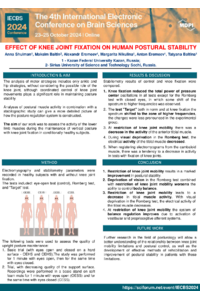
Introduction. The analysis of motor strategies includes only ankle and hip strategies, without considering the possible role of the knee joint, although coordinated control of knee joint movements plays a significant role in maintaining posture stability. Methods. Electromyography and stabilometry parameters were recorded in healthy subjects with and without knee joint fixation. The tests included: eye-open test (control), Romberg test, and "Target" test. Results. Stabilometry results of control and knee fixation were compared. Knee fixation reduced the total power of pressure center oscillations in all tests except for the Romberg test with closed eyes, in which some shift of the spectrum to higher frequencies was observed. At the same time in the test "Target" both in norm and at knee fixation the spectrum shifted to the zone of higher frequencies, the changes were less pronounced in the experimental group. At restriction of knee joint mobility there was a decrease in the activity of the anterior tibial muscle. During visual deprivation in the Romberg test, the electrical activity of the tibial muscle decreased. When registering electromyograms from the cambaloid muscle, there was a tendency to a decrease in activity in tests with fixation of knee joints.
Conclusion. At restriction of knee joint mobility the system of balance regulation improves due to activation of vestibular and proprioceptive afferent systems.
Keywords
Postural stability
knee joint
electromyography
Poster
sciforum-098862_Margarita Nikulina.pdf
Monomyelic amyotrophy. A clinical case.
Virtual Reality for Schizophrenia Symptom Regulation