Event submissions
Published
This submission belongs to the session S3. Neurotechnology and Neuroimaging of the event The 4th International Electronic Conference on Brain Sciences
Published date
22 Oct, 2024
Academic Editor
'%3e%3cpath%20d='M12.6657%2010.9104C12.4185%2010.325%2012.0599%209.79327%2011.6097%209.34482C11.1609%208.89508%2010.6293%208.5365%2010.0442%208.28888C10.0389%208.28626%2010.0337%208.28495%2010.0285%208.28233C10.8446%207.69279%2011.3752%206.73249%2011.3752%205.64904C11.3752%203.8542%209.92103%202.39999%208.1262%202.39999C6.33136%202.39999%204.87715%203.8542%204.87715%205.64904C4.87715%206.73249%205.40774%207.69279%206.22393%208.28364C6.21869%208.28626%206.21345%208.28757%206.20821%208.29019C5.62129%208.5378%205.09463%208.89284%204.64265%209.34613C4.1929%209.79493%203.83432%2010.3266%203.58671%2010.9117C3.34345%2011.4845%203.21226%2012.0987%203.20023%2012.7209C3.19988%2012.7349%203.20233%2012.7488%203.20744%2012.7619C3.21255%2012.7749%203.22022%2012.7867%203.22998%2012.7968C3.23975%2012.8068%203.25142%2012.8147%203.26431%2012.8202C3.2772%2012.8256%203.29105%2012.8284%203.30504%2012.8284H4.09109C4.14874%2012.8284%204.19459%2012.7825%204.1959%2012.7262C4.2221%2011.7148%204.62823%2010.7676%205.34617%2010.0497C6.08899%209.30683%207.0755%208.89808%208.1262%208.89808C9.17689%208.89808%2010.1634%209.30683%2010.9062%2010.0497C11.6242%2010.7676%2012.0303%2011.7148%2012.0565%2012.7262C12.0578%2012.7838%2012.1037%2012.8284%2012.1613%2012.8284H12.9474C12.9613%2012.8284%2012.9752%2012.8256%2012.9881%2012.8202C13.001%2012.8147%2013.0126%2012.8068%2013.0224%2012.7968C13.0322%2012.7867%2013.0398%2012.7749%2013.0449%2012.7619C13.0501%2012.7488%2013.0525%2012.7349%2013.0522%2012.7209C13.0391%2012.0947%2012.9094%2011.4855%2012.6657%2010.9104ZM8.1262%207.9024C7.52486%207.9024%206.9589%207.6679%206.53312%207.24211C6.10733%206.81633%205.87283%206.25037%205.87283%205.64904C5.87283%205.0477%206.10733%204.48174%206.53312%204.05596C6.9589%203.63018%207.52486%203.39567%208.1262%203.39567C8.72753%203.39567%209.29349%203.63018%209.71927%204.05596C10.1451%204.48174%2010.3796%205.0477%2010.3796%205.64904C10.3796%206.25037%2010.1451%206.81633%209.71927%207.24211C9.29349%207.6679%208.72753%207.9024%208.1262%207.9024Z'%20fill='%235D1EE1'/%3e%3c/g%3e%3c/svg%3e) Evanthia Bernitsas
Evanthia BernitsasCitation
Xinbi Zhang, Wangyang Xu, Magnetoencephalographic Evidence of Ketamine's Efficacy in Alleviating Symptoms of Major Depressive Disorder: A Systematic Review, in Proceedings of The 4th International Electronic Conference on Brain Sciences, 23 October–25 October 2024, MDPI: Basel, Switzerland
Share
Email
Facebook
Twitter
LinkedIn
Magnetoencephalographic Evidence of Ketamine's Efficacy in Alleviating Symptoms of Major Depressive Disorder: A Systematic Review

Xinbi Zhang 1
'%3e%3cpath%20d='M12.6647%2010.9104C12.4176%2010.325%2012.0589%209.7933%2011.6088%209.34485C11.16%208.89511%2010.6283%208.53653%2010.0432%208.28891C10.038%208.28629%2010.0327%208.28498%2010.0275%208.28236C10.8437%207.69282%2011.3743%206.73252%2011.3743%205.64907C11.3743%203.85423%209.92005%202.40002%208.12522%202.40002C6.33038%202.40002%204.87618%203.85423%204.87618%205.64907C4.87618%206.73252%205.40677%207.69282%206.22296%208.28367C6.21772%208.28629%206.21248%208.2876%206.20724%208.29022C5.62031%208.53783%205.09365%208.89287%204.64167%209.34616C4.19192%209.79496%203.83334%2010.3266%203.58573%2010.9117C3.34247%2011.4846%203.21128%2012.0987%203.19925%2012.721C3.1989%2012.735%203.20135%2012.7489%203.20646%2012.7619C3.21157%2012.7749%203.21924%2012.7868%203.22901%2012.7968C3.23877%2012.8068%203.25045%2012.8148%203.26334%2012.8202C3.27623%2012.8256%203.29007%2012.8284%203.30406%2012.8284H4.09012C4.14776%2012.8284%204.19362%2012.7825%204.19493%2012.7262C4.22113%2011.7148%204.62726%2010.7676%205.34519%2010.0497C6.08802%209.30686%207.07452%208.89811%208.12522%208.89811C9.17592%208.89811%2010.1624%209.30686%2010.9052%2010.0497C11.6232%2010.7676%2012.0293%2011.7148%2012.0555%2012.7262C12.0568%2012.7839%2012.1027%2012.8284%2012.1603%2012.8284H12.9464C12.9604%2012.8284%2012.9742%2012.8256%2012.9871%2012.8202C13%2012.8148%2013.0117%2012.8068%2013.0214%2012.7968C13.0312%2012.7868%2013.0389%2012.7749%2013.044%2012.7619C13.0491%2012.7489%2013.0515%2012.735%2013.0512%2012.721C13.0381%2012.0947%2012.9084%2011.4856%2012.6647%2010.9104ZM8.12522%207.90243C7.52388%207.90243%206.95792%207.66793%206.53214%207.24215C6.10636%206.81636%205.87185%206.2504%205.87185%205.64907C5.87185%205.04773%206.10636%204.48177%206.53214%204.05599C6.95792%203.63021%207.52388%203.3957%208.12522%203.3957C8.72655%203.3957%209.29252%203.63021%209.7183%204.05599C10.1441%204.48177%2010.3786%205.04773%2010.3786%205.64907C10.3786%206.2504%2010.1441%206.81636%209.7183%207.24215C9.29252%207.66793%208.72655%207.90243%208.12522%207.90243Z'%20fill='%235D1EE1'/%3e%3c/g%3e%3c/svg%3e)
Wangyang Xu 2
1. Capital University of Physical Education and Sports, Beijing, 100191, China
2. Shanghai University of Sport
Abstract
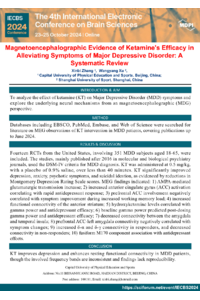
This study aimed to analyze the effect of ketamine (KT) on Major Depressive Disorder (MDD) symptoms and explore the underlying neural mechanisms from a magnetoencephalographic (MEG) perspective.
Methods: Databases including EBSCO, PubMed, Embase, and Web of Science were searched for studies on MEG observations of KT intervention in MDD patients, covering publications up to June 2024.
Results: In total, 14 RCTs from the United States, involving 351 MDD subjects aged 18-65, were included. The studies, mainly published after 2016 in molecular and biological psychiatry journals, used the DSM-IV criteria for MDD diagnosis. KT was administered at 0.5 mg/kg, with a placebo of 0.9% saline, for a duration of less than 40 minutes. KT significantly improved depression, anxiety, psychotic symptoms, and suicidal ideation, as evidenced by reductions in Montgomery Depression Rating Scale scores. MEG findings indicated the following: 1) AMPA-mediated glutamatergic transmission increase; 2) increased anterior cingulate gyrus (ACC) activation correlating with rapid antidepressant response; 3) prefrontal ACC involvement negatively correlated with symptom improvement during increased working memory load; 4) increased functional connectivity of the anterior striatum; 5) hydroxyketamine levels correlated with gamma power and antidepressant efficacy; 6) baseline gamma power predicted post-dosing gamma power and antidepressant efficacy; 7) decreased connectivity between the amygdala and temporal insula; 8) prefrontal ACC–eft amygdala connectivity negatively correlated with symptom changes; 9) increased δ-α and δ-γ connectivity in responders, and decreased connectivity in non-responders; and 10) fusiform M170 component association with antidepressant effects.
Conclusion: KT improves depression and enhances resting functional connectivity in MDD patients; however, the involved frequency bands are inconsistent and the findings lack reproducibility.
Keywords
Major depressive disorder
ketamine
magnetoencephalography
MEG
neuroimaging
antidepressant mechanisms
Poster
Xinbi_Zhang_Poster_ID_sciforum-101442.pdf
A meta-analysis on the influence of transcranial direct current stimulation (tDCS) on the processing of implicit associations (IATs)
Visualization of multichannel surface electromyography as a map of muscle component activation