Event submissions
Published
This submission belongs to the session S1. Behavioral Neuroscience of the event The 4th International Electronic Conference on Brain Sciences
Published date
22 Oct, 2024
Academic Editor
'%3e%3cpath%20d='M12.6657%2010.9104C12.4185%2010.325%2012.0599%209.79327%2011.6097%209.34482C11.1609%208.89508%2010.6293%208.5365%2010.0442%208.28888C10.0389%208.28626%2010.0337%208.28495%2010.0285%208.28233C10.8446%207.69279%2011.3752%206.73249%2011.3752%205.64904C11.3752%203.8542%209.92103%202.39999%208.1262%202.39999C6.33136%202.39999%204.87715%203.8542%204.87715%205.64904C4.87715%206.73249%205.40774%207.69279%206.22393%208.28364C6.21869%208.28626%206.21345%208.28757%206.20821%208.29019C5.62129%208.5378%205.09463%208.89284%204.64265%209.34613C4.1929%209.79493%203.83432%2010.3266%203.58671%2010.9117C3.34345%2011.4845%203.21226%2012.0987%203.20023%2012.7209C3.19988%2012.7349%203.20233%2012.7488%203.20744%2012.7619C3.21255%2012.7749%203.22022%2012.7867%203.22998%2012.7968C3.23975%2012.8068%203.25142%2012.8147%203.26431%2012.8202C3.2772%2012.8256%203.29105%2012.8284%203.30504%2012.8284H4.09109C4.14874%2012.8284%204.19459%2012.7825%204.1959%2012.7262C4.2221%2011.7148%204.62823%2010.7676%205.34617%2010.0497C6.08899%209.30683%207.0755%208.89808%208.1262%208.89808C9.17689%208.89808%2010.1634%209.30683%2010.9062%2010.0497C11.6242%2010.7676%2012.0303%2011.7148%2012.0565%2012.7262C12.0578%2012.7838%2012.1037%2012.8284%2012.1613%2012.8284H12.9474C12.9613%2012.8284%2012.9752%2012.8256%2012.9881%2012.8202C13.001%2012.8147%2013.0126%2012.8068%2013.0224%2012.7968C13.0322%2012.7867%2013.0398%2012.7749%2013.0449%2012.7619C13.0501%2012.7488%2013.0525%2012.7349%2013.0522%2012.7209C13.0391%2012.0947%2012.9094%2011.4855%2012.6657%2010.9104ZM8.1262%207.9024C7.52486%207.9024%206.9589%207.6679%206.53312%207.24211C6.10733%206.81633%205.87283%206.25037%205.87283%205.64904C5.87283%205.0477%206.10733%204.48174%206.53312%204.05596C6.9589%203.63018%207.52486%203.39567%208.1262%203.39567C8.72753%203.39567%209.29349%203.63018%209.71927%204.05596C10.1451%204.48174%2010.3796%205.0477%2010.3796%205.64904C10.3796%206.25037%2010.1451%206.81633%209.71927%207.24211C9.29349%207.6679%208.72753%207.9024%208.1262%207.9024Z'%20fill='%235D1EE1'/%3e%3c/g%3e%3c/svg%3e) Woon‑Man Kung
Woon‑Man KungCitation
Amanda Gollo Bertollo, Kelli Maria Kreuz, Jesiel de Medeiros, Maiqueli Eduarda Dama Mingoti, Brunna Varela da Silva, Laysa Anacleto Schuh, Marina Kipper, Paula Dallagnol, Rafael Antonio Narzeti, Zuleide Maria Ignácio, Therapeutic potential of Centella asiatica in the intergenerational effect of childhood stress on depressive-like behaviors, in Proceedings of The 4th International Electronic Conference on Brain Sciences, 23 October–25 October 2024, MDPI: Basel, Switzerland
Share
Email
Facebook
Twitter
LinkedIn
Therapeutic potential of Centella asiatica in the intergenerational effect of childhood stress on depressive-like behaviors

Amanda Gollo Bertollo 1
'%3e%3cpath%20d='M12.6647%2010.9104C12.4176%2010.325%2012.0589%209.7933%2011.6088%209.34485C11.16%208.89511%2010.6283%208.53653%2010.0432%208.28891C10.038%208.28629%2010.0327%208.28498%2010.0275%208.28236C10.8437%207.69282%2011.3743%206.73252%2011.3743%205.64907C11.3743%203.85423%209.92005%202.40002%208.12522%202.40002C6.33038%202.40002%204.87618%203.85423%204.87618%205.64907C4.87618%206.73252%205.40677%207.69282%206.22296%208.28367C6.21772%208.28629%206.21248%208.2876%206.20724%208.29022C5.62031%208.53783%205.09365%208.89287%204.64167%209.34616C4.19192%209.79496%203.83334%2010.3266%203.58573%2010.9117C3.34247%2011.4846%203.21128%2012.0987%203.19925%2012.721C3.1989%2012.735%203.20135%2012.7489%203.20646%2012.7619C3.21157%2012.7749%203.21924%2012.7868%203.22901%2012.7968C3.23877%2012.8068%203.25045%2012.8148%203.26334%2012.8202C3.27623%2012.8256%203.29007%2012.8284%203.30406%2012.8284H4.09012C4.14776%2012.8284%204.19362%2012.7825%204.19493%2012.7262C4.22113%2011.7148%204.62726%2010.7676%205.34519%2010.0497C6.08802%209.30686%207.07452%208.89811%208.12522%208.89811C9.17592%208.89811%2010.1624%209.30686%2010.9052%2010.0497C11.6232%2010.7676%2012.0293%2011.7148%2012.0555%2012.7262C12.0568%2012.7839%2012.1027%2012.8284%2012.1603%2012.8284H12.9464C12.9604%2012.8284%2012.9742%2012.8256%2012.9871%2012.8202C13%2012.8148%2013.0117%2012.8068%2013.0214%2012.7968C13.0312%2012.7868%2013.0389%2012.7749%2013.044%2012.7619C13.0491%2012.7489%2013.0515%2012.735%2013.0512%2012.721C13.0381%2012.0947%2012.9084%2011.4856%2012.6647%2010.9104ZM8.12522%207.90243C7.52388%207.90243%206.95792%207.66793%206.53214%207.24215C6.10636%206.81636%205.87185%206.2504%205.87185%205.64907C5.87185%205.04773%206.10636%204.48177%206.53214%204.05599C6.95792%203.63021%207.52388%203.3957%208.12522%203.3957C8.72655%203.3957%209.29252%203.63021%209.7183%204.05599C10.1441%204.48177%2010.3786%205.04773%2010.3786%205.64907C10.3786%206.2504%2010.1441%206.81636%209.7183%207.24215C9.29252%207.66793%208.72655%207.90243%208.12522%207.90243Z'%20fill='%235D1EE1'/%3e%3c/g%3e%3c/svg%3e)
Kelli Maria Kreuz 1
Jesiel de Medeiros 1
Maiqueli Eduarda Dama Mingoti 1
Brunna Varela da Silva 1
Laysa Anacleto Schuh 1
Marina Kipper 1
Paula Dallagnol 1
Rafael Antonio Narzeti 1
Zuleide Maria Ignácio 1
1. Laboratory of Physiology Pharmacology and Psychopathology, Graduate Program in Biomedical Sciences, Federal University of Fronteira Sul
Abstract
Introduction: Relevant factors underlying major depressive disorder (MDD) are childhood stress and a lack of social support, which are mimicked in animal models by maternal deprivation (MD) and social isolation (SI). The objective was to evaluate depressive-like behaviors in rats subjected to MD and SI and in the female offspring, and to assess the treatment with Centella asiatica and madecassic acid. Methods: This study assessed the effects of MD and SI stress on young adult Wistar male and female rats from the first-generation and non-stressed offspring of stressed mothers. Forced swimming and open-field tests were conducted in 92-94 days, and the possible therapeutic effect of Centella asiatica (30 mg/kg) hydroalcoholic extract and madecassic acid (10 mg/kg) administered by gavage for fourteen days was investigated. Data were analyzed using ANOVA and Tukey's post hoc test (p < 0.05). Results: In the forced swimming test, immobility time was higher in the stress + saline group compared to the stress-free control group, and all treatments reversed this depressive-like behavior in the first phase. In the second phase, immobility time was higher in the offspring + saline group compared to the control group, and treatment with Centella asiatica in males and Centella asiatica and madecassic acid in females reversed this behavior. Conclusions: Stress in the first generation causes depressive-like behavior in rats, which Centella asiatica and madecassic acid can counteract. Mothers' childhood stress can have intergenerational effects on their children, and treatments with Centella asiatica and madecassic acid reduced depressive-like behaviors in stressed mothers and their offspring.
Keywords
Maternal deprivation
Social isolation
Depression
Intergenerational effect
Centella asiatica.
Poster
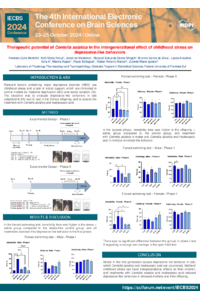
Poster Brain Sciences.pdf
Error Monitoring in an Ecologically Valid Context: Exploring Event-Related Potentials
Neuroprotective Epigenetic and DNA-Damage-Repairing Molecular Mechanisms of Centella Asiatica Extract (CAE) on Experimentally Induced Parkinsonism in Aged Sprague--Dawley Rats