Event submissions
Published
This submission belongs to the session S5. Neurodegenerative Diseases of the event The 4th International Electronic Conference on Brain Sciences
Published date
22 Oct, 2024
Academic Editor
'%3e%3cpath%20d='M12.6657%2010.9104C12.4185%2010.325%2012.0599%209.79327%2011.6097%209.34482C11.1609%208.89508%2010.6293%208.5365%2010.0442%208.28888C10.0389%208.28626%2010.0337%208.28495%2010.0285%208.28233C10.8446%207.69279%2011.3752%206.73249%2011.3752%205.64904C11.3752%203.8542%209.92103%202.39999%208.1262%202.39999C6.33136%202.39999%204.87715%203.8542%204.87715%205.64904C4.87715%206.73249%205.40774%207.69279%206.22393%208.28364C6.21869%208.28626%206.21345%208.28757%206.20821%208.29019C5.62129%208.5378%205.09463%208.89284%204.64265%209.34613C4.1929%209.79493%203.83432%2010.3266%203.58671%2010.9117C3.34345%2011.4845%203.21226%2012.0987%203.20023%2012.7209C3.19988%2012.7349%203.20233%2012.7488%203.20744%2012.7619C3.21255%2012.7749%203.22022%2012.7867%203.22998%2012.7968C3.23975%2012.8068%203.25142%2012.8147%203.26431%2012.8202C3.2772%2012.8256%203.29105%2012.8284%203.30504%2012.8284H4.09109C4.14874%2012.8284%204.19459%2012.7825%204.1959%2012.7262C4.2221%2011.7148%204.62823%2010.7676%205.34617%2010.0497C6.08899%209.30683%207.0755%208.89808%208.1262%208.89808C9.17689%208.89808%2010.1634%209.30683%2010.9062%2010.0497C11.6242%2010.7676%2012.0303%2011.7148%2012.0565%2012.7262C12.0578%2012.7838%2012.1037%2012.8284%2012.1613%2012.8284H12.9474C12.9613%2012.8284%2012.9752%2012.8256%2012.9881%2012.8202C13.001%2012.8147%2013.0126%2012.8068%2013.0224%2012.7968C13.0322%2012.7867%2013.0398%2012.7749%2013.0449%2012.7619C13.0501%2012.7488%2013.0525%2012.7349%2013.0522%2012.7209C13.0391%2012.0947%2012.9094%2011.4855%2012.6657%2010.9104ZM8.1262%207.9024C7.52486%207.9024%206.9589%207.6679%206.53312%207.24211C6.10733%206.81633%205.87283%206.25037%205.87283%205.64904C5.87283%205.0477%206.10733%204.48174%206.53312%204.05596C6.9589%203.63018%207.52486%203.39567%208.1262%203.39567C8.72753%203.39567%209.29349%203.63018%209.71927%204.05596C10.1451%204.48174%2010.3796%205.0477%2010.3796%205.64904C10.3796%206.25037%2010.1451%206.81633%209.71927%207.24211C9.29349%207.6679%208.72753%207.9024%208.1262%207.9024Z'%20fill='%235D1EE1'/%3e%3c/g%3e%3c/svg%3e) Woon‑Man Kung
Woon‑Man KungCitation
Dr Kumar Ponnusamy, Siddarth Srigokul Kumar, Sripriyanka Kumar, Neuroprotective Epigenetic and DNA-Damage-Repairing Molecular Mechanisms of Centella Asiatica Extract (CAE) on Experimentally Induced Parkinsonism in Aged Sprague--Dawley Rats, in Proceedings of The 4th International Electronic Conference on Brain Sciences, 23 October–25 October 2024, MDPI: Basel, Switzerland
Share
Email
Facebook
Twitter
LinkedIn
Neuroprotective Epigenetic and DNA-Damage-Repairing Molecular Mechanisms of Centella Asiatica Extract (CAE) on Experimentally Induced Parkinsonism in Aged Sprague--Dawley Rats
'%3e%3cpath%20d='M12.6647%2010.9104C12.4176%2010.325%2012.0589%209.7933%2011.6088%209.34485C11.16%208.89511%2010.6283%208.53653%2010.0432%208.28891C10.038%208.28629%2010.0327%208.28498%2010.0275%208.28236C10.8437%207.69282%2011.3743%206.73252%2011.3743%205.64907C11.3743%203.85423%209.92005%202.40002%208.12522%202.40002C6.33038%202.40002%204.87618%203.85423%204.87618%205.64907C4.87618%206.73252%205.40677%207.69282%206.22296%208.28367C6.21772%208.28629%206.21248%208.2876%206.20724%208.29022C5.62031%208.53783%205.09365%208.89287%204.64167%209.34616C4.19192%209.79496%203.83334%2010.3266%203.58573%2010.9117C3.34247%2011.4846%203.21128%2012.0987%203.19925%2012.721C3.1989%2012.735%203.20135%2012.7489%203.20646%2012.7619C3.21157%2012.7749%203.21924%2012.7868%203.22901%2012.7968C3.23877%2012.8068%203.25045%2012.8148%203.26334%2012.8202C3.27623%2012.8256%203.29007%2012.8284%203.30406%2012.8284H4.09012C4.14776%2012.8284%204.19362%2012.7825%204.19493%2012.7262C4.22113%2011.7148%204.62726%2010.7676%205.34519%2010.0497C6.08802%209.30686%207.07452%208.89811%208.12522%208.89811C9.17592%208.89811%2010.1624%209.30686%2010.9052%2010.0497C11.6232%2010.7676%2012.0293%2011.7148%2012.0555%2012.7262C12.0568%2012.7839%2012.1027%2012.8284%2012.1603%2012.8284H12.9464C12.9604%2012.8284%2012.9742%2012.8256%2012.9871%2012.8202C13%2012.8148%2013.0117%2012.8068%2013.0214%2012.7968C13.0312%2012.7868%2013.0389%2012.7749%2013.044%2012.7619C13.0491%2012.7489%2013.0515%2012.735%2013.0512%2012.721C13.0381%2012.0947%2012.9084%2011.4856%2012.6647%2010.9104ZM8.12522%207.90243C7.52388%207.90243%206.95792%207.66793%206.53214%207.24215C6.10636%206.81636%205.87185%206.2504%205.87185%205.64907C5.87185%205.04773%206.10636%204.48177%206.53214%204.05599C6.95792%203.63021%207.52388%203.3957%208.12522%203.3957C8.72655%203.3957%209.29252%203.63021%209.7183%204.05599C10.1441%204.48177%2010.3786%205.04773%2010.3786%205.64907C10.3786%206.2504%2010.1441%206.81636%209.7183%207.24215C9.29252%207.66793%208.72655%207.90243%208.12522%207.90243Z'%20fill='%235D1EE1'/%3e%3c/g%3e%3c/svg%3e)
Dr Kumar Ponnusamy 1
Siddarth Srigokul Kumar 2
Sripriyanka Kumar 3
1. Department of Biochemistry & Medical Genetics, Aureus University School of Medicine (AUSOM), Oranjestad, Aruba
2. School of Medicine, Pondicherry Institute of Medical Sciences, Pondicherry, India
3. School of Medicine, Indhira Gandhi Medical College & Research Institute, Pondicherry, india
Abstract
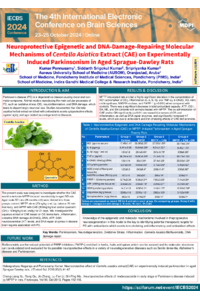
Introduction: Parkinson’s disease (PD) is a degenerative disease causing motor and non-motor symptoms. Animal models reproducing the main cellular processes of PD, such as oxidative stress (OS), neuroinflammation, and DNA damage, which leads to dopaminergic neuronal loss. Studies documented that Centalla asiatica herbal extract enriched with antioxidants exerts cytoprotective effects against aging and age-related neurodegenerative diseases.
Materials & Methods: The present study was designed to investigate whether the CAE would ameliorate MPTP-induced neurotoxicity in aged SD rats. Aged male SD rats (26 months old) were divided into three groups: control, MPTP alone (20mg/kg b.wt, i.p, twice at 20 min intervals), and MPTP with CAE (300mg/kg b.wt and/or quercetin (QN) (100mg/kg b.wt, orally) for 21 days. We invesitgated the aqueous extract of CAE based on OS biomarkers , inflammation, oxidative DNA damage (8 OHdG), DNA, ATP, GSH, neurotransmitter (NT) levels, and DNA repair enzymes in discrete brain regions associated with PD.
Results: MPTP-intoxicated rats elicited a highly significant elevation in the concentration of NO• (a biomarker of OS), inflammation (IL-6, IL-1β, and TNF-α ), 8-OHdG, XO, nitric oxide synthase, NADPH oxidase, and PARP-1 (p<0.001) when compared with controls. There was a significant decrease in total antioxidant capacity, ATP, GSH, DA, NE, and SN contents with animals treated with MPTP. The co-administration of CAE and/or QN significantly (p<0.01) decreased biomarkers of OS and inflammation, as well as DNA repair enzymes, and significantly increased NT levels.
Conclusion: Knowledge of the epigenetic and molecular mechanisms involved in the neurodegeneration in this model is the key to identifying potential therapeutic targets for PD with antioxidants.
Keywords
Parkinsonism
Neurodegeneration
Oxidative Stress
Inflammation
Centella Asiatica Bioflavonoids
DNA damage-repair.
Poster
sciforum-101884 –Poster-Kumar Ponnusamy-Neuroprotective Epigenetic and DNA-Damage-Repairing Molecular Mechanisms of Centella Asiatica Extract (CAE) on Experimentally Induced Parkinsonism in Aged Sprague-Dawley Rats.pdf
Therapeutic potential of Centella asiatica in the intergenerational effect of childhood stress on depressive-like behaviors
16Ch BDD-MEA devices: solid tools for the amperometric determination of serotonin released by exocytosis in human platelets