Event submissions
Published
This submission belongs to the session S7. Clinical Neuroscience of the event The 4th International Electronic Conference on Brain Sciences
Published date
22 Oct, 2024
Academic Editor
'%3e%3cpath%20d='M12.6657%2010.9104C12.4185%2010.325%2012.0599%209.79327%2011.6097%209.34482C11.1609%208.89508%2010.6293%208.5365%2010.0442%208.28888C10.0389%208.28626%2010.0337%208.28495%2010.0285%208.28233C10.8446%207.69279%2011.3752%206.73249%2011.3752%205.64904C11.3752%203.8542%209.92103%202.39999%208.1262%202.39999C6.33136%202.39999%204.87715%203.8542%204.87715%205.64904C4.87715%206.73249%205.40774%207.69279%206.22393%208.28364C6.21869%208.28626%206.21345%208.28757%206.20821%208.29019C5.62129%208.5378%205.09463%208.89284%204.64265%209.34613C4.1929%209.79493%203.83432%2010.3266%203.58671%2010.9117C3.34345%2011.4845%203.21226%2012.0987%203.20023%2012.7209C3.19988%2012.7349%203.20233%2012.7488%203.20744%2012.7619C3.21255%2012.7749%203.22022%2012.7867%203.22998%2012.7968C3.23975%2012.8068%203.25142%2012.8147%203.26431%2012.8202C3.2772%2012.8256%203.29105%2012.8284%203.30504%2012.8284H4.09109C4.14874%2012.8284%204.19459%2012.7825%204.1959%2012.7262C4.2221%2011.7148%204.62823%2010.7676%205.34617%2010.0497C6.08899%209.30683%207.0755%208.89808%208.1262%208.89808C9.17689%208.89808%2010.1634%209.30683%2010.9062%2010.0497C11.6242%2010.7676%2012.0303%2011.7148%2012.0565%2012.7262C12.0578%2012.7838%2012.1037%2012.8284%2012.1613%2012.8284H12.9474C12.9613%2012.8284%2012.9752%2012.8256%2012.9881%2012.8202C13.001%2012.8147%2013.0126%2012.8068%2013.0224%2012.7968C13.0322%2012.7867%2013.0398%2012.7749%2013.0449%2012.7619C13.0501%2012.7488%2013.0525%2012.7349%2013.0522%2012.7209C13.0391%2012.0947%2012.9094%2011.4855%2012.6657%2010.9104ZM8.1262%207.9024C7.52486%207.9024%206.9589%207.6679%206.53312%207.24211C6.10733%206.81633%205.87283%206.25037%205.87283%205.64904C5.87283%205.0477%206.10733%204.48174%206.53312%204.05596C6.9589%203.63018%207.52486%203.39567%208.1262%203.39567C8.72753%203.39567%209.29349%203.63018%209.71927%204.05596C10.1451%204.48174%2010.3796%205.0477%2010.3796%205.64904C10.3796%206.25037%2010.1451%206.81633%209.71927%207.24211C9.29349%207.6679%208.72753%207.9024%208.1262%207.9024Z'%20fill='%235D1EE1'/%3e%3c/g%3e%3c/svg%3e) Robert Emmett Kelly
Robert Emmett KellyCitation
MADELINE HWANG, Sidney Crowley, Mason Briggs, Benjamin Gibson, Christopher Wertz, Adam Woods, John Phillips, Sephira Ryman, Andrew Mayer, Michelle Cox, Vincent P Clark, Cognitive Assessment for the Prediction of Transcranial Electrical Simulation Effects on Memory Improvement, in Proceedings of The 4th International Electronic Conference on Brain Sciences, 23 October–25 October 2024, MDPI: Basel, Switzerland
Share
Email
Facebook
Twitter
LinkedIn
Cognitive Assessment for the Prediction of Transcranial Electrical Simulation Effects on Memory Improvement
'%3e%3cpath%20d='M12.6647%2010.9104C12.4176%2010.325%2012.0589%209.7933%2011.6088%209.34485C11.16%208.89511%2010.6283%208.53653%2010.0432%208.28891C10.038%208.28629%2010.0327%208.28498%2010.0275%208.28236C10.8437%207.69282%2011.3743%206.73252%2011.3743%205.64907C11.3743%203.85423%209.92005%202.40002%208.12522%202.40002C6.33038%202.40002%204.87618%203.85423%204.87618%205.64907C4.87618%206.73252%205.40677%207.69282%206.22296%208.28367C6.21772%208.28629%206.21248%208.2876%206.20724%208.29022C5.62031%208.53783%205.09365%208.89287%204.64167%209.34616C4.19192%209.79496%203.83334%2010.3266%203.58573%2010.9117C3.34247%2011.4846%203.21128%2012.0987%203.19925%2012.721C3.1989%2012.735%203.20135%2012.7489%203.20646%2012.7619C3.21157%2012.7749%203.21924%2012.7868%203.22901%2012.7968C3.23877%2012.8068%203.25045%2012.8148%203.26334%2012.8202C3.27623%2012.8256%203.29007%2012.8284%203.30406%2012.8284H4.09012C4.14776%2012.8284%204.19362%2012.7825%204.19493%2012.7262C4.22113%2011.7148%204.62726%2010.7676%205.34519%2010.0497C6.08802%209.30686%207.07452%208.89811%208.12522%208.89811C9.17592%208.89811%2010.1624%209.30686%2010.9052%2010.0497C11.6232%2010.7676%2012.0293%2011.7148%2012.0555%2012.7262C12.0568%2012.7839%2012.1027%2012.8284%2012.1603%2012.8284H12.9464C12.9604%2012.8284%2012.9742%2012.8256%2012.9871%2012.8202C13%2012.8148%2013.0117%2012.8068%2013.0214%2012.7968C13.0312%2012.7868%2013.0389%2012.7749%2013.044%2012.7619C13.0491%2012.7489%2013.0515%2012.735%2013.0512%2012.721C13.0381%2012.0947%2012.9084%2011.4856%2012.6647%2010.9104ZM8.12522%207.90243C7.52388%207.90243%206.95792%207.66793%206.53214%207.24215C6.10636%206.81636%205.87185%206.2504%205.87185%205.64907C5.87185%205.04773%206.10636%204.48177%206.53214%204.05599C6.95792%203.63021%207.52388%203.3957%208.12522%203.3957C8.72655%203.3957%209.29252%203.63021%209.7183%204.05599C10.1441%204.48177%2010.3786%205.04773%2010.3786%205.64907C10.3786%206.2504%2010.1441%206.81636%209.7183%207.24215C9.29252%207.66793%208.72655%207.90243%208.12522%207.90243Z'%20fill='%235D1EE1'/%3e%3c/g%3e%3c/svg%3e)
MADELINE HWANG 1
Sidney Crowley 1
Mason Briggs 1
Benjamin Gibson 1
Christopher Wertz 1
Adam Woods 2
John Phillips 3
Sephira Ryman 3
Andrew Mayer 3
Michelle Cox 4

Vincent P Clark 1
1. University of New Mexico
2. University of Florida
3. Mind Research Network
4. ThriveMO, LLC
Abstract
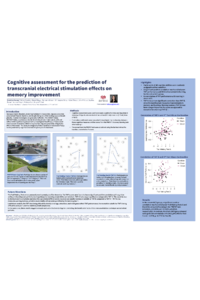
Introduction: Neuropsychiatric disorders, including Alzheimer’s Disease (AD), impose substantial personal and financial burdens, and despite being one of the leading causes of death globally, treatment strategies are generally ineffective. The MEMORI Study (NCT05077826), a randomized double-blind clinical trial of older adults with and without Mild Cognitive Impairment (MCI), investigated the efficacy of transcranial electrical stimulation (tES) to improve learning and potentially mitigate the effects of dementia. This study investigated whether variation in treatment efficacy can be predicted by cognitive assessments given prior to treatment.
Methods: Cognitive assessments were used to evaluate cognitive function and impairment among participants who received either a sham (0.1 mA) or verum (2.0 mA) dose of tES. This analysis involved computing correlation coefficients to investigate the relationship between these cognitive measures and the scores from the PRETXT discovery learning task after training (Gibson et al., 2020).
Results: In the verum tES group, Trail Making Tests A and B showed significant positive correlations between learning task improvement and training (r=0.4415, p=0.0030 and r=0.3270, p=0.0324, respectively). In contrast, the sham tES group showed nonsignificant correlations (r=0.1453, p=0.3468 for Test A and r=0.0446, p=0.7740 for Test B).
Conclusion: Trail Making Test scores were found to have a significant correlation with learning task performance in participants receiving verum tES, but not sham. Further research will be needed in order for us to understand this relationship. In the meantime, these results suggest a simple and cost-effective strategy for predicting the beneficial effects of this neuromodulation technique on individual patients.
Keywords
Trail Making Test A and B
cognitive assessments
dementia
tES
Alzheimer's Disease
Poster
MHH_Poster_V005.pdf
Voice signal analysis for early detection of Parkinson's disease using machine learning techniques
Telehealth intervention involving the HEARTS Technical Package and the use of an activity monitor to increase physical activity level post-stroke: protocol for a feasibility randomized controlled trial