Event submissions
Published
This submission belongs to the session S9. Neurorehabilitation of the event The 4th International Electronic Conference on Brain Sciences
Published date
22 Oct, 2024
Academic Editor
'%3e%3cpath%20d='M12.6657%2010.9104C12.4185%2010.325%2012.0599%209.79327%2011.6097%209.34482C11.1609%208.89508%2010.6293%208.5365%2010.0442%208.28888C10.0389%208.28626%2010.0337%208.28495%2010.0285%208.28233C10.8446%207.69279%2011.3752%206.73249%2011.3752%205.64904C11.3752%203.8542%209.92103%202.39999%208.1262%202.39999C6.33136%202.39999%204.87715%203.8542%204.87715%205.64904C4.87715%206.73249%205.40774%207.69279%206.22393%208.28364C6.21869%208.28626%206.21345%208.28757%206.20821%208.29019C5.62129%208.5378%205.09463%208.89284%204.64265%209.34613C4.1929%209.79493%203.83432%2010.3266%203.58671%2010.9117C3.34345%2011.4845%203.21226%2012.0987%203.20023%2012.7209C3.19988%2012.7349%203.20233%2012.7488%203.20744%2012.7619C3.21255%2012.7749%203.22022%2012.7867%203.22998%2012.7968C3.23975%2012.8068%203.25142%2012.8147%203.26431%2012.8202C3.2772%2012.8256%203.29105%2012.8284%203.30504%2012.8284H4.09109C4.14874%2012.8284%204.19459%2012.7825%204.1959%2012.7262C4.2221%2011.7148%204.62823%2010.7676%205.34617%2010.0497C6.08899%209.30683%207.0755%208.89808%208.1262%208.89808C9.17689%208.89808%2010.1634%209.30683%2010.9062%2010.0497C11.6242%2010.7676%2012.0303%2011.7148%2012.0565%2012.7262C12.0578%2012.7838%2012.1037%2012.8284%2012.1613%2012.8284H12.9474C12.9613%2012.8284%2012.9752%2012.8256%2012.9881%2012.8202C13.001%2012.8147%2013.0126%2012.8068%2013.0224%2012.7968C13.0322%2012.7867%2013.0398%2012.7749%2013.0449%2012.7619C13.0501%2012.7488%2013.0525%2012.7349%2013.0522%2012.7209C13.0391%2012.0947%2012.9094%2011.4855%2012.6657%2010.9104ZM8.1262%207.9024C7.52486%207.9024%206.9589%207.6679%206.53312%207.24211C6.10733%206.81633%205.87283%206.25037%205.87283%205.64904C5.87283%205.0477%206.10733%204.48174%206.53312%204.05596C6.9589%203.63018%207.52486%203.39567%208.1262%203.39567C8.72753%203.39567%209.29349%203.63018%209.71927%204.05596C10.1451%204.48174%2010.3796%205.0477%2010.3796%205.64904C10.3796%206.25037%2010.1451%206.81633%209.71927%207.24211C9.29349%207.6679%208.72753%207.9024%208.1262%207.9024Z'%20fill='%235D1EE1'/%3e%3c/g%3e%3c/svg%3e) Christina Danielli Coelho De Morais Faria
Christina Danielli Coelho De Morais FariaCitation
Paula da Cruz Peniche, Olive Lennon, Jordana de Paula Magalhães, Jéssica Melo dos Santos, Janaine Cunha Polese, Christina Danielli Coelho de Morais Faria, Telehealth intervention involving the HEARTS Technical Package and the use of an activity monitor to increase physical activity level post-stroke: protocol for a feasibility randomized controlled trial, in Proceedings of The 4th International Electronic Conference on Brain Sciences, 23 October–25 October 2024, MDPI: Basel, Switzerland
Share
Email
Facebook
Twitter
LinkedIn
Telehealth intervention involving the HEARTS Technical Package and the use of an activity monitor to increase physical activity level post-stroke: protocol for a feasibility randomized controlled trial
'%3e%3cpath%20d='M12.6647%2010.9104C12.4176%2010.325%2012.0589%209.7933%2011.6088%209.34485C11.16%208.89511%2010.6283%208.53653%2010.0432%208.28891C10.038%208.28629%2010.0327%208.28498%2010.0275%208.28236C10.8437%207.69282%2011.3743%206.73252%2011.3743%205.64907C11.3743%203.85423%209.92005%202.40002%208.12522%202.40002C6.33038%202.40002%204.87618%203.85423%204.87618%205.64907C4.87618%206.73252%205.40677%207.69282%206.22296%208.28367C6.21772%208.28629%206.21248%208.2876%206.20724%208.29022C5.62031%208.53783%205.09365%208.89287%204.64167%209.34616C4.19192%209.79496%203.83334%2010.3266%203.58573%2010.9117C3.34247%2011.4846%203.21128%2012.0987%203.19925%2012.721C3.1989%2012.735%203.20135%2012.7489%203.20646%2012.7619C3.21157%2012.7749%203.21924%2012.7868%203.22901%2012.7968C3.23877%2012.8068%203.25045%2012.8148%203.26334%2012.8202C3.27623%2012.8256%203.29007%2012.8284%203.30406%2012.8284H4.09012C4.14776%2012.8284%204.19362%2012.7825%204.19493%2012.7262C4.22113%2011.7148%204.62726%2010.7676%205.34519%2010.0497C6.08802%209.30686%207.07452%208.89811%208.12522%208.89811C9.17592%208.89811%2010.1624%209.30686%2010.9052%2010.0497C11.6232%2010.7676%2012.0293%2011.7148%2012.0555%2012.7262C12.0568%2012.7839%2012.1027%2012.8284%2012.1603%2012.8284H12.9464C12.9604%2012.8284%2012.9742%2012.8256%2012.9871%2012.8202C13%2012.8148%2013.0117%2012.8068%2013.0214%2012.7968C13.0312%2012.7868%2013.0389%2012.7749%2013.044%2012.7619C13.0491%2012.7489%2013.0515%2012.735%2013.0512%2012.721C13.0381%2012.0947%2012.9084%2011.4856%2012.6647%2010.9104ZM8.12522%207.90243C7.52388%207.90243%206.95792%207.66793%206.53214%207.24215C6.10636%206.81636%205.87185%206.2504%205.87185%205.64907C5.87185%205.04773%206.10636%204.48177%206.53214%204.05599C6.95792%203.63021%207.52388%203.3957%208.12522%203.3957C8.72655%203.3957%209.29252%203.63021%209.7183%204.05599C10.1441%204.48177%2010.3786%205.04773%2010.3786%205.64907C10.3786%206.2504%2010.1441%206.81636%209.7183%207.24215C9.29252%207.66793%208.72655%207.90243%208.12522%207.90243Z'%20fill='%235D1EE1'/%3e%3c/g%3e%3c/svg%3e)
Paula da Cruz Peniche 1
Olive Lennon 2
Jordana de Paula Magalhães 1
Jéssica Melo dos Santos 1
Janaine Cunha Polese 1

Christina Danielli Coelho de Morais Faria 1
1. Department of Physiotherapy, Universidade Federal de Minas Gerais, Belo Horizonte, Minas Gerais, Brazil
2. School of Public Health, Physiotherapy and Sports Science, University College Dublin, Belfield, Dublin 4, Dublin, Ireland
Abstract
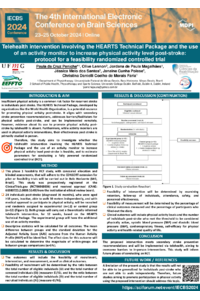
Introduction: Insufficient physical activity is a common risk factor for recurrent stroke in individuals post-stroke. The HEARTS Technical Package, developed by organizations like the World Health Organization, is a potential resource for promoting physical activity post-stroke. It aligns with secondary stroke prevention recommendations, addresses barriers/facilitators for physical activity post-stroke, and can be implemented remotely. However, evidence about its use to promote physical activity post-stroke by telehealth is absent. Furthermore, while activity monitors are used in physical activity interventions, their effectiveness post-stroke is primarily studied in-person. Therefore, this study aims to investigate whether the telehealth intervention involving the HEARTS Technical Package and the use of an activity monitor to increase physical activity level post-stroke is feasible, and to estimate parameters for conducting a fully powered randomized controlled trial (RCT).
Methods: A feasibility RCT study, with blinded assessment, assigned 24 individuals post-stroke (diagnosed ≥6 months), who were aged ≥18 years, inactive, able to walk 10 meters independently, and with medical approval to participate in physical activity, to an experimental (n=12) or a control group (n=12). Both groups carried out a theoretically-informed telehealth intervention, for 12 weeks, based on the HEARTS Technical Package. The experimental group had additional use of an activity monitor.
Results: The outcomes include the feasibility of recruitment, intervention, and measurement, as well as clinical outcomes.
Conclusions: The proposed intervention meets secondary stroke prevention recommendations and will be implemented via telehealth, aiming to overcome barriers to in-person interventions. This study will inform future phases of conducting an RCT.
Keywords
Stroke
Physical activity
Telehealth
Feasibility Study
Poster
Poster 2 - paula da cruz peniche - 17-10-2024.pdf
Cognitive Assessment for the Prediction of Transcranial Electrical Simulation Effects on Memory Improvement
Prototype behavioural test of memory in Wistar rats exposed to valproic acid: AME Memoriavers maze