Event submissions
Published
This submission belongs to the session S5. Chemistry and Physicochemical Properties of Foods of the event The 5th International Electronic Conference on Foods
Published date
25 Oct, 2024
Academic Editor
'%3e%3cpath%20d='M12.6657%2010.9104C12.4185%2010.325%2012.0599%209.79327%2011.6097%209.34482C11.1609%208.89508%2010.6293%208.5365%2010.0442%208.28888C10.0389%208.28626%2010.0337%208.28495%2010.0285%208.28233C10.8446%207.69279%2011.3752%206.73249%2011.3752%205.64904C11.3752%203.8542%209.92103%202.39999%208.1262%202.39999C6.33136%202.39999%204.87715%203.8542%204.87715%205.64904C4.87715%206.73249%205.40774%207.69279%206.22393%208.28364C6.21869%208.28626%206.21345%208.28757%206.20821%208.29019C5.62129%208.5378%205.09463%208.89284%204.64265%209.34613C4.1929%209.79493%203.83432%2010.3266%203.58671%2010.9117C3.34345%2011.4845%203.21226%2012.0987%203.20023%2012.7209C3.19988%2012.7349%203.20233%2012.7488%203.20744%2012.7619C3.21255%2012.7749%203.22022%2012.7867%203.22998%2012.7968C3.23975%2012.8068%203.25142%2012.8147%203.26431%2012.8202C3.2772%2012.8256%203.29105%2012.8284%203.30504%2012.8284H4.09109C4.14874%2012.8284%204.19459%2012.7825%204.1959%2012.7262C4.2221%2011.7148%204.62823%2010.7676%205.34617%2010.0497C6.08899%209.30683%207.0755%208.89808%208.1262%208.89808C9.17689%208.89808%2010.1634%209.30683%2010.9062%2010.0497C11.6242%2010.7676%2012.0303%2011.7148%2012.0565%2012.7262C12.0578%2012.7838%2012.1037%2012.8284%2012.1613%2012.8284H12.9474C12.9613%2012.8284%2012.9752%2012.8256%2012.9881%2012.8202C13.001%2012.8147%2013.0126%2012.8068%2013.0224%2012.7968C13.0322%2012.7867%2013.0398%2012.7749%2013.0449%2012.7619C13.0501%2012.7488%2013.0525%2012.7349%2013.0522%2012.7209C13.0391%2012.0947%2012.9094%2011.4855%2012.6657%2010.9104ZM8.1262%207.9024C7.52486%207.9024%206.9589%207.6679%206.53312%207.24211C6.10733%206.81633%205.87283%206.25037%205.87283%205.64904C5.87283%205.0477%206.10733%204.48174%206.53312%204.05596C6.9589%203.63018%207.52486%203.39567%208.1262%203.39567C8.72753%203.39567%209.29349%203.63018%209.71927%204.05596C10.1451%204.48174%2010.3796%205.0477%2010.3796%205.64904C10.3796%206.25037%2010.1451%206.81633%209.71927%207.24211C9.29349%207.6679%208.72753%207.9024%208.1262%207.9024Z'%20fill='%235D1EE1'/%3e%3c/g%3e%3c/svg%3e) Antonello Santini
Antonello SantiniCitation
Gloria López-Gámez, Raquel Del Pino-García, Andrea Justicia-Rueda, María Asunción López-Bascón, Vito Verardo, Transforming Vegetable Waste: Insect Flour Quality through Tenebrio molitor Larvae Supplementation , in Proceedings of The 5th International Electronic Conference on Foods, 28 October–30 October 2024, MDPI: Basel, Switzerland
Share
Email
Facebook
Twitter
LinkedIn
Transforming Vegetable Waste: Insect Flour Quality through Tenebrio molitor Larvae Supplementation
'%3e%3cpath%20d='M12.6647%2010.9104C12.4176%2010.325%2012.0589%209.7933%2011.6088%209.34485C11.16%208.89511%2010.6283%208.53653%2010.0432%208.28891C10.038%208.28629%2010.0327%208.28498%2010.0275%208.28236C10.8437%207.69282%2011.3743%206.73252%2011.3743%205.64907C11.3743%203.85423%209.92005%202.40002%208.12522%202.40002C6.33038%202.40002%204.87618%203.85423%204.87618%205.64907C4.87618%206.73252%205.40677%207.69282%206.22296%208.28367C6.21772%208.28629%206.21248%208.2876%206.20724%208.29022C5.62031%208.53783%205.09365%208.89287%204.64167%209.34616C4.19192%209.79496%203.83334%2010.3266%203.58573%2010.9117C3.34247%2011.4846%203.21128%2012.0987%203.19925%2012.721C3.1989%2012.735%203.20135%2012.7489%203.20646%2012.7619C3.21157%2012.7749%203.21924%2012.7868%203.22901%2012.7968C3.23877%2012.8068%203.25045%2012.8148%203.26334%2012.8202C3.27623%2012.8256%203.29007%2012.8284%203.30406%2012.8284H4.09012C4.14776%2012.8284%204.19362%2012.7825%204.19493%2012.7262C4.22113%2011.7148%204.62726%2010.7676%205.34519%2010.0497C6.08802%209.30686%207.07452%208.89811%208.12522%208.89811C9.17592%208.89811%2010.1624%209.30686%2010.9052%2010.0497C11.6232%2010.7676%2012.0293%2011.7148%2012.0555%2012.7262C12.0568%2012.7839%2012.1027%2012.8284%2012.1603%2012.8284H12.9464C12.9604%2012.8284%2012.9742%2012.8256%2012.9871%2012.8202C13%2012.8148%2013.0117%2012.8068%2013.0214%2012.7968C13.0312%2012.7868%2013.0389%2012.7749%2013.044%2012.7619C13.0491%2012.7489%2013.0515%2012.735%2013.0512%2012.721C13.0381%2012.0947%2012.9084%2011.4856%2012.6647%2010.9104ZM8.12522%207.90243C7.52388%207.90243%206.95792%207.66793%206.53214%207.24215C6.10636%206.81636%205.87185%206.2504%205.87185%205.64907C5.87185%205.04773%206.10636%204.48177%206.53214%204.05599C6.95792%203.63021%207.52388%203.3957%208.12522%203.3957C8.72655%203.3957%209.29252%203.63021%209.7183%204.05599C10.1441%204.48177%2010.3786%205.04773%2010.3786%205.64907C10.3786%206.2504%2010.1441%206.81636%209.7183%207.24215C9.29252%207.66793%208.72655%207.90243%208.12522%207.90243Z'%20fill='%235D1EE1'/%3e%3c/g%3e%3c/svg%3e)
Gloria López-Gámez 1
Raquel Del Pino-García 1
Andrea Justicia-Rueda 1
María Asunción López-Bascón 1

Vito Verardo 1,2,3
1. Centro de Investigación y Desarrollo del Alimento Funcional (CIDAF), Avda. del Conocimiento, 37, 18016 Granada, Spain.
2. Institute of Nutrition and Food Technology Jose Mataix, Biomedical Research Center, University of Granada, Avda. Conocimiento s/n, 18100 Granada, Spain
3. Department of Nutrition and Food Science, Campus of Cartuja, University of Granada, 18071 Granada, Spain.
Abstract
Insect farming presents a viable solution to transform vegetable waste generated by the food industry into valuable products such as insect flours. Vegetable waste is rich in bioactive compounds and essential nutrients, which can potentially enhance the quality of insect flours. This study aims to investigate the impact of adding vegetable waste to the diets of Tenebrio molitor larvae on the quality of the generated flours during long-term storage.
The iets of T. molitor larvae consisted of supplementing (1:1) wheat bran with cucumber or tomato wastes for 6 weeks. Post-supplementation, the larvae were dried using a pilot infrared oven at 68°C for 4 hours, and then ground into flour. The quality attributes (moisture, color, lipid oxidation, and microbial load) of these insect flours were assessed over a 12-month storage period at room temperature.
During storage, moisture was around 5-7% in all flours, which is essential for avoiding microorganism growth. Thus, the presence of Salmonella spp., Escherichia coli, and Listeria monocytogenes was below the legislation limit. The color parameters of L*, a*, b*, and C* progressively decreased in all flours; this reduction was more pronounced in flours from larvae fed only with wheat bran. All flours darkened during storage, especially those from supplemented larvae. These results are consistent with the results of nutritional composition and lipid oxidation since flours from larvae fed with vegetable wastes have a higher proportion of unsaturated fatty acids (35% in supplemented versus 25% in control), and are more prone to oxidation, which provides a darker color. Lipid oxidation was stable until 3 months of storage.
Therefore, using tomato and cucumber wastes as supplements for T. molitor diet is a sustainable strategy to revalorize vegetable waste and produce flours that maintain acceptable quality attributes for at least 3 months of storage at room temperature.
Keywords
Insect flour
alternative protein
quality attributes
vegetable waste
circular bioeconomy
Poster
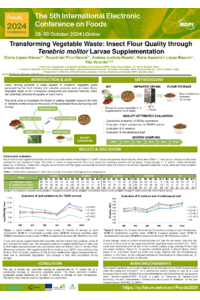
Plantilla poster foods online 2024_ecoinsect_logos.pdf
Optimization of drying conditions and supercritical extraction to improve the antioxidant activity of three ecotypes of Chilean hops (Humulus lupulus) through response surface methodology
Functionality and structure of protein isolate from decolorized moringa leaf