Event submissions
Published
This submission belongs to the session S5. Chemistry and Physicochemical Properties of Foods of the event The 5th International Electronic Conference on Foods
Published date
25 Oct, 2024
Academic Editor
'%3e%3cpath%20d='M12.6657%2010.9104C12.4185%2010.325%2012.0599%209.79327%2011.6097%209.34482C11.1609%208.89508%2010.6293%208.5365%2010.0442%208.28888C10.0389%208.28626%2010.0337%208.28495%2010.0285%208.28233C10.8446%207.69279%2011.3752%206.73249%2011.3752%205.64904C11.3752%203.8542%209.92103%202.39999%208.1262%202.39999C6.33136%202.39999%204.87715%203.8542%204.87715%205.64904C4.87715%206.73249%205.40774%207.69279%206.22393%208.28364C6.21869%208.28626%206.21345%208.28757%206.20821%208.29019C5.62129%208.5378%205.09463%208.89284%204.64265%209.34613C4.1929%209.79493%203.83432%2010.3266%203.58671%2010.9117C3.34345%2011.4845%203.21226%2012.0987%203.20023%2012.7209C3.19988%2012.7349%203.20233%2012.7488%203.20744%2012.7619C3.21255%2012.7749%203.22022%2012.7867%203.22998%2012.7968C3.23975%2012.8068%203.25142%2012.8147%203.26431%2012.8202C3.2772%2012.8256%203.29105%2012.8284%203.30504%2012.8284H4.09109C4.14874%2012.8284%204.19459%2012.7825%204.1959%2012.7262C4.2221%2011.7148%204.62823%2010.7676%205.34617%2010.0497C6.08899%209.30683%207.0755%208.89808%208.1262%208.89808C9.17689%208.89808%2010.1634%209.30683%2010.9062%2010.0497C11.6242%2010.7676%2012.0303%2011.7148%2012.0565%2012.7262C12.0578%2012.7838%2012.1037%2012.8284%2012.1613%2012.8284H12.9474C12.9613%2012.8284%2012.9752%2012.8256%2012.9881%2012.8202C13.001%2012.8147%2013.0126%2012.8068%2013.0224%2012.7968C13.0322%2012.7867%2013.0398%2012.7749%2013.0449%2012.7619C13.0501%2012.7488%2013.0525%2012.7349%2013.0522%2012.7209C13.0391%2012.0947%2012.9094%2011.4855%2012.6657%2010.9104ZM8.1262%207.9024C7.52486%207.9024%206.9589%207.6679%206.53312%207.24211C6.10733%206.81633%205.87283%206.25037%205.87283%205.64904C5.87283%205.0477%206.10733%204.48174%206.53312%204.05596C6.9589%203.63018%207.52486%203.39567%208.1262%203.39567C8.72753%203.39567%209.29349%203.63018%209.71927%204.05596C10.1451%204.48174%2010.3796%205.0477%2010.3796%205.64904C10.3796%206.25037%2010.1451%206.81633%209.71927%207.24211C9.29349%207.6679%208.72753%207.9024%208.1262%207.9024Z'%20fill='%235D1EE1'/%3e%3c/g%3e%3c/svg%3e) Antonello Santini
Antonello SantiniCitation
Franco Emmanuel Calvo, Eduardo Trentacoste, Roxana Elizabeth Gonzalez, Pamela Yanina Quintas, Fatty acid profile and proximate composition of nuts grown in the Cuyo Region, Argentina, in Proceedings of The 5th International Electronic Conference on Foods, 28 October–30 October 2024, MDPI: Basel, Switzerland
Share
Email
Facebook
Twitter
LinkedIn
Fatty acid profile and proximate composition of nuts grown in the Cuyo Region, Argentina

Franco Emmanuel Calvo 1

Eduardo Trentacoste 2
'%3e%3cpath%20d='M12.6647%2010.9104C12.4176%2010.325%2012.0589%209.7933%2011.6088%209.34485C11.16%208.89511%2010.6283%208.53653%2010.0432%208.28891C10.038%208.28629%2010.0327%208.28498%2010.0275%208.28236C10.8437%207.69282%2011.3743%206.73252%2011.3743%205.64907C11.3743%203.85423%209.92005%202.40002%208.12522%202.40002C6.33038%202.40002%204.87618%203.85423%204.87618%205.64907C4.87618%206.73252%205.40677%207.69282%206.22296%208.28367C6.21772%208.28629%206.21248%208.2876%206.20724%208.29022C5.62031%208.53783%205.09365%208.89287%204.64167%209.34616C4.19192%209.79496%203.83334%2010.3266%203.58573%2010.9117C3.34247%2011.4846%203.21128%2012.0987%203.19925%2012.721C3.1989%2012.735%203.20135%2012.7489%203.20646%2012.7619C3.21157%2012.7749%203.21924%2012.7868%203.22901%2012.7968C3.23877%2012.8068%203.25045%2012.8148%203.26334%2012.8202C3.27623%2012.8256%203.29007%2012.8284%203.30406%2012.8284H4.09012C4.14776%2012.8284%204.19362%2012.7825%204.19493%2012.7262C4.22113%2011.7148%204.62726%2010.7676%205.34519%2010.0497C6.08802%209.30686%207.07452%208.89811%208.12522%208.89811C9.17592%208.89811%2010.1624%209.30686%2010.9052%2010.0497C11.6232%2010.7676%2012.0293%2011.7148%2012.0555%2012.7262C12.0568%2012.7839%2012.1027%2012.8284%2012.1603%2012.8284H12.9464C12.9604%2012.8284%2012.9742%2012.8256%2012.9871%2012.8202C13%2012.8148%2013.0117%2012.8068%2013.0214%2012.7968C13.0312%2012.7868%2013.0389%2012.7749%2013.044%2012.7619C13.0491%2012.7489%2013.0515%2012.735%2013.0512%2012.721C13.0381%2012.0947%2012.9084%2011.4856%2012.6647%2010.9104ZM8.12522%207.90243C7.52388%207.90243%206.95792%207.66793%206.53214%207.24215C6.10636%206.81636%205.87185%206.2504%205.87185%205.64907C5.87185%205.04773%206.10636%204.48177%206.53214%204.05599C6.95792%203.63021%207.52388%203.3957%208.12522%203.3957C8.72655%203.3957%209.29252%203.63021%209.7183%204.05599C10.1441%204.48177%2010.3786%205.04773%2010.3786%205.64907C10.3786%206.2504%2010.1441%206.81636%209.7183%207.24215C9.29252%207.66793%208.72655%207.90243%208.12522%207.90243Z'%20fill='%235D1EE1'/%3e%3c/g%3e%3c/svg%3e)
Roxana Elizabeth Gonzalez 2
Pamela Yanina Quintas 3
1. Instituto de Agricultura Sostenible en el Oasis (IASO),
Universidad Nacional de Chilecito (UNdeC), La Rioja.
2. EEA La Consulta, INTA. Mendoza, Argentina.
3. Dr. Pamela Y. Quintas
Assistant Researcher, CONICET
Applied Nanomaterials Group (GNA)
Institute of Research and Development in Process Engineering, Biotechnology, and Alternative Energies (PROBIEN)
Neuquén, Argentina
Abstract
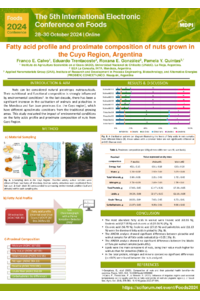
Nuts are energy-rich foods with nutrients like monounsaturated and polyunsaturated fatty acids, high-quality proteins, fiber, minerals, tocopherols, phytosterols, and antioxidants. These components improve metabolic pathways and vascular physiology. Nut consumption is linked to a lower cancer incidence, improved cognitive function, and reduced depression and cholesterol. Nuts can be considered natural pleiotropic nutraceuticals. Their nutritional and functional composition is strongly influenced by environmental conditions. In the last decade, there has been a significant increase in the cultivation of walnuts and pistachios in the Mendoza and San Juan provinces (i.e., the Cuyo region), which have different agroclimatic conditions from the traditional growing areas. This study evaluated the impact of environmental conditions on the fatty acid profile and proximate composition of nuts from the Cuyo Region. Chandler-variety walnut samples were obtained from two farms in Mendoza, while Kerman-variety pistachios were recollected from San Juan. On each farm, three blocks were randomly selected, each with three adjacent trees with similar fruit load and crown size. Each block corresponded to contrasting environmental conditions (soil and altitude) within each farm. The proximate composition varied across the nuts evaluated. The highest moisture content, fiber, and carbohydrate content were found in pistachio. The total lipids content ranged from 44.5 to 68.1 g of oil per 100 g−1 dry solids for walnut and pistachio, respectively. The identification of fatty acids was carried out using gas chromatography–mass spectrophotometry. The most abundant fatty acids in walnut were linoleic acid (63.36 %), linolenic acid (17.18 %), and cis oleic acid (11.04 %), while cis oleic acid (56.70 %), linolenic acid (27.15 %), and palmitoleic acid (11.13 %) were the dominant fatty acids in pistachio. The results did not show variability in fatty acid concentrations between blocks (p<0.05). This information provides insights into the fatty acid profiles and compositions of nuts from two new production areas.
Keywords
Chandler variety walnut
Kerman variety pistachio
Cuyo Region
Fatty acids
Poster
Poster_nuts.pdf
Green Synthesis of Silver Nanoparticles by Using Phyllanthus emblica and Adhatoda vasica Leaf Extract and their comparative study on microbes
Evolution of bacterial growth in Melipona bicolor honeys after one year of storage