Event submissions
Published
This submission belongs to the session S4. Food Microbiology of the event The 5th International Electronic Conference on Foods
Published date
25 Oct, 2024
Academic Editor
'%3e%3cpath%20d='M12.6657%2010.9104C12.4185%2010.325%2012.0599%209.79327%2011.6097%209.34482C11.1609%208.89508%2010.6293%208.5365%2010.0442%208.28888C10.0389%208.28626%2010.0337%208.28495%2010.0285%208.28233C10.8446%207.69279%2011.3752%206.73249%2011.3752%205.64904C11.3752%203.8542%209.92103%202.39999%208.1262%202.39999C6.33136%202.39999%204.87715%203.8542%204.87715%205.64904C4.87715%206.73249%205.40774%207.69279%206.22393%208.28364C6.21869%208.28626%206.21345%208.28757%206.20821%208.29019C5.62129%208.5378%205.09463%208.89284%204.64265%209.34613C4.1929%209.79493%203.83432%2010.3266%203.58671%2010.9117C3.34345%2011.4845%203.21226%2012.0987%203.20023%2012.7209C3.19988%2012.7349%203.20233%2012.7488%203.20744%2012.7619C3.21255%2012.7749%203.22022%2012.7867%203.22998%2012.7968C3.23975%2012.8068%203.25142%2012.8147%203.26431%2012.8202C3.2772%2012.8256%203.29105%2012.8284%203.30504%2012.8284H4.09109C4.14874%2012.8284%204.19459%2012.7825%204.1959%2012.7262C4.2221%2011.7148%204.62823%2010.7676%205.34617%2010.0497C6.08899%209.30683%207.0755%208.89808%208.1262%208.89808C9.17689%208.89808%2010.1634%209.30683%2010.9062%2010.0497C11.6242%2010.7676%2012.0303%2011.7148%2012.0565%2012.7262C12.0578%2012.7838%2012.1037%2012.8284%2012.1613%2012.8284H12.9474C12.9613%2012.8284%2012.9752%2012.8256%2012.9881%2012.8202C13.001%2012.8147%2013.0126%2012.8068%2013.0224%2012.7968C13.0322%2012.7867%2013.0398%2012.7749%2013.0449%2012.7619C13.0501%2012.7488%2013.0525%2012.7349%2013.0522%2012.7209C13.0391%2012.0947%2012.9094%2011.4855%2012.6657%2010.9104ZM8.1262%207.9024C7.52486%207.9024%206.9589%207.6679%206.53312%207.24211C6.10733%206.81633%205.87283%206.25037%205.87283%205.64904C5.87283%205.0477%206.10733%204.48174%206.53312%204.05596C6.9589%203.63018%207.52486%203.39567%208.1262%203.39567C8.72753%203.39567%209.29349%203.63018%209.71927%204.05596C10.1451%204.48174%2010.3796%205.0477%2010.3796%205.64904C10.3796%206.25037%2010.1451%206.81633%209.71927%207.24211C9.29349%207.6679%208.72753%207.9024%208.1262%207.9024Z'%20fill='%235D1EE1'/%3e%3c/g%3e%3c/svg%3e) Antonio Bevilacqua
Antonio BevilacquaCitation
Lorena Lima Ludovico, Milena Gabrielle de Jesus, Kauã Colaço Schier, Elisana Julek, Luana Siqueira de Souza, Juliana Chiesse Da Silva Zatta, Julia Arantes Galvão, Evolution of bacterial growth in Melipona bicolor honeys after one year of storage, in Proceedings of The 5th International Electronic Conference on Foods, 28 October–30 October 2024, MDPI: Basel, Switzerland
Share
Email
Facebook
Twitter
LinkedIn
Evolution of bacterial growth in Melipona bicolor honeys after one year of storage
'%3e%3cpath%20d='M12.6647%2010.9104C12.4176%2010.325%2012.0589%209.7933%2011.6088%209.34485C11.16%208.89511%2010.6283%208.53653%2010.0432%208.28891C10.038%208.28629%2010.0327%208.28498%2010.0275%208.28236C10.8437%207.69282%2011.3743%206.73252%2011.3743%205.64907C11.3743%203.85423%209.92005%202.40002%208.12522%202.40002C6.33038%202.40002%204.87618%203.85423%204.87618%205.64907C4.87618%206.73252%205.40677%207.69282%206.22296%208.28367C6.21772%208.28629%206.21248%208.2876%206.20724%208.29022C5.62031%208.53783%205.09365%208.89287%204.64167%209.34616C4.19192%209.79496%203.83334%2010.3266%203.58573%2010.9117C3.34247%2011.4846%203.21128%2012.0987%203.19925%2012.721C3.1989%2012.735%203.20135%2012.7489%203.20646%2012.7619C3.21157%2012.7749%203.21924%2012.7868%203.22901%2012.7968C3.23877%2012.8068%203.25045%2012.8148%203.26334%2012.8202C3.27623%2012.8256%203.29007%2012.8284%203.30406%2012.8284H4.09012C4.14776%2012.8284%204.19362%2012.7825%204.19493%2012.7262C4.22113%2011.7148%204.62726%2010.7676%205.34519%2010.0497C6.08802%209.30686%207.07452%208.89811%208.12522%208.89811C9.17592%208.89811%2010.1624%209.30686%2010.9052%2010.0497C11.6232%2010.7676%2012.0293%2011.7148%2012.0555%2012.7262C12.0568%2012.7839%2012.1027%2012.8284%2012.1603%2012.8284H12.9464C12.9604%2012.8284%2012.9742%2012.8256%2012.9871%2012.8202C13%2012.8148%2013.0117%2012.8068%2013.0214%2012.7968C13.0312%2012.7868%2013.0389%2012.7749%2013.044%2012.7619C13.0491%2012.7489%2013.0515%2012.735%2013.0512%2012.721C13.0381%2012.0947%2012.9084%2011.4856%2012.6647%2010.9104ZM8.12522%207.90243C7.52388%207.90243%206.95792%207.66793%206.53214%207.24215C6.10636%206.81636%205.87185%206.2504%205.87185%205.64907C5.87185%205.04773%206.10636%204.48177%206.53214%204.05599C6.95792%203.63021%207.52388%203.3957%208.12522%203.3957C8.72655%203.3957%209.29252%203.63021%209.7183%204.05599C10.1441%204.48177%2010.3786%205.04773%2010.3786%205.64907C10.3786%206.2504%2010.1441%206.81636%209.7183%207.24215C9.29252%207.66793%208.72655%207.90243%208.12522%207.90243Z'%20fill='%235D1EE1'/%3e%3c/g%3e%3c/svg%3e)
Lorena Lima Ludovico 1
Milena Gabrielle de Jesus 1
Kauã Colaço Schier 1
Elisana Julek 1,2
Luana Siqueira de Souza 1,3
Juliana Chiesse Da Silva Zatta 1

Julia Arantes Galvão 1,3
1. Quality Control and Food Safety Laboratory - Federal University of Paraná , Curitiba/Paraná, Brazil
2. Post-Graduation Program in Veterinary Sciences - Federal University of Paraná, Curitiba/Paraná, 80035-050, Brazil
3. Post-Graduation Program in Veterinary Sciences - Federal University of Paraná, Curitiba/Paraná, Brazil
Abstract
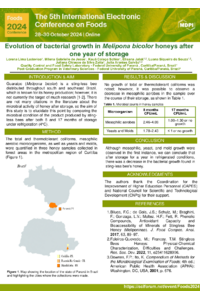
Guaraipo (Melipona bicolor) is a sting-less bee distributed throughout south and southeast Brazil, which is known for its honey production; however, it is not currently the target of much research. There are not many citations in the literature about the microbial activity of honey after storage, so the aim of this study is to elucidate this point by comparing the microbial condition of the product produced by sting-less bees after both 8 and 17 months of storage under refrigeration (4°C). With that in mind, the total and thermotolerant coliforms, mesophilic aerobic microorganisms, as well as yeasts and molds, were quantified in three honey samples collected in forest areas in the metropolitan region of Curitiba. No growth of total or thermotolerant coliforms was noted; however, it was possible to observe a decrease in mesophilic aerobes in the sample over the course of their storage. In the sample stored for 8 months, the counts were between 2.46 and 4.08 log CFU/mL; in the sample stored for ayear, these values were between 1 and 1.30 log CFU/mL or even no growth of mesophiles was observed. In addition, no growth of yeasts and molds was observed in the samples from 17 months of storage, with ≤ 1 log CFU/mL, unlike the samples stored for 8 months, which previously had both yeasts and molds, with counts ranging from 1.78 to 2.43 log CFU/mL. Although mesophilic, yeast, and mold growth were observed in the first instnace, we can conclude that after storage for a year in refrigerated conditions, there was a decrease in the bacterial growth found in sting-less bee's honey.
Keywords
Storage
Total coliforms
Thermotolerant coliforms
Guaraipo
Mesophiles
Poster
poster_lorena.pdf
Fatty acid profile and proximate composition of nuts grown in the Cuyo Region, Argentina
STRUCTURAL CHARACTERIZATION AND QUALITY EVALUATION OF CHAPATHI (INDIAN FLAT BREAD) WITH ENCAPSULATED FOLIC ACID