Event submissions
Published
This submission belongs to the session S2. Food Nutrition and Functional Foods of the event The 5th International Electronic Conference on Foods
Published date
25 Oct, 2024
Academic Editor
'%3e%3cpath%20d='M12.6657%2010.9104C12.4185%2010.325%2012.0599%209.79327%2011.6097%209.34482C11.1609%208.89508%2010.6293%208.5365%2010.0442%208.28888C10.0389%208.28626%2010.0337%208.28495%2010.0285%208.28233C10.8446%207.69279%2011.3752%206.73249%2011.3752%205.64904C11.3752%203.8542%209.92103%202.39999%208.1262%202.39999C6.33136%202.39999%204.87715%203.8542%204.87715%205.64904C4.87715%206.73249%205.40774%207.69279%206.22393%208.28364C6.21869%208.28626%206.21345%208.28757%206.20821%208.29019C5.62129%208.5378%205.09463%208.89284%204.64265%209.34613C4.1929%209.79493%203.83432%2010.3266%203.58671%2010.9117C3.34345%2011.4845%203.21226%2012.0987%203.20023%2012.7209C3.19988%2012.7349%203.20233%2012.7488%203.20744%2012.7619C3.21255%2012.7749%203.22022%2012.7867%203.22998%2012.7968C3.23975%2012.8068%203.25142%2012.8147%203.26431%2012.8202C3.2772%2012.8256%203.29105%2012.8284%203.30504%2012.8284H4.09109C4.14874%2012.8284%204.19459%2012.7825%204.1959%2012.7262C4.2221%2011.7148%204.62823%2010.7676%205.34617%2010.0497C6.08899%209.30683%207.0755%208.89808%208.1262%208.89808C9.17689%208.89808%2010.1634%209.30683%2010.9062%2010.0497C11.6242%2010.7676%2012.0303%2011.7148%2012.0565%2012.7262C12.0578%2012.7838%2012.1037%2012.8284%2012.1613%2012.8284H12.9474C12.9613%2012.8284%2012.9752%2012.8256%2012.9881%2012.8202C13.001%2012.8147%2013.0126%2012.8068%2013.0224%2012.7968C13.0322%2012.7867%2013.0398%2012.7749%2013.0449%2012.7619C13.0501%2012.7488%2013.0525%2012.7349%2013.0522%2012.7209C13.0391%2012.0947%2012.9094%2011.4855%2012.6657%2010.9104ZM8.1262%207.9024C7.52486%207.9024%206.9589%207.6679%206.53312%207.24211C6.10733%206.81633%205.87283%206.25037%205.87283%205.64904C5.87283%205.0477%206.10733%204.48174%206.53312%204.05596C6.9589%203.63018%207.52486%203.39567%208.1262%203.39567C8.72753%203.39567%209.29349%203.63018%209.71927%204.05596C10.1451%204.48174%2010.3796%205.0477%2010.3796%205.64904C10.3796%206.25037%2010.1451%206.81633%209.71927%207.24211C9.29349%207.6679%208.72753%207.9024%208.1262%207.9024Z'%20fill='%235D1EE1'/%3e%3c/g%3e%3c/svg%3e) Antonello Santini
Antonello SantiniCitation
Víctor Gutiérrez González, Gisela Gerardi, Marta Sendra, Pilar Muñiz, Mónica Cavia-Saiz, White wine pomace mitigates hypoxia in 3D SH-SY5Y model, in Proceedings of The 5th International Electronic Conference on Foods, 28 October–30 October 2024, MDPI: Basel, Switzerland
Share
Email
Facebook
Twitter
LinkedIn
White wine pomace mitigates hypoxia in 3D SH-SY5Y model
'%3e%3cpath%20d='M12.6647%2010.9104C12.4176%2010.325%2012.0589%209.7933%2011.6088%209.34485C11.16%208.89511%2010.6283%208.53653%2010.0432%208.28891C10.038%208.28629%2010.0327%208.28498%2010.0275%208.28236C10.8437%207.69282%2011.3743%206.73252%2011.3743%205.64907C11.3743%203.85423%209.92005%202.40002%208.12522%202.40002C6.33038%202.40002%204.87618%203.85423%204.87618%205.64907C4.87618%206.73252%205.40677%207.69282%206.22296%208.28367C6.21772%208.28629%206.21248%208.2876%206.20724%208.29022C5.62031%208.53783%205.09365%208.89287%204.64167%209.34616C4.19192%209.79496%203.83334%2010.3266%203.58573%2010.9117C3.34247%2011.4846%203.21128%2012.0987%203.19925%2012.721C3.1989%2012.735%203.20135%2012.7489%203.20646%2012.7619C3.21157%2012.7749%203.21924%2012.7868%203.22901%2012.7968C3.23877%2012.8068%203.25045%2012.8148%203.26334%2012.8202C3.27623%2012.8256%203.29007%2012.8284%203.30406%2012.8284H4.09012C4.14776%2012.8284%204.19362%2012.7825%204.19493%2012.7262C4.22113%2011.7148%204.62726%2010.7676%205.34519%2010.0497C6.08802%209.30686%207.07452%208.89811%208.12522%208.89811C9.17592%208.89811%2010.1624%209.30686%2010.9052%2010.0497C11.6232%2010.7676%2012.0293%2011.7148%2012.0555%2012.7262C12.0568%2012.7839%2012.1027%2012.8284%2012.1603%2012.8284H12.9464C12.9604%2012.8284%2012.9742%2012.8256%2012.9871%2012.8202C13%2012.8148%2013.0117%2012.8068%2013.0214%2012.7968C13.0312%2012.7868%2013.0389%2012.7749%2013.044%2012.7619C13.0491%2012.7489%2013.0515%2012.735%2013.0512%2012.721C13.0381%2012.0947%2012.9084%2011.4856%2012.6647%2010.9104ZM8.12522%207.90243C7.52388%207.90243%206.95792%207.66793%206.53214%207.24215C6.10636%206.81636%205.87185%206.2504%205.87185%205.64907C5.87185%205.04773%206.10636%204.48177%206.53214%204.05599C6.95792%203.63021%207.52388%203.3957%208.12522%203.3957C8.72655%203.3957%209.29252%203.63021%209.7183%204.05599C10.1441%204.48177%2010.3786%205.04773%2010.3786%205.64907C10.3786%206.2504%2010.1441%206.81636%209.7183%207.24215C9.29252%207.66793%208.72655%207.90243%208.12522%207.90243Z'%20fill='%235D1EE1'/%3e%3c/g%3e%3c/svg%3e)
Víctor Gutiérrez González 1
Gisela Gerardi 1
Marta Sendra 1
Pilar Muñiz 1
Mónica Cavia-Saiz 1
1. Department of Food Biotechnology and Science, Faculty of Sciences, University of Burgos, Plaza Misael Bañuelos, 09001 Burgos, Spain
Abstract
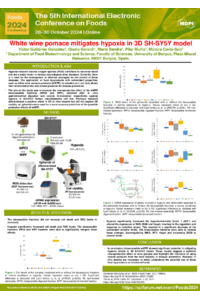
Hypoxia-induced reactive oxygen species (ROS) contribute to neuronal death and are a major factor in various neurodegenerative diseases. Currently, there is a need for the development of effective strategies for the control of these diseases. The application of food by-products with antioxidant properties, such as white pomace products (wWPPs), is valuable as it not only allows their revalorization but also shows potential for disease prevention.
The objective of this study was to evaluate the neuroprotective effect of bioaccessible wWPPs against hypoxia in SH-SY5Y human neuroblastoma cell line (ATCC-CRL2266™). Previous research demonstrated a positive effect in 2D in vitro models but did not explore 3D models. As a key innovation in this study, a 3D spheroid model was used, as it more closely mimics in vivo conditions. The cells were treated with 1.5 μg GAE/mL of bioaccessible wWPP and then subjected to hypoxia induced by CoCl2. Cell viability, ROS levels, and gene expression were evaluated.
Hypoxia significantly increased hypoxia-inducible factor (HIF1) gene expression, cell death, and ROS levels, while the pretreatment with bioaccessible wWPP mitigated these effects. Hypoxia also altered the mRNA expression of nuclear factor-like 2 (Nrf2), nuclear factor κB (NF-kB), and Nrf2 inhibitor (Keap1), resulting in increased NF-kB and Keap1 expression and decreased Nrf2 levels. Bioaccessible wWPP fractions were able to reverse these changes, regulating the mRNA expression to control levels and upregulating antioxidant enzymes like superoxide dismutase 2.
In conclusion, bioaccessible wWPPs showed significant potential in mitigating hypoxia effects in a 3D SH-SY5Y model. These results suggest a potential neuroprotective effect of wine pomace and highlight the relevance of using natural products from the food industry in disease prevention. However, in vivo studies are necessary to better understand the potential use of these food by-products as functional foods.
The authors thank to MICIU and ERDF (Project PGC2018-097113-B-I00).
Keywords
SH-SY5Y
hypoxia
wine pomace
Poster
Póster IECF 2024 - Víctor Gutiérrez González.pdf
STRUCTURAL CHARACTERIZATION AND QUALITY EVALUATION OF CHAPATHI (INDIAN FLAT BREAD) WITH ENCAPSULATED FOLIC ACID
DEVELOPING A FUNCTIONAL FOOD FROM BEER BAGASSE WITH ADDED PROBIOTICS FROM DEHYDRATED KEFIR GRANULES