Event submissions
Published
This submission belongs to the session S8. Food Quality and Safety of the event The 5th International Electronic Conference on Foods
Published date
25 Oct, 2024
Academic Editor
'%3e%3cpath%20d='M12.6657%2010.9104C12.4185%2010.325%2012.0599%209.79327%2011.6097%209.34482C11.1609%208.89508%2010.6293%208.5365%2010.0442%208.28888C10.0389%208.28626%2010.0337%208.28495%2010.0285%208.28233C10.8446%207.69279%2011.3752%206.73249%2011.3752%205.64904C11.3752%203.8542%209.92103%202.39999%208.1262%202.39999C6.33136%202.39999%204.87715%203.8542%204.87715%205.64904C4.87715%206.73249%205.40774%207.69279%206.22393%208.28364C6.21869%208.28626%206.21345%208.28757%206.20821%208.29019C5.62129%208.5378%205.09463%208.89284%204.64265%209.34613C4.1929%209.79493%203.83432%2010.3266%203.58671%2010.9117C3.34345%2011.4845%203.21226%2012.0987%203.20023%2012.7209C3.19988%2012.7349%203.20233%2012.7488%203.20744%2012.7619C3.21255%2012.7749%203.22022%2012.7867%203.22998%2012.7968C3.23975%2012.8068%203.25142%2012.8147%203.26431%2012.8202C3.2772%2012.8256%203.29105%2012.8284%203.30504%2012.8284H4.09109C4.14874%2012.8284%204.19459%2012.7825%204.1959%2012.7262C4.2221%2011.7148%204.62823%2010.7676%205.34617%2010.0497C6.08899%209.30683%207.0755%208.89808%208.1262%208.89808C9.17689%208.89808%2010.1634%209.30683%2010.9062%2010.0497C11.6242%2010.7676%2012.0303%2011.7148%2012.0565%2012.7262C12.0578%2012.7838%2012.1037%2012.8284%2012.1613%2012.8284H12.9474C12.9613%2012.8284%2012.9752%2012.8256%2012.9881%2012.8202C13.001%2012.8147%2013.0126%2012.8068%2013.0224%2012.7968C13.0322%2012.7867%2013.0398%2012.7749%2013.0449%2012.7619C13.0501%2012.7488%2013.0525%2012.7349%2013.0522%2012.7209C13.0391%2012.0947%2012.9094%2011.4855%2012.6657%2010.9104ZM8.1262%207.9024C7.52486%207.9024%206.9589%207.6679%206.53312%207.24211C6.10733%206.81633%205.87283%206.25037%205.87283%205.64904C5.87283%205.0477%206.10733%204.48174%206.53312%204.05596C6.9589%203.63018%207.52486%203.39567%208.1262%203.39567C8.72753%203.39567%209.29349%203.63018%209.71927%204.05596C10.1451%204.48174%2010.3796%205.0477%2010.3796%205.64904C10.3796%206.25037%2010.1451%206.81633%209.71927%207.24211C9.29349%207.6679%208.72753%207.9024%208.1262%207.9024Z'%20fill='%235D1EE1'/%3e%3c/g%3e%3c/svg%3e) Antonello Santini
Antonello SantiniCitation
Ewa Ostrowska-Ligȩza, Jakub Kacperski, Magdalena Wirkowska-Wojdyła, Rita Brzezińska, Iga Piasecka, Agata Górska, Assessment of thermal properties of hull-less pumpkin seeds using differential scanning calorimetry, in Proceedings of The 5th International Electronic Conference on Foods, 28 October–30 October 2024, MDPI: Basel, Switzerland
Share
Email
Facebook
Twitter
LinkedIn
Assessment of thermal properties of hull-less pumpkin seeds using differential scanning calorimetry

Ewa Ostrowska-Ligȩza 1
'%3e%3cpath%20d='M12.6647%2010.9104C12.4176%2010.325%2012.0589%209.7933%2011.6088%209.34485C11.16%208.89511%2010.6283%208.53653%2010.0432%208.28891C10.038%208.28629%2010.0327%208.28498%2010.0275%208.28236C10.8437%207.69282%2011.3743%206.73252%2011.3743%205.64907C11.3743%203.85423%209.92005%202.40002%208.12522%202.40002C6.33038%202.40002%204.87618%203.85423%204.87618%205.64907C4.87618%206.73252%205.40677%207.69282%206.22296%208.28367C6.21772%208.28629%206.21248%208.2876%206.20724%208.29022C5.62031%208.53783%205.09365%208.89287%204.64167%209.34616C4.19192%209.79496%203.83334%2010.3266%203.58573%2010.9117C3.34247%2011.4846%203.21128%2012.0987%203.19925%2012.721C3.1989%2012.735%203.20135%2012.7489%203.20646%2012.7619C3.21157%2012.7749%203.21924%2012.7868%203.22901%2012.7968C3.23877%2012.8068%203.25045%2012.8148%203.26334%2012.8202C3.27623%2012.8256%203.29007%2012.8284%203.30406%2012.8284H4.09012C4.14776%2012.8284%204.19362%2012.7825%204.19493%2012.7262C4.22113%2011.7148%204.62726%2010.7676%205.34519%2010.0497C6.08802%209.30686%207.07452%208.89811%208.12522%208.89811C9.17592%208.89811%2010.1624%209.30686%2010.9052%2010.0497C11.6232%2010.7676%2012.0293%2011.7148%2012.0555%2012.7262C12.0568%2012.7839%2012.1027%2012.8284%2012.1603%2012.8284H12.9464C12.9604%2012.8284%2012.9742%2012.8256%2012.9871%2012.8202C13%2012.8148%2013.0117%2012.8068%2013.0214%2012.7968C13.0312%2012.7868%2013.0389%2012.7749%2013.044%2012.7619C13.0491%2012.7489%2013.0515%2012.735%2013.0512%2012.721C13.0381%2012.0947%2012.9084%2011.4856%2012.6647%2010.9104ZM8.12522%207.90243C7.52388%207.90243%206.95792%207.66793%206.53214%207.24215C6.10636%206.81636%205.87185%206.2504%205.87185%205.64907C5.87185%205.04773%206.10636%204.48177%206.53214%204.05599C6.95792%203.63021%207.52388%203.3957%208.12522%203.3957C8.72655%203.3957%209.29252%203.63021%209.7183%204.05599C10.1441%204.48177%2010.3786%205.04773%2010.3786%205.64907C10.3786%206.2504%2010.1441%206.81636%209.7183%207.24215C9.29252%207.66793%208.72655%207.90243%208.12522%207.90243Z'%20fill='%235D1EE1'/%3e%3c/g%3e%3c/svg%3e)
Jakub Kacperski 2

Magdalena Wirkowska-Wojdyła 2
Rita Brzezińska 2
Iga Piasecka 2

Agata Górska 2
1. Department of Chemistry, Institute of Food Sciences, Warsaw University of Life Sciences
2. Department of Chemistry, Institute of Food Sciences, Warsaw University of Life Sciences (WULS – SGGW), Nowoursynowska st. 166, 02-787 Warsaw, Poland
Abstract
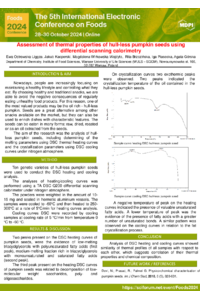
Today, people are focusing on maintaining a healthy lifestyle and controlling what they eat. By choosing healthy snacks, we are able to avoid the negative consequences of regularly eating unhealthy food. For this reason, one of the most valued products may be the oil-rich hull-less pumpkin. Seeds are a great alternative to the snacks available on the market, but they can also be used to enrich dishes with characteristic features. These seeds can be eaten raw, dried, roasted or as an oil extracted from the seeds. The aim of this research was the analysis of hull-less pumpkin seeds, including the determination of theirmelting parameters using DSC thermal heating curves, and the crystallization parameters, using DSC cooling curves. Ten genetic varieties of hull-less pumpkin seeds were used to conduct the DSC heating and cooling analysis. Two peaks present on the DSC heating curves of seeds providedevidence of low-melting triacyclglycerols with polyunsaturated fatty acids (first peak), and a medium-melting fraction rich in triacyclglycerols with monounsaturated and saturated fatty acids (second peak). The third peak present on the heating DSC curves of pumpkin seeds was related to the decomposition of low-molecular weight saccharides and poly- and oligosaccharides. On crystallization curves, two exothermic peaks were observed. Two peaks indicated the crystallization temperature of the oil contained in the hull-less pumpkin seeds. A negative temperature of the peak on the heating curves indicated the presence of valuable unsaturated fatty acids. A lower peak temperature was evidence of the presence of fatty acids, with a greater number of unsaturated bonds. A similar pattern was observed for the cooling curves in relation to the fat crystallization process. An analysis of DSC heating and cooling curves showed the similarity of the thermal profiles of all of the samples with respect to each other, which suggestes a correlation between their thermal properties and chemical composition.
Keywords
hull-less pumpkin
differential scanning calorimetry
Poster
3089.pdf
DEVELOPING A FUNCTIONAL FOOD FROM BEER BAGASSE WITH ADDED PROBIOTICS FROM DEHYDRATED KEFIR GRANULES
INFLUENCE OF FERMENTATION PATTERN ON AROMA COMPOUNDS IN LEGUME SPREADS