Event submissions
Published
This submission belongs to the session S6. Emerging Methods of Food Analysis of the event The 5th International Electronic Conference on Foods
Published date
25 Oct, 2024
Academic Editor
'%3e%3cpath%20d='M12.6657%2010.9104C12.4185%2010.325%2012.0599%209.79327%2011.6097%209.34482C11.1609%208.89508%2010.6293%208.5365%2010.0442%208.28888C10.0389%208.28626%2010.0337%208.28495%2010.0285%208.28233C10.8446%207.69279%2011.3752%206.73249%2011.3752%205.64904C11.3752%203.8542%209.92103%202.39999%208.1262%202.39999C6.33136%202.39999%204.87715%203.8542%204.87715%205.64904C4.87715%206.73249%205.40774%207.69279%206.22393%208.28364C6.21869%208.28626%206.21345%208.28757%206.20821%208.29019C5.62129%208.5378%205.09463%208.89284%204.64265%209.34613C4.1929%209.79493%203.83432%2010.3266%203.58671%2010.9117C3.34345%2011.4845%203.21226%2012.0987%203.20023%2012.7209C3.19988%2012.7349%203.20233%2012.7488%203.20744%2012.7619C3.21255%2012.7749%203.22022%2012.7867%203.22998%2012.7968C3.23975%2012.8068%203.25142%2012.8147%203.26431%2012.8202C3.2772%2012.8256%203.29105%2012.8284%203.30504%2012.8284H4.09109C4.14874%2012.8284%204.19459%2012.7825%204.1959%2012.7262C4.2221%2011.7148%204.62823%2010.7676%205.34617%2010.0497C6.08899%209.30683%207.0755%208.89808%208.1262%208.89808C9.17689%208.89808%2010.1634%209.30683%2010.9062%2010.0497C11.6242%2010.7676%2012.0303%2011.7148%2012.0565%2012.7262C12.0578%2012.7838%2012.1037%2012.8284%2012.1613%2012.8284H12.9474C12.9613%2012.8284%2012.9752%2012.8256%2012.9881%2012.8202C13.001%2012.8147%2013.0126%2012.8068%2013.0224%2012.7968C13.0322%2012.7867%2013.0398%2012.7749%2013.0449%2012.7619C13.0501%2012.7488%2013.0525%2012.7349%2013.0522%2012.7209C13.0391%2012.0947%2012.9094%2011.4855%2012.6657%2010.9104ZM8.1262%207.9024C7.52486%207.9024%206.9589%207.6679%206.53312%207.24211C6.10733%206.81633%205.87283%206.25037%205.87283%205.64904C5.87283%205.0477%206.10733%204.48174%206.53312%204.05596C6.9589%203.63018%207.52486%203.39567%208.1262%203.39567C8.72753%203.39567%209.29349%203.63018%209.71927%204.05596C10.1451%204.48174%2010.3796%205.0477%2010.3796%205.64904C10.3796%206.25037%2010.1451%206.81633%209.71927%207.24211C9.29349%207.6679%208.72753%207.9024%208.1262%207.9024Z'%20fill='%235D1EE1'/%3e%3c/g%3e%3c/svg%3e) Susana Casal
Susana CasalCitation
Danica Mostoles, Sònia Sentellas, Javier Saurina, Oscar Nuñez, Potential of HPLC-UV fingerprints to assess honey geographical production region, in Proceedings of The 5th International Electronic Conference on Foods, 28 October–30 October 2024, MDPI: Basel, Switzerland
Share
Email
Facebook
Twitter
LinkedIn
Potential of HPLC-UV fingerprints to assess honey geographical production region
'%3e%3cpath%20d='M12.6647%2010.9104C12.4176%2010.325%2012.0589%209.7933%2011.6088%209.34485C11.16%208.89511%2010.6283%208.53653%2010.0432%208.28891C10.038%208.28629%2010.0327%208.28498%2010.0275%208.28236C10.8437%207.69282%2011.3743%206.73252%2011.3743%205.64907C11.3743%203.85423%209.92005%202.40002%208.12522%202.40002C6.33038%202.40002%204.87618%203.85423%204.87618%205.64907C4.87618%206.73252%205.40677%207.69282%206.22296%208.28367C6.21772%208.28629%206.21248%208.2876%206.20724%208.29022C5.62031%208.53783%205.09365%208.89287%204.64167%209.34616C4.19192%209.79496%203.83334%2010.3266%203.58573%2010.9117C3.34247%2011.4846%203.21128%2012.0987%203.19925%2012.721C3.1989%2012.735%203.20135%2012.7489%203.20646%2012.7619C3.21157%2012.7749%203.21924%2012.7868%203.22901%2012.7968C3.23877%2012.8068%203.25045%2012.8148%203.26334%2012.8202C3.27623%2012.8256%203.29007%2012.8284%203.30406%2012.8284H4.09012C4.14776%2012.8284%204.19362%2012.7825%204.19493%2012.7262C4.22113%2011.7148%204.62726%2010.7676%205.34519%2010.0497C6.08802%209.30686%207.07452%208.89811%208.12522%208.89811C9.17592%208.89811%2010.1624%209.30686%2010.9052%2010.0497C11.6232%2010.7676%2012.0293%2011.7148%2012.0555%2012.7262C12.0568%2012.7839%2012.1027%2012.8284%2012.1603%2012.8284H12.9464C12.9604%2012.8284%2012.9742%2012.8256%2012.9871%2012.8202C13%2012.8148%2013.0117%2012.8068%2013.0214%2012.7968C13.0312%2012.7868%2013.0389%2012.7749%2013.044%2012.7619C13.0491%2012.7489%2013.0515%2012.735%2013.0512%2012.721C13.0381%2012.0947%2012.9084%2011.4856%2012.6647%2010.9104ZM8.12522%207.90243C7.52388%207.90243%206.95792%207.66793%206.53214%207.24215C6.10636%206.81636%205.87185%206.2504%205.87185%205.64907C5.87185%205.04773%206.10636%204.48177%206.53214%204.05599C6.95792%203.63021%207.52388%203.3957%208.12522%203.3957C8.72655%203.3957%209.29252%203.63021%209.7183%204.05599C10.1441%204.48177%2010.3786%205.04773%2010.3786%205.64907C10.3786%206.2504%2010.1441%206.81636%209.7183%207.24215C9.29252%207.66793%208.72655%207.90243%208.12522%207.90243Z'%20fill='%235D1EE1'/%3e%3c/g%3e%3c/svg%3e)
Danica Mostoles 1

Sònia Sentellas 1,2,3

Javier Saurina 1,2

Oscar Nuñez 1,2,3
1. Department of Chemical Engineering and Analytical Chemistry, University of Barcelona, Martí i Franquès 1-11, E08028 Barcelona, Spain.
2. Research Institute in Food Nutrition and Food Safety, University of Barcelona, Santa Coloma de Gramenet, Barcelona, Spain
3. Serra Húnter Lecturer, Generalitat de Catalunya, 08007 Barcelona, Spain
Abstract
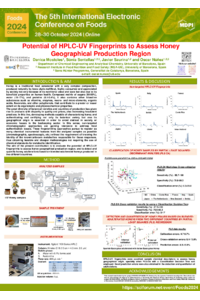
Honey is a natural product, highly appreciated by society as a natural sweetener and for its important health benefits. It isproduced by bees from nectar and other non-floral secretions. The great diversity of botanical varieties and the various countries of production have given rise to products with disparities in quality and prices, while also increasing fraudulent practices. In this line, developing methods capable of characterizing honey and authenticating and certifying not only its botanical variety but also its geographical origin is essential in order to avoid distrust within society or economic losses in the beekeeping sector.
The potential to use HPLC-UV fingerprints to assess honey geographical production regions via chemometrics was evaluated. One hundred and fifty-seven honey samples produced in different countries (Spain, Italy, France, The Netherlands, Serbia, Japan, China, Costa Rica, and New Zeeland) were analyzed after simple sample treatment (1 g of honey dissolved in 10 mL of water and diluted in a ratio of 1:1 with methanol). Reversed-phase C18 HPLC-UV (at 280 nm) fingerprints showed that there were chemical descriptors with which to assess honey geographical production region via partial least squares-discriminant analysis (PLS-DA). Results obtained via PLS-DA classification based on a decision tree showed cross-validation calibration sensitivity and specificity values of 100% (except for Japanese samples, 76.5%) and > 81.3%, respectively; prediction sensitivity and specificity values of 100% (except for French samples, 75%) and >82.4%, respectively; and calibration and prediction errors below 18.0% and 12.5%, respectively. The obtained fingerprints were also evaluated for the detection and quantitation of honey adulterations via partial least squares (PLS) regression based on blended adulterated honey produced in two different countries (adulteration levels from 15 to 85%). Calibration and prediction errors below 15% were achieved. Thus, HPLC-UV fingerprinting is a simple, cost-effective, and reliable classification technique with which to authenticate honey and to prevent fraudulent practices involving blended honey from different production regions.
Keywords
Honey authentication
HPLC-UV Fingerprinting
Geographical production region
Authentication
Poster
Poster Foods2024_HPLC-UV honey_ONuñez.pdf
Impact of COVID-19 Pandemic on Food Security in Selected Households of Mataasnakahoy, Batangas, Philippines
Health-promoting Effects of Goji Berries (Lycium barbarum): a Literature Overview