Event submissions
Published
This submission belongs to the session S8. Food Quality and Safety of the event The 5th International Electronic Conference on Foods
Published date
25 Oct, 2024
Academic Editor
'%3e%3cpath%20d='M12.6657%2010.9104C12.4185%2010.325%2012.0599%209.79327%2011.6097%209.34482C11.1609%208.89508%2010.6293%208.5365%2010.0442%208.28888C10.0389%208.28626%2010.0337%208.28495%2010.0285%208.28233C10.8446%207.69279%2011.3752%206.73249%2011.3752%205.64904C11.3752%203.8542%209.92103%202.39999%208.1262%202.39999C6.33136%202.39999%204.87715%203.8542%204.87715%205.64904C4.87715%206.73249%205.40774%207.69279%206.22393%208.28364C6.21869%208.28626%206.21345%208.28757%206.20821%208.29019C5.62129%208.5378%205.09463%208.89284%204.64265%209.34613C4.1929%209.79493%203.83432%2010.3266%203.58671%2010.9117C3.34345%2011.4845%203.21226%2012.0987%203.20023%2012.7209C3.19988%2012.7349%203.20233%2012.7488%203.20744%2012.7619C3.21255%2012.7749%203.22022%2012.7867%203.22998%2012.7968C3.23975%2012.8068%203.25142%2012.8147%203.26431%2012.8202C3.2772%2012.8256%203.29105%2012.8284%203.30504%2012.8284H4.09109C4.14874%2012.8284%204.19459%2012.7825%204.1959%2012.7262C4.2221%2011.7148%204.62823%2010.7676%205.34617%2010.0497C6.08899%209.30683%207.0755%208.89808%208.1262%208.89808C9.17689%208.89808%2010.1634%209.30683%2010.9062%2010.0497C11.6242%2010.7676%2012.0303%2011.7148%2012.0565%2012.7262C12.0578%2012.7838%2012.1037%2012.8284%2012.1613%2012.8284H12.9474C12.9613%2012.8284%2012.9752%2012.8256%2012.9881%2012.8202C13.001%2012.8147%2013.0126%2012.8068%2013.0224%2012.7968C13.0322%2012.7867%2013.0398%2012.7749%2013.0449%2012.7619C13.0501%2012.7488%2013.0525%2012.7349%2013.0522%2012.7209C13.0391%2012.0947%2012.9094%2011.4855%2012.6657%2010.9104ZM8.1262%207.9024C7.52486%207.9024%206.9589%207.6679%206.53312%207.24211C6.10733%206.81633%205.87283%206.25037%205.87283%205.64904C5.87283%205.0477%206.10733%204.48174%206.53312%204.05596C6.9589%203.63018%207.52486%203.39567%208.1262%203.39567C8.72753%203.39567%209.29349%203.63018%209.71927%204.05596C10.1451%204.48174%2010.3796%205.0477%2010.3796%205.64904C10.3796%206.25037%2010.1451%206.81633%209.71927%207.24211C9.29349%207.6679%208.72753%207.9024%208.1262%207.9024Z'%20fill='%235D1EE1'/%3e%3c/g%3e%3c/svg%3e) Antonello Santini
Antonello SantiniCitation
Marta Mesias, Francisco J Morales, Acrylamide-forming capacity of different flours in heated glucose/flour systems, in Proceedings of The 5th International Electronic Conference on Foods, 28 October–30 October 2024, MDPI: Basel, Switzerland
Share
Email
Facebook
Twitter
LinkedIn
Acrylamide-forming capacity of different flours in heated glucose/flour systems

Marta Mesias 1

Francisco J Morales 1
1. Institute of Food Science, Technology and Nutrition (ICTAN-CSIC), José Antonio Nováis 6, Madrid 28040, Spain
Abstract
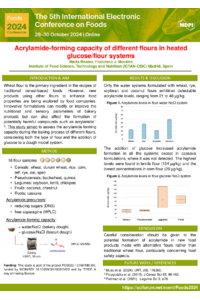
Wheat flour is typically the primary ingredient in the recipes of traditional cereal-based foods. However, food companies are increasingly exploring the development of new products, using alternative ingredients to enhance food properties. Although substituting wheat with other flours can modify or even improve the nutritional content and sensory attributes of the final baked goods, this substitution can also influence the formation of potentially harmful compounds, such as acrylamide. The objective of this study was to assess acrylamide-forming capacity during the baking process of various flours commonly used in the food industry, considering both the type of flour and the addition of glucose to a dough model system. Sixteen flour samples from cereals, pseudocereals, legumes, fruits, and roots were characterized based on their content of acrylamide precursors (reducing sugars and free asparagine) and their acrylamide-forming capacity. The samples were mixed with water/sodium chloride and glucose/sodium chloride to mimic the conditions of bakery dough and biscuit dough, respectively. They were then baked at 150ºC for 30 minutes in a forced air convection oven. Acrylamide levels were analyzed using HPLC-ESI-QQQ-MS/MS. Only the water systems formulated with wheat, coconut, rye, and soy flours exhibited detectable acrylamide levels, ranging from 21 to 48 µg/kg. The addition of glucose increased acrylamide formation in all the systems, except in cassava formulations, where it as not detected. The highest levels were found in lentil flour (154 µg/kg), while the lowest concentrations were observed in corn flour (20 µg/kg). In conclusion, careful consideration should be given to the potential formation of acrylamide in new food products made with alternative flours rather than traditional wheat flour, particularly aspects of concerning food safety.
Keywords
acrylamide
flour
cereal-based foods
baking
risk
Poster
3052.pdf
Drying kinetics of apple pomace by-product using refractance window
Strategic approaches for reducing toxic components in plum kernels (Prunus domestica L.): A sustainable valorization approach