Event submissions
Published
This submission belongs to the session S3. Sustainable Food Security and Food System of the event The 5th International Electronic Conference on Foods
Published date
25 Oct, 2024
Academic Editor
'%3e%3cpath%20d='M12.6657%2010.9104C12.4185%2010.325%2012.0599%209.79327%2011.6097%209.34482C11.1609%208.89508%2010.6293%208.5365%2010.0442%208.28888C10.0389%208.28626%2010.0337%208.28495%2010.0285%208.28233C10.8446%207.69279%2011.3752%206.73249%2011.3752%205.64904C11.3752%203.8542%209.92103%202.39999%208.1262%202.39999C6.33136%202.39999%204.87715%203.8542%204.87715%205.64904C4.87715%206.73249%205.40774%207.69279%206.22393%208.28364C6.21869%208.28626%206.21345%208.28757%206.20821%208.29019C5.62129%208.5378%205.09463%208.89284%204.64265%209.34613C4.1929%209.79493%203.83432%2010.3266%203.58671%2010.9117C3.34345%2011.4845%203.21226%2012.0987%203.20023%2012.7209C3.19988%2012.7349%203.20233%2012.7488%203.20744%2012.7619C3.21255%2012.7749%203.22022%2012.7867%203.22998%2012.7968C3.23975%2012.8068%203.25142%2012.8147%203.26431%2012.8202C3.2772%2012.8256%203.29105%2012.8284%203.30504%2012.8284H4.09109C4.14874%2012.8284%204.19459%2012.7825%204.1959%2012.7262C4.2221%2011.7148%204.62823%2010.7676%205.34617%2010.0497C6.08899%209.30683%207.0755%208.89808%208.1262%208.89808C9.17689%208.89808%2010.1634%209.30683%2010.9062%2010.0497C11.6242%2010.7676%2012.0303%2011.7148%2012.0565%2012.7262C12.0578%2012.7838%2012.1037%2012.8284%2012.1613%2012.8284H12.9474C12.9613%2012.8284%2012.9752%2012.8256%2012.9881%2012.8202C13.001%2012.8147%2013.0126%2012.8068%2013.0224%2012.7968C13.0322%2012.7867%2013.0398%2012.7749%2013.0449%2012.7619C13.0501%2012.7488%2013.0525%2012.7349%2013.0522%2012.7209C13.0391%2012.0947%2012.9094%2011.4855%2012.6657%2010.9104ZM8.1262%207.9024C7.52486%207.9024%206.9589%207.6679%206.53312%207.24211C6.10733%206.81633%205.87283%206.25037%205.87283%205.64904C5.87283%205.0477%206.10733%204.48174%206.53312%204.05596C6.9589%203.63018%207.52486%203.39567%208.1262%203.39567C8.72753%203.39567%209.29349%203.63018%209.71927%204.05596C10.1451%204.48174%2010.3796%205.0477%2010.3796%205.64904C10.3796%206.25037%2010.1451%206.81633%209.71927%207.24211C9.29349%207.6679%208.72753%207.9024%208.1262%207.9024Z'%20fill='%235D1EE1'/%3e%3c/g%3e%3c/svg%3e) Theodoros Varzakas
Theodoros VarzakasCitation
Mohd Aaqib Sheikh, Strategic approaches for reducing toxic components in plum kernels (Prunus domestica L.): A sustainable valorization approach, in Proceedings of The 5th International Electronic Conference on Foods, 28 October–30 October 2024, MDPI: Basel, Switzerland
Share
Email
Facebook
Twitter
LinkedIn
Strategic approaches for reducing toxic components in plum kernels (Prunus domestica L.): A sustainable valorization approach

Mohd Aaqib Sheikh 1
1. Department of Food Process Engineering, National Institute of Technology, Rourkela (769008), Odisha, India
Abstract
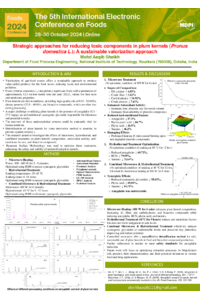
In the current scenario, transforming agricultural by-products into high-value commodities is essential for preserving the environment. Plums are globally renowned for their flavor, juiciness, and nutritional value. Despite being widely popular, substantial quantities of plum kernels, rich in oils (45.95–50%) and proteins (35.9–40.0%), are underutilized due to the presence of toxic compounds like amygdalin (range 0.1–17.5 mg/g). Therefore, detoxification becomes a crucial step to mitigate the risks associated with cyanide toxicity. This study employed a response surface methodology to optimize hydrothermal treatment conditions to reduce amygdalin levels. Despite the significant reduction of 68.72 %, none of the treatment conditions reduced amygdalin to below the allowed limits. On the contrary, microwave heating at 540 W for 6 min also showed a considerable reduction of 67.90% in amygdalin but not within the permissible limits, and the prolonged heating caused burning spots on the samples. However, a combined approach involving microwave heating at 450 W for 6 minutes and hydrothermal treatment at 45 °C for 10 hours reduced the amygdalin levels to undetectable levels. These detoxified samples exhibited significant quantities of high-quality dietary proteins (32.09 %), crude fat (45.14%), crude fibre (4.16%), total ash (2.16%), carbohydrates (7.19%), and bioactive compounds, representing valuable resources for human nutrition and food industry applications. Isolated proteins from detoxified plum kernel meal displayed notable antioxidative properties alongside their nutritional and functional attributes, making them attractive ingredients for various product formulations. The purity, yield, and solubility of protein isolate from detoxified plum kernel meal at a pH of 10.5 were 90.49 %, 26.45 %, and 66.36 %, respectively. The protein isolate was rich in essential amino acids. This study underscores the potential of detoxified plum kernels as a sustainable source of essential nutrients and functional additives, contributing to advancing Sustainable Development Goals through innovative agricultural revalorization practices.
Keywords
Plum kernels
waste management
detoxification
amygdalin
protein isolate
Poster
Poster (Foods).pdf
Acrylamide-forming capacity of different flours in heated glucose/flour systems
Investigation of ESBL-Producing Escherichia coli Presence, Antibiotic Resistance and Biofilm Production Ability in Chicken Meat in Istanbul