Event submissions
Published
This submission belongs to the session S4. Food Microbiology of the event The 5th International Electronic Conference on Foods
Published date
25 Oct, 2024
Academic Editor
'%3e%3cpath%20d='M12.6657%2010.9104C12.4185%2010.325%2012.0599%209.79327%2011.6097%209.34482C11.1609%208.89508%2010.6293%208.5365%2010.0442%208.28888C10.0389%208.28626%2010.0337%208.28495%2010.0285%208.28233C10.8446%207.69279%2011.3752%206.73249%2011.3752%205.64904C11.3752%203.8542%209.92103%202.39999%208.1262%202.39999C6.33136%202.39999%204.87715%203.8542%204.87715%205.64904C4.87715%206.73249%205.40774%207.69279%206.22393%208.28364C6.21869%208.28626%206.21345%208.28757%206.20821%208.29019C5.62129%208.5378%205.09463%208.89284%204.64265%209.34613C4.1929%209.79493%203.83432%2010.3266%203.58671%2010.9117C3.34345%2011.4845%203.21226%2012.0987%203.20023%2012.7209C3.19988%2012.7349%203.20233%2012.7488%203.20744%2012.7619C3.21255%2012.7749%203.22022%2012.7867%203.22998%2012.7968C3.23975%2012.8068%203.25142%2012.8147%203.26431%2012.8202C3.2772%2012.8256%203.29105%2012.8284%203.30504%2012.8284H4.09109C4.14874%2012.8284%204.19459%2012.7825%204.1959%2012.7262C4.2221%2011.7148%204.62823%2010.7676%205.34617%2010.0497C6.08899%209.30683%207.0755%208.89808%208.1262%208.89808C9.17689%208.89808%2010.1634%209.30683%2010.9062%2010.0497C11.6242%2010.7676%2012.0303%2011.7148%2012.0565%2012.7262C12.0578%2012.7838%2012.1037%2012.8284%2012.1613%2012.8284H12.9474C12.9613%2012.8284%2012.9752%2012.8256%2012.9881%2012.8202C13.001%2012.8147%2013.0126%2012.8068%2013.0224%2012.7968C13.0322%2012.7867%2013.0398%2012.7749%2013.0449%2012.7619C13.0501%2012.7488%2013.0525%2012.7349%2013.0522%2012.7209C13.0391%2012.0947%2012.9094%2011.4855%2012.6657%2010.9104ZM8.1262%207.9024C7.52486%207.9024%206.9589%207.6679%206.53312%207.24211C6.10733%206.81633%205.87283%206.25037%205.87283%205.64904C5.87283%205.0477%206.10733%204.48174%206.53312%204.05596C6.9589%203.63018%207.52486%203.39567%208.1262%203.39567C8.72753%203.39567%209.29349%203.63018%209.71927%204.05596C10.1451%204.48174%2010.3796%205.0477%2010.3796%205.64904C10.3796%206.25037%2010.1451%206.81633%209.71927%207.24211C9.29349%207.6679%208.72753%207.9024%208.1262%207.9024Z'%20fill='%235D1EE1'/%3e%3c/g%3e%3c/svg%3e) Antonio Bevilacqua
Antonio BevilacquaCitation
Ali Aydin, Ali Anıl Süleymanoğlu, Abzal Abdramanov, Peter Paulsen, Emek Dümen, Investigation of ESBL-Producing Escherichia coli Presence, Antibiotic Resistance and Biofilm Production Ability in Chicken Meat in Istanbul, in Proceedings of The 5th International Electronic Conference on Foods, 28 October–30 October 2024, MDPI: Basel, Switzerland
Share
Email
Facebook
Twitter
LinkedIn
Investigation of ESBL-Producing Escherichia coli Presence, Antibiotic Resistance and Biofilm Production Ability in Chicken Meat in Istanbul
'%3e%3cpath%20d='M12.6647%2010.9104C12.4176%2010.325%2012.0589%209.7933%2011.6088%209.34485C11.16%208.89511%2010.6283%208.53653%2010.0432%208.28891C10.038%208.28629%2010.0327%208.28498%2010.0275%208.28236C10.8437%207.69282%2011.3743%206.73252%2011.3743%205.64907C11.3743%203.85423%209.92005%202.40002%208.12522%202.40002C6.33038%202.40002%204.87618%203.85423%204.87618%205.64907C4.87618%206.73252%205.40677%207.69282%206.22296%208.28367C6.21772%208.28629%206.21248%208.2876%206.20724%208.29022C5.62031%208.53783%205.09365%208.89287%204.64167%209.34616C4.19192%209.79496%203.83334%2010.3266%203.58573%2010.9117C3.34247%2011.4846%203.21128%2012.0987%203.19925%2012.721C3.1989%2012.735%203.20135%2012.7489%203.20646%2012.7619C3.21157%2012.7749%203.21924%2012.7868%203.22901%2012.7968C3.23877%2012.8068%203.25045%2012.8148%203.26334%2012.8202C3.27623%2012.8256%203.29007%2012.8284%203.30406%2012.8284H4.09012C4.14776%2012.8284%204.19362%2012.7825%204.19493%2012.7262C4.22113%2011.7148%204.62726%2010.7676%205.34519%2010.0497C6.08802%209.30686%207.07452%208.89811%208.12522%208.89811C9.17592%208.89811%2010.1624%209.30686%2010.9052%2010.0497C11.6232%2010.7676%2012.0293%2011.7148%2012.0555%2012.7262C12.0568%2012.7839%2012.1027%2012.8284%2012.1603%2012.8284H12.9464C12.9604%2012.8284%2012.9742%2012.8256%2012.9871%2012.8202C13%2012.8148%2013.0117%2012.8068%2013.0214%2012.7968C13.0312%2012.7868%2013.0389%2012.7749%2013.044%2012.7619C13.0491%2012.7489%2013.0515%2012.735%2013.0512%2012.721C13.0381%2012.0947%2012.9084%2011.4856%2012.6647%2010.9104ZM8.12522%207.90243C7.52388%207.90243%206.95792%207.66793%206.53214%207.24215C6.10636%206.81636%205.87185%206.2504%205.87185%205.64907C5.87185%205.04773%206.10636%204.48177%206.53214%204.05599C6.95792%203.63021%207.52388%203.3957%208.12522%203.3957C8.72655%203.3957%209.29252%203.63021%209.7183%204.05599C10.1441%204.48177%2010.3786%205.04773%2010.3786%205.64907C10.3786%206.2504%2010.1441%206.81636%209.7183%207.24215C9.29252%207.66793%208.72655%207.90243%208.12522%207.90243Z'%20fill='%235D1EE1'/%3e%3c/g%3e%3c/svg%3e)
Ali Aydin 1

Ali Anıl Süleymanoğlu 1
Abzal Abdramanov 2
Peter Paulsen 3
Emek Dümen 1
1. Department of Food Hygiene and Technology, Faculty of Veterinary Medicine, ˙Istanbul University-Cerrahpasa, 34320 Istanbul, Türkiye
2. Department of Veterinary Sanitary Examination and Hygiene, Kazakh National Agrarian Research University, 050010 Almaty, Kazakhstan;
3. Unit for Food Hygiene and Technology, Centre for Food Science and Veterinary Public Health, Clinical Department for Farm Animals and Food System Science, University of Veterinary Medicine Vienna, 1210 Vienna, Austria
Abstract
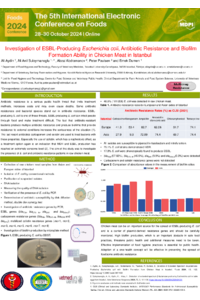
Multiple-drug resistance (MDR) complicates the treatment of E. coli infections. Food is an important carrier for the spread and infection of MDR E. coli. Extended-spectrum ß-lactamase-producing E. coli is included in the list of priority pathogens to be considered in 2024 published by WHO. In this study, the presence of ESBL-producing E. coli, antibiotic resistance patterns and biofilm production capacity were measured in raw chicken meat obtained from Istanbul (n=208). 48.5% (101/208) E. coli isolates were detected via PCR and multiple antibiotic resistance was detected in 79.2% of E. coli isolates. The highest resistance was observed against amoxicillin clavulanic acid, ampicillin and tetracycline. In addition, all isolates were susceptible to piperacillin-tazobactam. In total, 17.8% of E. coli isolates were found to produce phenotypically ESBL. ESBL genes were investigated via the mPCR method; blaTEM (97.02%), blaCTX- M (45.5%), blaSHV (9.9%) and blaOXA-2 (0.9%) were observed. In the study, 34% of E. coli isolates were resistant to carbapenem, as observed via disc diffusion. Carbapenem resistance genes (blaVIM, blaOXA-48, blaNDM and blaKPC) were analyzed via mPCR, and no related genes were found. The PCR method was used to investigate colistin resistance, and the mcr-1, mcr-2, mcr-3, mcr-4, mcr-4, mcr-5, mcr-6, mcr-7, and mcr-8 genes were not observed. The biofilm production capacity of the isolates was measured using the microplate method on Tryptone Soya broth (TSB) containing 1% sucrose, TSB containing 0.6% yeast extract, brain heart infusion broth, nutrient broth and LB broth. The highest biofilm production was detected in TSB with 1% sucrose at a rate of 43.5%. E. coli isolates producing multiple-antibiotic resistance and biofilms through foods threaten public health, and this study highlights the significance of food safety.
Keywords
Escherichia coli
extended spectrum ß-lactamase
carbapenem resistance
chicken meat
multiple antibiotic resistance
Poster
Investigation of ESBL-Producing Escherichia coli, Antibiotic Resistance and Biofilm Formation Ability in Chicken Meat in Istanbul.pdf
Strategic approaches for reducing toxic components in plum kernels (Prunus domestica L.): A sustainable valorization approach
Influence of simulated in vitro gastrointestinal digestion on phytochemical contents and biological activities of date by-product extract (Phoenix dactylifera L.)