Event submissions
Published
This submission belongs to the session S2. Food Nutrition and Functional Foods of the event The 5th International Electronic Conference on Foods
Published date
25 Oct, 2024
Academic Editor
'%3e%3cpath%20d='M12.6657%2010.9104C12.4185%2010.325%2012.0599%209.79327%2011.6097%209.34482C11.1609%208.89508%2010.6293%208.5365%2010.0442%208.28888C10.0389%208.28626%2010.0337%208.28495%2010.0285%208.28233C10.8446%207.69279%2011.3752%206.73249%2011.3752%205.64904C11.3752%203.8542%209.92103%202.39999%208.1262%202.39999C6.33136%202.39999%204.87715%203.8542%204.87715%205.64904C4.87715%206.73249%205.40774%207.69279%206.22393%208.28364C6.21869%208.28626%206.21345%208.28757%206.20821%208.29019C5.62129%208.5378%205.09463%208.89284%204.64265%209.34613C4.1929%209.79493%203.83432%2010.3266%203.58671%2010.9117C3.34345%2011.4845%203.21226%2012.0987%203.20023%2012.7209C3.19988%2012.7349%203.20233%2012.7488%203.20744%2012.7619C3.21255%2012.7749%203.22022%2012.7867%203.22998%2012.7968C3.23975%2012.8068%203.25142%2012.8147%203.26431%2012.8202C3.2772%2012.8256%203.29105%2012.8284%203.30504%2012.8284H4.09109C4.14874%2012.8284%204.19459%2012.7825%204.1959%2012.7262C4.2221%2011.7148%204.62823%2010.7676%205.34617%2010.0497C6.08899%209.30683%207.0755%208.89808%208.1262%208.89808C9.17689%208.89808%2010.1634%209.30683%2010.9062%2010.0497C11.6242%2010.7676%2012.0303%2011.7148%2012.0565%2012.7262C12.0578%2012.7838%2012.1037%2012.8284%2012.1613%2012.8284H12.9474C12.9613%2012.8284%2012.9752%2012.8256%2012.9881%2012.8202C13.001%2012.8147%2013.0126%2012.8068%2013.0224%2012.7968C13.0322%2012.7867%2013.0398%2012.7749%2013.0449%2012.7619C13.0501%2012.7488%2013.0525%2012.7349%2013.0522%2012.7209C13.0391%2012.0947%2012.9094%2011.4855%2012.6657%2010.9104ZM8.1262%207.9024C7.52486%207.9024%206.9589%207.6679%206.53312%207.24211C6.10733%206.81633%205.87283%206.25037%205.87283%205.64904C5.87283%205.0477%206.10733%204.48174%206.53312%204.05596C6.9589%203.63018%207.52486%203.39567%208.1262%203.39567C8.72753%203.39567%209.29349%203.63018%209.71927%204.05596C10.1451%204.48174%2010.3796%205.0477%2010.3796%205.64904C10.3796%206.25037%2010.1451%206.81633%209.71927%207.24211C9.29349%207.6679%208.72753%207.9024%208.1262%207.9024Z'%20fill='%235D1EE1'/%3e%3c/g%3e%3c/svg%3e) Antonello Santini
Antonello SantiniCitation
Ouarda DJAOUDENE, Inês Mansinhos, Sandra Gonçalves, M. José Jara-Palacios, Mostapha Bachir bey, Anabela Romano, Influence of simulated in vitro gastrointestinal digestion on phytochemical contents and biological activities of date by-product extract (Phoenix dactylifera L.), in Proceedings of The 5th International Electronic Conference on Foods, 28 October–30 October 2024, MDPI: Basel, Switzerland
Share
Email
Facebook
Twitter
LinkedIn
Influence of simulated in vitro gastrointestinal digestion on phytochemical contents and biological activities of date by-product extract (Phoenix dactylifera L.)
'%3e%3cpath%20d='M12.6647%2010.9104C12.4176%2010.325%2012.0589%209.7933%2011.6088%209.34485C11.16%208.89511%2010.6283%208.53653%2010.0432%208.28891C10.038%208.28629%2010.0327%208.28498%2010.0275%208.28236C10.8437%207.69282%2011.3743%206.73252%2011.3743%205.64907C11.3743%203.85423%209.92005%202.40002%208.12522%202.40002C6.33038%202.40002%204.87618%203.85423%204.87618%205.64907C4.87618%206.73252%205.40677%207.69282%206.22296%208.28367C6.21772%208.28629%206.21248%208.2876%206.20724%208.29022C5.62031%208.53783%205.09365%208.89287%204.64167%209.34616C4.19192%209.79496%203.83334%2010.3266%203.58573%2010.9117C3.34247%2011.4846%203.21128%2012.0987%203.19925%2012.721C3.1989%2012.735%203.20135%2012.7489%203.20646%2012.7619C3.21157%2012.7749%203.21924%2012.7868%203.22901%2012.7968C3.23877%2012.8068%203.25045%2012.8148%203.26334%2012.8202C3.27623%2012.8256%203.29007%2012.8284%203.30406%2012.8284H4.09012C4.14776%2012.8284%204.19362%2012.7825%204.19493%2012.7262C4.22113%2011.7148%204.62726%2010.7676%205.34519%2010.0497C6.08802%209.30686%207.07452%208.89811%208.12522%208.89811C9.17592%208.89811%2010.1624%209.30686%2010.9052%2010.0497C11.6232%2010.7676%2012.0293%2011.7148%2012.0555%2012.7262C12.0568%2012.7839%2012.1027%2012.8284%2012.1603%2012.8284H12.9464C12.9604%2012.8284%2012.9742%2012.8256%2012.9871%2012.8202C13%2012.8148%2013.0117%2012.8068%2013.0214%2012.7968C13.0312%2012.7868%2013.0389%2012.7749%2013.044%2012.7619C13.0491%2012.7489%2013.0515%2012.735%2013.0512%2012.721C13.0381%2012.0947%2012.9084%2011.4856%2012.6647%2010.9104ZM8.12522%207.90243C7.52388%207.90243%206.95792%207.66793%206.53214%207.24215C6.10636%206.81636%205.87185%206.2504%205.87185%205.64907C5.87185%205.04773%206.10636%204.48177%206.53214%204.05599C6.95792%203.63021%207.52388%203.3957%208.12522%203.3957C8.72655%203.3957%209.29252%203.63021%209.7183%204.05599C10.1441%204.48177%2010.3786%205.04773%2010.3786%205.64907C10.3786%206.2504%2010.1441%206.81636%209.7183%207.24215C9.29252%207.66793%208.72655%207.90243%208.12522%207.90243Z'%20fill='%235D1EE1'/%3e%3c/g%3e%3c/svg%3e)
Ouarda DJAOUDENE 1

Inês Mansinhos 2
Sandra Gonçalves 2

M. José Jara-Palacios 3
Mostapha Bachir bey 4
Anabela Romano 2
1. Centre de Recherche en Technologies Agroalimentaires
2. MED – Mediterranean Institute for Agriculture, Environment and Development & CHANGE – Global Change and Sustainability Institute, Universidade do Algarve, Faculdade de Ciências e Tecnologia, Campus de Gambelas, Ed. 8, 8005‑139 Faro, Portugal
3. Department of Analytical Chemistry, Facultad de Farmacia, Universidad de Sevilla, 41012 Sevilla, Spain
4. Département des Sciences Alimentaires, Laboratoire de Biochimie Appliquée, Faculté des Sciences de la Nature et de la Vie, Université de Bejaia, 06000, Bejaia, Algérie
Abstract
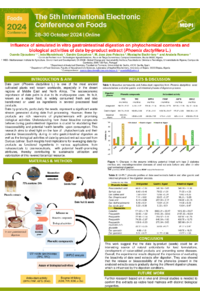
The fruit of the date palm, Phoenix dactylifera L., is an essential raw material for a multitude of industries. The processing of date fruit results in the generation of a considerable quantity of seeds. Due to their abundance in high-added-value bioactive compounds, they have the potential to be exploited to make functional foods, food supplements, cosmetics, and pharmacology. The objective of this research was to assess the effect of in vitro digestion on the stability of the phytochemical composition and biological activities, as well as on the release of individual phenolics from date seed extracts of the Ourous cultivar. The total phenolic (TPC) and flavonoid (TFC) contents, the antioxidant capacity (ABTS, ORAC, FRAP, and DPPH), and the enzyme inhibitory potential against acetylcholinesterase, butyrylcholinesterase, tyrosinase (TYR), α-glucosidase (α-GLU), and α-amylase of extracts were evaluated before and after each digestion step (gastric and intestinal). Moreover, the release of individual phenolics, including phenolic acids and flavonoids, was quantified throughout the digestion process by UHPLC analysis. The results demonstrated a significant increase in both TPC (298 to 1042 mg GAE/g) and TFC (14 to 160 mg QE/g) after digestion. Furthermore, UHPLC analysis delineated an incremental release of individual phenolics, throughout the digestion process. In vitro digestion also enhanced the scavenging of ABTS (565 to 625 mg TE/g) and peroxyl (354 to 4580 mg TE/g in ORAC assay) radicals, as well as FRAP (978 to 1176 mg AAE/g), but resulted in a reduction in DPPH (578 to 249 mg TE/g) scavenging capacity. The enzyme inhibitory potential of the extracts decreased after digestion, although this was maintained or enhanced for α-GLU (87 to 86 %) and TYR (27 to 35 %), respectively. These findings indicate that the seed extract contains several bioaccessible components, which may enhance its functional attributes.
Keywords
Date cultivar
bioaccessibility
phenolic profile
in vitro gastrointestinal digestion
bioactive compounds
biological activities
Poster
DJAOUDENE O. (digestion).pdf
Investigation of ESBL-Producing Escherichia coli Presence, Antibiotic Resistance and Biofilm Production Ability in Chicken Meat in Istanbul
Robust HPLC determination of synthetic food colorants in alcoholic beverages