Event submissions
Published
This submission belongs to the session S2. Food Nutrition and Functional Foods of the event The 5th International Electronic Conference on Foods
Published date
25 Oct, 2024
Academic Editor
'%3e%3cpath%20d='M12.6657%2010.9104C12.4185%2010.325%2012.0599%209.79327%2011.6097%209.34482C11.1609%208.89508%2010.6293%208.5365%2010.0442%208.28888C10.0389%208.28626%2010.0337%208.28495%2010.0285%208.28233C10.8446%207.69279%2011.3752%206.73249%2011.3752%205.64904C11.3752%203.8542%209.92103%202.39999%208.1262%202.39999C6.33136%202.39999%204.87715%203.8542%204.87715%205.64904C4.87715%206.73249%205.40774%207.69279%206.22393%208.28364C6.21869%208.28626%206.21345%208.28757%206.20821%208.29019C5.62129%208.5378%205.09463%208.89284%204.64265%209.34613C4.1929%209.79493%203.83432%2010.3266%203.58671%2010.9117C3.34345%2011.4845%203.21226%2012.0987%203.20023%2012.7209C3.19988%2012.7349%203.20233%2012.7488%203.20744%2012.7619C3.21255%2012.7749%203.22022%2012.7867%203.22998%2012.7968C3.23975%2012.8068%203.25142%2012.8147%203.26431%2012.8202C3.2772%2012.8256%203.29105%2012.8284%203.30504%2012.8284H4.09109C4.14874%2012.8284%204.19459%2012.7825%204.1959%2012.7262C4.2221%2011.7148%204.62823%2010.7676%205.34617%2010.0497C6.08899%209.30683%207.0755%208.89808%208.1262%208.89808C9.17689%208.89808%2010.1634%209.30683%2010.9062%2010.0497C11.6242%2010.7676%2012.0303%2011.7148%2012.0565%2012.7262C12.0578%2012.7838%2012.1037%2012.8284%2012.1613%2012.8284H12.9474C12.9613%2012.8284%2012.9752%2012.8256%2012.9881%2012.8202C13.001%2012.8147%2013.0126%2012.8068%2013.0224%2012.7968C13.0322%2012.7867%2013.0398%2012.7749%2013.0449%2012.7619C13.0501%2012.7488%2013.0525%2012.7349%2013.0522%2012.7209C13.0391%2012.0947%2012.9094%2011.4855%2012.6657%2010.9104ZM8.1262%207.9024C7.52486%207.9024%206.9589%207.6679%206.53312%207.24211C6.10733%206.81633%205.87283%206.25037%205.87283%205.64904C5.87283%205.0477%206.10733%204.48174%206.53312%204.05596C6.9589%203.63018%207.52486%203.39567%208.1262%203.39567C8.72753%203.39567%209.29349%203.63018%209.71927%204.05596C10.1451%204.48174%2010.3796%205.0477%2010.3796%205.64904C10.3796%206.25037%2010.1451%206.81633%209.71927%207.24211C9.29349%207.6679%208.72753%207.9024%208.1262%207.9024Z'%20fill='%235D1EE1'/%3e%3c/g%3e%3c/svg%3e) Antonello Santini
Antonello SantiniCitation
Madara Samaranayake, Kanchana Abeysekera, Ranjith Mahanama, Ilmi Hewajulige, Sudarshana Somasiri, Jayantha Senanayake, Sirimal Premakumara, Vitamin B contents of widely cultivating new improved rice (Oryza sativa L.) varieties of Sri Lanka, in Proceedings of The 5th International Electronic Conference on Foods, 28 October–30 October 2024, MDPI: Basel, Switzerland
Share
Email
Facebook
Twitter
LinkedIn
Vitamin B contents of widely cultivating new improved rice (Oryza sativa L.) varieties of Sri Lanka
'%3e%3cpath%20d='M12.6647%2010.9104C12.4176%2010.325%2012.0589%209.7933%2011.6088%209.34485C11.16%208.89511%2010.6283%208.53653%2010.0432%208.28891C10.038%208.28629%2010.0327%208.28498%2010.0275%208.28236C10.8437%207.69282%2011.3743%206.73252%2011.3743%205.64907C11.3743%203.85423%209.92005%202.40002%208.12522%202.40002C6.33038%202.40002%204.87618%203.85423%204.87618%205.64907C4.87618%206.73252%205.40677%207.69282%206.22296%208.28367C6.21772%208.28629%206.21248%208.2876%206.20724%208.29022C5.62031%208.53783%205.09365%208.89287%204.64167%209.34616C4.19192%209.79496%203.83334%2010.3266%203.58573%2010.9117C3.34247%2011.4846%203.21128%2012.0987%203.19925%2012.721C3.1989%2012.735%203.20135%2012.7489%203.20646%2012.7619C3.21157%2012.7749%203.21924%2012.7868%203.22901%2012.7968C3.23877%2012.8068%203.25045%2012.8148%203.26334%2012.8202C3.27623%2012.8256%203.29007%2012.8284%203.30406%2012.8284H4.09012C4.14776%2012.8284%204.19362%2012.7825%204.19493%2012.7262C4.22113%2011.7148%204.62726%2010.7676%205.34519%2010.0497C6.08802%209.30686%207.07452%208.89811%208.12522%208.89811C9.17592%208.89811%2010.1624%209.30686%2010.9052%2010.0497C11.6232%2010.7676%2012.0293%2011.7148%2012.0555%2012.7262C12.0568%2012.7839%2012.1027%2012.8284%2012.1603%2012.8284H12.9464C12.9604%2012.8284%2012.9742%2012.8256%2012.9871%2012.8202C13%2012.8148%2013.0117%2012.8068%2013.0214%2012.7968C13.0312%2012.7868%2013.0389%2012.7749%2013.044%2012.7619C13.0491%2012.7489%2013.0515%2012.735%2013.0512%2012.721C13.0381%2012.0947%2012.9084%2011.4856%2012.6647%2010.9104ZM8.12522%207.90243C7.52388%207.90243%206.95792%207.66793%206.53214%207.24215C6.10636%206.81636%205.87185%206.2504%205.87185%205.64907C5.87185%205.04773%206.10636%204.48177%206.53214%204.05599C6.95792%203.63021%207.52388%203.3957%208.12522%203.3957C8.72655%203.3957%209.29252%203.63021%209.7183%204.05599C10.1441%204.48177%2010.3786%205.04773%2010.3786%205.64907C10.3786%206.2504%2010.1441%206.81636%209.7183%207.24215C9.29252%207.66793%208.72655%207.90243%208.12522%207.90243Z'%20fill='%235D1EE1'/%3e%3c/g%3e%3c/svg%3e)
Madara Samaranayake 1
Kanchana Abeysekera 2
Ranjith Mahanama 3
Ilmi Hewajulige 1
Sudarshana Somasiri 1
Jayantha Senanayake 4
Sirimal Premakumara 5
1. Industrial Technology Institute
2. Department of Agricultural Technology, Faculty of Technology, University of Colombo, Sri Lanka.
3. Department of Chemistry, Faculty of Science, University of Colombo, Sri Lanka
4. Rice Research and Development Institute, Batalagoda, Sri Lanka.
5. Department of Basic Science & Social Science, Faculty of Nursing, University of Colombo, Sri Lanka
Abstract
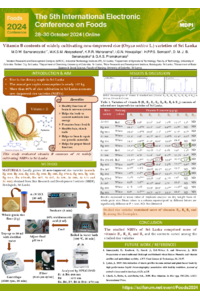
Rice is a good source of vitamin B, which is important for human nutrition and health. In Sri Lanka, rice is the dietary staple and new improved rice varieties (NIRVs) account for more than 90% of rice cultivation in Sri Lanka. However, extremely limited studies are available on the vitamin B contents of NIRVs of Sri Lanka. This study evaluated the vitamin B contents of 16 widely cultivating NIRVs in Sri Lanka. The selected rice varieties (RVs) for the present study were Bg 300, Bg 352, Bg 358, Bg 360, Bg 366, Bg 379-2, Bg 403, Bg 450, Bg 94-1, Bw 272-6b, Bw 367, At 307, At 308, At 309, At 311 and At 362. Vitamin B was extracted from whole-grain rice flour in 0.1N HCL (n=3 each) and analyzed using High-Performance Liquid Chromatography coupled with a Diode-Array Detector (HPLC-DAD). The rResults clearly showed that vitamin B contents significantly (p<0.05) varied among the studied RVs. The vitamin B1, B2, B3, B5, B6, B7 and B9 contents of the tested RVs ranged from 4.3 to 31.9, 0.7 to 4.3, 15.1 to 82.9, 11.1 to 82.5, 5.7 to 13.8, 1.6 to 72.5 and 0.5 to 3.3 µg/g, respectively. The studied RVs contained more of vitamins B1, B3, B5 and B7 among the B-complex. Among the studied RVs, vitamin B1 was significantly high in a red RV, At 311, while white RVs, namely Bg 300, Bg 352 and Bg 450, were significantly high in vitamin B3. Interestingly, both highest vitamin B2 and B7 contents were also observed in Bg 300 RV while a red RV, Bw 272-6b, showed the highest vitamin B5 content. Vitamin B9 was only detected in the At 311, Bg 94-1, At 308, Bg 300, At 362, At 309, Bw 272-6b, Bg 450 and Bg 352 RVs and it was high in the Bg 300, Bg 352 and Bw 272-6b RVs. In conclusion, the studied NIRVs of Sri Lanka contained more of vitamin B1, B3, B5 and B7 and the contents varied among the studied RVs.
Keywords
Vitamin B
New Improved Rice
Red and White Rice
Whole-Grain Rice
Sri Lankan Rice
Poster
Poster presentation -Foods2024 (Madara).pdf
Robust HPLC determination of synthetic food colorants in alcoholic beverages
Valorization of halophyte Mesembryanthemum nodiflorum for nutraceutical application: in vitro digestion and bioaccessibility of phenolic compounds