Event submissions
Published
This submission belongs to the session S1. Innovation in Food Technology and Engineering of the event The 5th International Electronic Conference on Foods
Published date
25 Oct, 2024
Academic Editor
'%3e%3cpath%20d='M12.6657%2010.9104C12.4185%2010.325%2012.0599%209.79327%2011.6097%209.34482C11.1609%208.89508%2010.6293%208.5365%2010.0442%208.28888C10.0389%208.28626%2010.0337%208.28495%2010.0285%208.28233C10.8446%207.69279%2011.3752%206.73249%2011.3752%205.64904C11.3752%203.8542%209.92103%202.39999%208.1262%202.39999C6.33136%202.39999%204.87715%203.8542%204.87715%205.64904C4.87715%206.73249%205.40774%207.69279%206.22393%208.28364C6.21869%208.28626%206.21345%208.28757%206.20821%208.29019C5.62129%208.5378%205.09463%208.89284%204.64265%209.34613C4.1929%209.79493%203.83432%2010.3266%203.58671%2010.9117C3.34345%2011.4845%203.21226%2012.0987%203.20023%2012.7209C3.19988%2012.7349%203.20233%2012.7488%203.20744%2012.7619C3.21255%2012.7749%203.22022%2012.7867%203.22998%2012.7968C3.23975%2012.8068%203.25142%2012.8147%203.26431%2012.8202C3.2772%2012.8256%203.29105%2012.8284%203.30504%2012.8284H4.09109C4.14874%2012.8284%204.19459%2012.7825%204.1959%2012.7262C4.2221%2011.7148%204.62823%2010.7676%205.34617%2010.0497C6.08899%209.30683%207.0755%208.89808%208.1262%208.89808C9.17689%208.89808%2010.1634%209.30683%2010.9062%2010.0497C11.6242%2010.7676%2012.0303%2011.7148%2012.0565%2012.7262C12.0578%2012.7838%2012.1037%2012.8284%2012.1613%2012.8284H12.9474C12.9613%2012.8284%2012.9752%2012.8256%2012.9881%2012.8202C13.001%2012.8147%2013.0126%2012.8068%2013.0224%2012.7968C13.0322%2012.7867%2013.0398%2012.7749%2013.0449%2012.7619C13.0501%2012.7488%2013.0525%2012.7349%2013.0522%2012.7209C13.0391%2012.0947%2012.9094%2011.4855%2012.6657%2010.9104ZM8.1262%207.9024C7.52486%207.9024%206.9589%207.6679%206.53312%207.24211C6.10733%206.81633%205.87283%206.25037%205.87283%205.64904C5.87283%205.0477%206.10733%204.48174%206.53312%204.05596C6.9589%203.63018%207.52486%203.39567%208.1262%203.39567C8.72753%203.39567%209.29349%203.63018%209.71927%204.05596C10.1451%204.48174%2010.3796%205.0477%2010.3796%205.64904C10.3796%206.25037%2010.1451%206.81633%209.71927%207.24211C9.29349%207.6679%208.72753%207.9024%208.1262%207.9024Z'%20fill='%235D1EE1'/%3e%3c/g%3e%3c/svg%3e) Moktar Hamdi
Moktar HamdiCitation
Agne Vasiliauskaite, Elvidas Aleksandrovas, Joana T. Martins, Jorge M. Vieira, Antonio A. Vicente, Mindaugas Malakauskas, Loreta Serniene, The Impact of Lactic Acid Bacteria on Rheological Properties of Whey-Pectin-Based Edible Coatings, in Proceedings of The 5th International Electronic Conference on Foods, 28 October–30 October 2024, MDPI: Basel, Switzerland
Share
Email
Facebook
Twitter
LinkedIn
The Impact of Lactic Acid Bacteria on Rheological Properties of Whey-Pectin-Based Edible Coatings
'%3e%3cpath%20d='M12.6647%2010.9104C12.4176%2010.325%2012.0589%209.7933%2011.6088%209.34485C11.16%208.89511%2010.6283%208.53653%2010.0432%208.28891C10.038%208.28629%2010.0327%208.28498%2010.0275%208.28236C10.8437%207.69282%2011.3743%206.73252%2011.3743%205.64907C11.3743%203.85423%209.92005%202.40002%208.12522%202.40002C6.33038%202.40002%204.87618%203.85423%204.87618%205.64907C4.87618%206.73252%205.40677%207.69282%206.22296%208.28367C6.21772%208.28629%206.21248%208.2876%206.20724%208.29022C5.62031%208.53783%205.09365%208.89287%204.64167%209.34616C4.19192%209.79496%203.83334%2010.3266%203.58573%2010.9117C3.34247%2011.4846%203.21128%2012.0987%203.19925%2012.721C3.1989%2012.735%203.20135%2012.7489%203.20646%2012.7619C3.21157%2012.7749%203.21924%2012.7868%203.22901%2012.7968C3.23877%2012.8068%203.25045%2012.8148%203.26334%2012.8202C3.27623%2012.8256%203.29007%2012.8284%203.30406%2012.8284H4.09012C4.14776%2012.8284%204.19362%2012.7825%204.19493%2012.7262C4.22113%2011.7148%204.62726%2010.7676%205.34519%2010.0497C6.08802%209.30686%207.07452%208.89811%208.12522%208.89811C9.17592%208.89811%2010.1624%209.30686%2010.9052%2010.0497C11.6232%2010.7676%2012.0293%2011.7148%2012.0555%2012.7262C12.0568%2012.7839%2012.1027%2012.8284%2012.1603%2012.8284H12.9464C12.9604%2012.8284%2012.9742%2012.8256%2012.9871%2012.8202C13%2012.8148%2013.0117%2012.8068%2013.0214%2012.7968C13.0312%2012.7868%2013.0389%2012.7749%2013.044%2012.7619C13.0491%2012.7489%2013.0515%2012.735%2013.0512%2012.721C13.0381%2012.0947%2012.9084%2011.4856%2012.6647%2010.9104ZM8.12522%207.90243C7.52388%207.90243%206.95792%207.66793%206.53214%207.24215C6.10636%206.81636%205.87185%206.2504%205.87185%205.64907C5.87185%205.04773%206.10636%204.48177%206.53214%204.05599C6.95792%203.63021%207.52388%203.3957%208.12522%203.3957C8.72655%203.3957%209.29252%203.63021%209.7183%204.05599C10.1441%204.48177%2010.3786%205.04773%2010.3786%205.64907C10.3786%206.2504%2010.1441%206.81636%209.7183%207.24215C9.29252%207.66793%208.72655%207.90243%208.12522%207.90243Z'%20fill='%235D1EE1'/%3e%3c/g%3e%3c/svg%3e)
Agne Vasiliauskaite 1
Elvidas Aleksandrovas 1
Joana T. Martins 2,3
Jorge M. Vieira 2,3
Antonio A. Vicente 2,3

Mindaugas Malakauskas 1

Loreta Serniene 1
1. Lithuanian University of Health Sciences, Veterinary Academy, Department of Food Safety and Quality, Tilzes str. 18, LT-47181 Kaunas, Lithuania
2. Centre of Biological Engineering (CEB), University of Minho, Campus de Gualtar, 4710-057 Braga, Portugal
3. LABBELS – Associate Laboratory, Braga/Guimarães, Portugal
Abstract
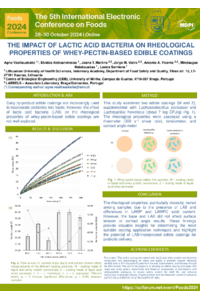
Edible coatings made from dairy by-products have recently become a popular method for incorporating beneficial components, such as probiotics, into food products. However, there is a lack of understanding of how the incorporation of lactic acid bacteria (LAB) effects the rheological properties of whey-pectin-based edible coatings.
In this research, two edible coatings composed of either liquid acid whey protein concentrate (LAWPC) or liquid acid whey permeate (LAWP) were supplemented with Lacticaseibacillus paracasei and Lactobacillus helveticus (approximately 7 log CFU/g). The rheological behavior of these coatings was evaluated using a rheometer (300 s−1 of shear rate), tensiometer, and contact angle meter.
The results revealed that LAWP-based coatings showed the lowest viscosity (average of the samples—20.9 Pa), making them suitable for spraying on the food product' surface and covering it, while the most viscous sample was the LAWPC-based control (44.2 Pa) coating (p < 0.05). This outcome was influenced by the higher solids content of the LAWPC-based coating, making it suitable for product immersion. Notably, the addition of LAB significantly decreased the viscosity of the LAWPC-based samples with encapsulated bacteria (with added L. paracasei—30.6 Pa; with added L. helveticus—27.3 Pa) (p < 0.05). However, the results showed that there were no statistical differences (p > 0.05) between samples in the case of surface tension and contact angle measurement results.
Overall, the rheological properties of the coatings, particularly viscosity, varied among the samples and were influenced by the presence of LAB and the different solid content of LAWP and LAWPC. Despite these variations, the base and LAB did not affect the surface tension and contact angle results. These findings provide valuable information for determining the most suitable technique for applying the coating to product surfaces and highlight the potential of LAB-incorporated edible coatings for delivering probiotics.
Keywords
lactobacilli
secondary dairy raw materials
edible coatings
viscosity
sustainability.
Poster
Vasiliauskaite. The impact of lactic acid bacteria on rheological properties of whey-pectin-based edible coatings.pdf
Valorization of halophyte Mesembryanthemum nodiflorum for nutraceutical application: in vitro digestion and bioaccessibility of phenolic compounds
Drainage kinetics of pulque foams prepared with egg white protein