Event submissions
Published
This submission belongs to the session S2. Food Nutrition and Functional Foods of the event The 5th International Electronic Conference on Foods
Published date
25 Oct, 2024
Academic Editor
'%3e%3cpath%20d='M12.6657%2010.9104C12.4185%2010.325%2012.0599%209.79327%2011.6097%209.34482C11.1609%208.89508%2010.6293%208.5365%2010.0442%208.28888C10.0389%208.28626%2010.0337%208.28495%2010.0285%208.28233C10.8446%207.69279%2011.3752%206.73249%2011.3752%205.64904C11.3752%203.8542%209.92103%202.39999%208.1262%202.39999C6.33136%202.39999%204.87715%203.8542%204.87715%205.64904C4.87715%206.73249%205.40774%207.69279%206.22393%208.28364C6.21869%208.28626%206.21345%208.28757%206.20821%208.29019C5.62129%208.5378%205.09463%208.89284%204.64265%209.34613C4.1929%209.79493%203.83432%2010.3266%203.58671%2010.9117C3.34345%2011.4845%203.21226%2012.0987%203.20023%2012.7209C3.19988%2012.7349%203.20233%2012.7488%203.20744%2012.7619C3.21255%2012.7749%203.22022%2012.7867%203.22998%2012.7968C3.23975%2012.8068%203.25142%2012.8147%203.26431%2012.8202C3.2772%2012.8256%203.29105%2012.8284%203.30504%2012.8284H4.09109C4.14874%2012.8284%204.19459%2012.7825%204.1959%2012.7262C4.2221%2011.7148%204.62823%2010.7676%205.34617%2010.0497C6.08899%209.30683%207.0755%208.89808%208.1262%208.89808C9.17689%208.89808%2010.1634%209.30683%2010.9062%2010.0497C11.6242%2010.7676%2012.0303%2011.7148%2012.0565%2012.7262C12.0578%2012.7838%2012.1037%2012.8284%2012.1613%2012.8284H12.9474C12.9613%2012.8284%2012.9752%2012.8256%2012.9881%2012.8202C13.001%2012.8147%2013.0126%2012.8068%2013.0224%2012.7968C13.0322%2012.7867%2013.0398%2012.7749%2013.0449%2012.7619C13.0501%2012.7488%2013.0525%2012.7349%2013.0522%2012.7209C13.0391%2012.0947%2012.9094%2011.4855%2012.6657%2010.9104ZM8.1262%207.9024C7.52486%207.9024%206.9589%207.6679%206.53312%207.24211C6.10733%206.81633%205.87283%206.25037%205.87283%205.64904C5.87283%205.0477%206.10733%204.48174%206.53312%204.05596C6.9589%203.63018%207.52486%203.39567%208.1262%203.39567C8.72753%203.39567%209.29349%203.63018%209.71927%204.05596C10.1451%204.48174%2010.3796%205.0477%2010.3796%205.64904C10.3796%206.25037%2010.1451%206.81633%209.71927%207.24211C9.29349%207.6679%208.72753%207.9024%208.1262%207.9024Z'%20fill='%235D1EE1'/%3e%3c/g%3e%3c/svg%3e) Antonello Santini
Antonello SantiniCitation
Vânia Mayumi Nakajima, Isabele de Souza Paula Silva, João Pablo Fortes Pereira, Pedro Pereira Rezende Moura, Marcos Vidal Martins, Rafael Arromba Sousa, Expanding sustainable iron sources: analysis of the minerals in Non-Conventional Food Plants, in Proceedings of The 5th International Electronic Conference on Foods, 28 October–30 October 2024, MDPI: Basel, Switzerland
Share
Email
Facebook
Twitter
LinkedIn
Expanding sustainable iron sources: analysis of the minerals in Non-Conventional Food Plants
'%3e%3cpath%20d='M12.6647%2010.9104C12.4176%2010.325%2012.0589%209.7933%2011.6088%209.34485C11.16%208.89511%2010.6283%208.53653%2010.0432%208.28891C10.038%208.28629%2010.0327%208.28498%2010.0275%208.28236C10.8437%207.69282%2011.3743%206.73252%2011.3743%205.64907C11.3743%203.85423%209.92005%202.40002%208.12522%202.40002C6.33038%202.40002%204.87618%203.85423%204.87618%205.64907C4.87618%206.73252%205.40677%207.69282%206.22296%208.28367C6.21772%208.28629%206.21248%208.2876%206.20724%208.29022C5.62031%208.53783%205.09365%208.89287%204.64167%209.34616C4.19192%209.79496%203.83334%2010.3266%203.58573%2010.9117C3.34247%2011.4846%203.21128%2012.0987%203.19925%2012.721C3.1989%2012.735%203.20135%2012.7489%203.20646%2012.7619C3.21157%2012.7749%203.21924%2012.7868%203.22901%2012.7968C3.23877%2012.8068%203.25045%2012.8148%203.26334%2012.8202C3.27623%2012.8256%203.29007%2012.8284%203.30406%2012.8284H4.09012C4.14776%2012.8284%204.19362%2012.7825%204.19493%2012.7262C4.22113%2011.7148%204.62726%2010.7676%205.34519%2010.0497C6.08802%209.30686%207.07452%208.89811%208.12522%208.89811C9.17592%208.89811%2010.1624%209.30686%2010.9052%2010.0497C11.6232%2010.7676%2012.0293%2011.7148%2012.0555%2012.7262C12.0568%2012.7839%2012.1027%2012.8284%2012.1603%2012.8284H12.9464C12.9604%2012.8284%2012.9742%2012.8256%2012.9871%2012.8202C13%2012.8148%2013.0117%2012.8068%2013.0214%2012.7968C13.0312%2012.7868%2013.0389%2012.7749%2013.044%2012.7619C13.0491%2012.7489%2013.0515%2012.735%2013.0512%2012.721C13.0381%2012.0947%2012.9084%2011.4856%2012.6647%2010.9104ZM8.12522%207.90243C7.52388%207.90243%206.95792%207.66793%206.53214%207.24215C6.10636%206.81636%205.87185%206.2504%205.87185%205.64907C5.87185%205.04773%206.10636%204.48177%206.53214%204.05599C6.95792%203.63021%207.52388%203.3957%208.12522%203.3957C8.72655%203.3957%209.29252%203.63021%209.7183%204.05599C10.1441%204.48177%2010.3786%205.04773%2010.3786%205.64907C10.3786%206.2504%2010.1441%206.81636%209.7183%207.24215C9.29252%207.66793%208.72655%207.90243%208.12522%207.90243Z'%20fill='%235D1EE1'/%3e%3c/g%3e%3c/svg%3e)
Vânia Mayumi Nakajima 1,2
Isabele de Souza Paula Silva 3
João Pablo Fortes Pereira 4
Pedro Pereira Rezende Moura 5
Marcos Vidal Martins 1
Rafael Arromba Sousa 6
1. Professor, Nutrition Department, Biological Science Institute, Federal University of Juiz de Fora
2. Post Graduation Program in Nutrition Science, Fluminense Federal University, Niteroi, Rio de Janeiro
3. Student, Nutrition Department, Biological Science Institute, Federal University of Juiz de Fora
4. Research assistant, Nutrition Department, Biological Science Institute, Federal University of Juiz de Fora
5. Student, Chemistry Departament, Sciences Exact Institute, Federal University of Juiz de Fora
6. Professor, Chemistry Departament, Sciences Exact Institute, Federal University of Juiz de Fora
Abstract
Plant sources of iron are often restricted due to the limited variety of plants currently consumed. Knowledge of the iron content in non-conventional food plants can stimulate the consumption of these vegetables, increasing the repertoire of plant foods in the diet, contributing to more sustainable consumption. The aim, therefore, was to analyze the iron and phytate content of five NFCPs and to calculate the phytate–iron ratio to determine which ones might have the best iron bioavailability. The following NCFPs were studied: Amaranthus viridis, Anredera cordifolia, Lactuca canadensis, Pereskia aculeata, Portulaca oleracea, and Stachys byzantine. The leaves were dried in an oven at 70 °C for approximately 70 hours and homogenized in a blender to produce flour. The iron was determined using Flame Atomic Absorption Spectrometry. For phytate, absorbance was read at 517 nm on a spectrophotometer. The analyses were carried out in triplicate and the results are expressed on a wet basis. The plant flours with the highest iron content were Stachys byzantine (72.6 ± 2,3mg/100g) and Anredera cordifolia (20.7 ± 4,0mg/100g). The flours with the best possible bioavailability, assessed by the phytate/iron ratio, were S. byzantine (1.00 ± 0.03) and A. cordifolia (2.90 ± 0,03). The data presented indicate that these plants have a high iron content compared to traditionally consumed vegetable sources, such as kale (0.5mg/100g) and broccoli (0.6mg/100g). Also, these flours can be used in a variety of preparations, and for S. byzantine, even at low concentrations, such as in 10% of a simple cookie recipe, it can already provide in one serving size enough iron to be considered a source of the mineral (at least 1.8mg of iron per serving size). In conclusion, S. byzantine flour stood out in terms of a higher iron content and a higher iron/phytate ratio, being a potential iron source, providing an alternative to complement the nutritional needs of the population.
Keywords
iron content
leafy vegetables
sustainable
Poster
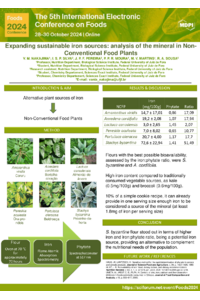
Poster_Foods_Nakajima.pdf
The Effect of Adding Degreased Flax Seeds on the Quality of Pork Sausages
Metagenomic Insights into the Antibiotic Resistome of an Organized Dairy Production System