Event submissions
Published
This submission belongs to the session S3. Sustainable Food Security and Food System of the event The 5th International Electronic Conference on Foods
Published date
25 Oct, 2024
Academic Editor
'%3e%3cpath%20d='M12.6657%2010.9104C12.4185%2010.325%2012.0599%209.79327%2011.6097%209.34482C11.1609%208.89508%2010.6293%208.5365%2010.0442%208.28888C10.0389%208.28626%2010.0337%208.28495%2010.0285%208.28233C10.8446%207.69279%2011.3752%206.73249%2011.3752%205.64904C11.3752%203.8542%209.92103%202.39999%208.1262%202.39999C6.33136%202.39999%204.87715%203.8542%204.87715%205.64904C4.87715%206.73249%205.40774%207.69279%206.22393%208.28364C6.21869%208.28626%206.21345%208.28757%206.20821%208.29019C5.62129%208.5378%205.09463%208.89284%204.64265%209.34613C4.1929%209.79493%203.83432%2010.3266%203.58671%2010.9117C3.34345%2011.4845%203.21226%2012.0987%203.20023%2012.7209C3.19988%2012.7349%203.20233%2012.7488%203.20744%2012.7619C3.21255%2012.7749%203.22022%2012.7867%203.22998%2012.7968C3.23975%2012.8068%203.25142%2012.8147%203.26431%2012.8202C3.2772%2012.8256%203.29105%2012.8284%203.30504%2012.8284H4.09109C4.14874%2012.8284%204.19459%2012.7825%204.1959%2012.7262C4.2221%2011.7148%204.62823%2010.7676%205.34617%2010.0497C6.08899%209.30683%207.0755%208.89808%208.1262%208.89808C9.17689%208.89808%2010.1634%209.30683%2010.9062%2010.0497C11.6242%2010.7676%2012.0303%2011.7148%2012.0565%2012.7262C12.0578%2012.7838%2012.1037%2012.8284%2012.1613%2012.8284H12.9474C12.9613%2012.8284%2012.9752%2012.8256%2012.9881%2012.8202C13.001%2012.8147%2013.0126%2012.8068%2013.0224%2012.7968C13.0322%2012.7867%2013.0398%2012.7749%2013.0449%2012.7619C13.0501%2012.7488%2013.0525%2012.7349%2013.0522%2012.7209C13.0391%2012.0947%2012.9094%2011.4855%2012.6657%2010.9104ZM8.1262%207.9024C7.52486%207.9024%206.9589%207.6679%206.53312%207.24211C6.10733%206.81633%205.87283%206.25037%205.87283%205.64904C5.87283%205.0477%206.10733%204.48174%206.53312%204.05596C6.9589%203.63018%207.52486%203.39567%208.1262%203.39567C8.72753%203.39567%209.29349%203.63018%209.71927%204.05596C10.1451%204.48174%2010.3796%205.0477%2010.3796%205.64904C10.3796%206.25037%2010.1451%206.81633%209.71927%207.24211C9.29349%207.6679%208.72753%207.9024%208.1262%207.9024Z'%20fill='%235D1EE1'/%3e%3c/g%3e%3c/svg%3e) Theodoros Varzakas
Theodoros VarzakasCitation
Monica Rose Amarlapudi, Hemlata Singh, Chandrasekhar Balasubramaniam, Akash Shriram, Atul Kolte, Amit Yadav, Raghu Vishweshwaraiah, Diwas Pradhan, Nishant Kumar, Dhiraj Dhotre, Rashmi Hogarehalli Mallappa, Metagenomic Insights into the Antibiotic Resistome of an Organized Dairy Production System, in Proceedings of The 5th International Electronic Conference on Foods, 28 October–30 October 2024, MDPI: Basel, Switzerland
Share
Email
Facebook
Twitter
LinkedIn
Metagenomic Insights into the Antibiotic Resistome of an Organized Dairy Production System
'%3e%3cpath%20d='M12.6647%2010.9104C12.4176%2010.325%2012.0589%209.7933%2011.6088%209.34485C11.16%208.89511%2010.6283%208.53653%2010.0432%208.28891C10.038%208.28629%2010.0327%208.28498%2010.0275%208.28236C10.8437%207.69282%2011.3743%206.73252%2011.3743%205.64907C11.3743%203.85423%209.92005%202.40002%208.12522%202.40002C6.33038%202.40002%204.87618%203.85423%204.87618%205.64907C4.87618%206.73252%205.40677%207.69282%206.22296%208.28367C6.21772%208.28629%206.21248%208.2876%206.20724%208.29022C5.62031%208.53783%205.09365%208.89287%204.64167%209.34616C4.19192%209.79496%203.83334%2010.3266%203.58573%2010.9117C3.34247%2011.4846%203.21128%2012.0987%203.19925%2012.721C3.1989%2012.735%203.20135%2012.7489%203.20646%2012.7619C3.21157%2012.7749%203.21924%2012.7868%203.22901%2012.7968C3.23877%2012.8068%203.25045%2012.8148%203.26334%2012.8202C3.27623%2012.8256%203.29007%2012.8284%203.30406%2012.8284H4.09012C4.14776%2012.8284%204.19362%2012.7825%204.19493%2012.7262C4.22113%2011.7148%204.62726%2010.7676%205.34519%2010.0497C6.08802%209.30686%207.07452%208.89811%208.12522%208.89811C9.17592%208.89811%2010.1624%209.30686%2010.9052%2010.0497C11.6232%2010.7676%2012.0293%2011.7148%2012.0555%2012.7262C12.0568%2012.7839%2012.1027%2012.8284%2012.1603%2012.8284H12.9464C12.9604%2012.8284%2012.9742%2012.8256%2012.9871%2012.8202C13%2012.8148%2013.0117%2012.8068%2013.0214%2012.7968C13.0312%2012.7868%2013.0389%2012.7749%2013.044%2012.7619C13.0491%2012.7489%2013.0515%2012.735%2013.0512%2012.721C13.0381%2012.0947%2012.9084%2011.4856%2012.6647%2010.9104ZM8.12522%207.90243C7.52388%207.90243%206.95792%207.66793%206.53214%207.24215C6.10636%206.81636%205.87185%206.2504%205.87185%205.64907C5.87185%205.04773%206.10636%204.48177%206.53214%204.05599C6.95792%203.63021%207.52388%203.3957%208.12522%203.3957C8.72655%203.3957%209.29252%203.63021%209.7183%204.05599C10.1441%204.48177%2010.3786%205.04773%2010.3786%205.64907C10.3786%206.2504%2010.1441%206.81636%209.7183%207.24215C9.29252%207.66793%208.72655%207.90243%208.12522%207.90243Z'%20fill='%235D1EE1'/%3e%3c/g%3e%3c/svg%3e)
Monica Rose Amarlapudi 1
Hemlata Singh 1
Chandrasekhar Balasubramaniam 2
Akash Shriram 1
Atul Kolte 3
Amit Yadav 4
Raghu Vishweshwaraiah 1
Diwas Pradhan 1
Nishant Kumar 1
Dhiraj Dhotre 4
Rashmi Hogarehalli Mallappa 5
1. ICAR-National Dairy Research Institute, Karnal, Haryana, 132001
2. Sam Higginbottom University of Agriculture, Technology and Sciences, Allahabad, Uttar Pradesh-211007
3. ICAR-National Institute of Animal Nutrition and Physiology, Bengaluru, Karnataka, 560030
4. National Centre for Cell Science, NCCS Complex, University of Pune Campus, University Road, Ganeshkhind, Pune, Maharashtra-411007
5. South Regional Station, ICAR-National Dairy Research Institute, Bengaluru, Karnataka, 560030.
Abstract
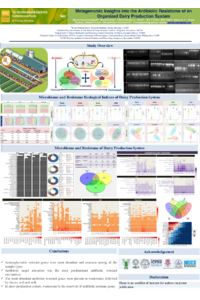
Metagenomics is a powerful approach for detecting antibiotic resistance in microbial communities, allowing for comprehensive analysis of genetic material from all organisms in a sample without the need for culturing. In this study, a metagenomics approach was used to understand the prevalence of antibiotic-resistant genes in various ecosystems within an organized dairy production system. A total of 36 samples of milk, faeces, soil, and wastewater were collected from three different dairy farms. Metagenomic sequencing yielded 275, 281, 348, and 281 million raw reads with data sizes of 200, 206, 243, and 207 GB from milk, faeces, soil, and wastewater, respectively. The majority of reads were mapped against bacterial genomes, revealing a total of 37 bacterial phyla, with the highest diversity in wastewater, followed by faeces, soil, and milk. A higher abundance of the phyla Pseudomonadota, Bacillota, Actinomycetota, and Bacteroidota was observed across the dairy production system. The most abundant genera found in milk, faeces, soil, and wastewater were Clostridium, Bifidobacterium, Janthinobacterium, and Corynebacterium, respectively. Furthermore, the antibiotic resistome analysis using the CARD database revealed a total of 455 distinct antibiotic-resistant genes in the organized dairy production system. These genes belonged to 36 diverse drug classes and were characterized by 12 distinct resistance mechanisms. The antibiotic-resistant genes were highly diverse in wastewater (354), followed by milk (229), faeces (156), and soil (109). Interestingly, the actual abundance of antibiotic-resistant genes was high in wastewater, followed by faeces, soil, and milk. The predominant resistance mechanisms identified included target modification and efflux pumps, with a high occurrence of genes conferring resistance to aminoglycosides and macrolides. This comprehensive metagenomic analysis provides critical insights into the antibiotic resistance landscape, underscoring the importance of ongoing surveillance and intervention strategies. The findings emphasize the urgent need for measures to control antimicrobial resistance and prevent its spread in dairy production systems.
Keywords
Antibiotic resistance
Dairy production system
Metagenomics
Microbiome
Resistome
Poster
sciforum-098579_FOODS 2024 metagenome.pdf
Expanding sustainable iron sources: analysis of the minerals in Non-Conventional Food Plants
Cytoprotective and anti-inflammatory properties of the bioaccessible fractions of encapsulated, HPP-treated mango peel extracts