Event submissions
Published
This submission belongs to the session S2. Food Nutrition and Functional Foods of the event The 5th International Electronic Conference on Foods
Published date
25 Oct, 2024
Academic Editor
'%3e%3cpath%20d='M12.6657%2010.9104C12.4185%2010.325%2012.0599%209.79327%2011.6097%209.34482C11.1609%208.89508%2010.6293%208.5365%2010.0442%208.28888C10.0389%208.28626%2010.0337%208.28495%2010.0285%208.28233C10.8446%207.69279%2011.3752%206.73249%2011.3752%205.64904C11.3752%203.8542%209.92103%202.39999%208.1262%202.39999C6.33136%202.39999%204.87715%203.8542%204.87715%205.64904C4.87715%206.73249%205.40774%207.69279%206.22393%208.28364C6.21869%208.28626%206.21345%208.28757%206.20821%208.29019C5.62129%208.5378%205.09463%208.89284%204.64265%209.34613C4.1929%209.79493%203.83432%2010.3266%203.58671%2010.9117C3.34345%2011.4845%203.21226%2012.0987%203.20023%2012.7209C3.19988%2012.7349%203.20233%2012.7488%203.20744%2012.7619C3.21255%2012.7749%203.22022%2012.7867%203.22998%2012.7968C3.23975%2012.8068%203.25142%2012.8147%203.26431%2012.8202C3.2772%2012.8256%203.29105%2012.8284%203.30504%2012.8284H4.09109C4.14874%2012.8284%204.19459%2012.7825%204.1959%2012.7262C4.2221%2011.7148%204.62823%2010.7676%205.34617%2010.0497C6.08899%209.30683%207.0755%208.89808%208.1262%208.89808C9.17689%208.89808%2010.1634%209.30683%2010.9062%2010.0497C11.6242%2010.7676%2012.0303%2011.7148%2012.0565%2012.7262C12.0578%2012.7838%2012.1037%2012.8284%2012.1613%2012.8284H12.9474C12.9613%2012.8284%2012.9752%2012.8256%2012.9881%2012.8202C13.001%2012.8147%2013.0126%2012.8068%2013.0224%2012.7968C13.0322%2012.7867%2013.0398%2012.7749%2013.0449%2012.7619C13.0501%2012.7488%2013.0525%2012.7349%2013.0522%2012.7209C13.0391%2012.0947%2012.9094%2011.4855%2012.6657%2010.9104ZM8.1262%207.9024C7.52486%207.9024%206.9589%207.6679%206.53312%207.24211C6.10733%206.81633%205.87283%206.25037%205.87283%205.64904C5.87283%205.0477%206.10733%204.48174%206.53312%204.05596C6.9589%203.63018%207.52486%203.39567%208.1262%203.39567C8.72753%203.39567%209.29349%203.63018%209.71927%204.05596C10.1451%204.48174%2010.3796%205.0477%2010.3796%205.64904C10.3796%206.25037%2010.1451%206.81633%209.71927%207.24211C9.29349%207.6679%208.72753%207.9024%208.1262%207.9024Z'%20fill='%235D1EE1'/%3e%3c/g%3e%3c/svg%3e) Antonello Santini
Antonello SantiniCitation
Laura Saez-Escudero, Gracia Patricia Blanch, Maria Luisa Ruiz Del Castillo, Effect of treatment with natural phytoregulators on purple carrots (Daucus carota L.) during storage, in Proceedings of The 5th International Electronic Conference on Foods, 28 October–30 October 2024, MDPI: Basel, Switzerland
Share
Email
Facebook
Twitter
LinkedIn
Effect of treatment with natural phytoregulators on purple carrots (Daucus carota L.) during storage
'%3e%3cpath%20d='M12.6647%2010.9104C12.4176%2010.325%2012.0589%209.7933%2011.6088%209.34485C11.16%208.89511%2010.6283%208.53653%2010.0432%208.28891C10.038%208.28629%2010.0327%208.28498%2010.0275%208.28236C10.8437%207.69282%2011.3743%206.73252%2011.3743%205.64907C11.3743%203.85423%209.92005%202.40002%208.12522%202.40002C6.33038%202.40002%204.87618%203.85423%204.87618%205.64907C4.87618%206.73252%205.40677%207.69282%206.22296%208.28367C6.21772%208.28629%206.21248%208.2876%206.20724%208.29022C5.62031%208.53783%205.09365%208.89287%204.64167%209.34616C4.19192%209.79496%203.83334%2010.3266%203.58573%2010.9117C3.34247%2011.4846%203.21128%2012.0987%203.19925%2012.721C3.1989%2012.735%203.20135%2012.7489%203.20646%2012.7619C3.21157%2012.7749%203.21924%2012.7868%203.22901%2012.7968C3.23877%2012.8068%203.25045%2012.8148%203.26334%2012.8202C3.27623%2012.8256%203.29007%2012.8284%203.30406%2012.8284H4.09012C4.14776%2012.8284%204.19362%2012.7825%204.19493%2012.7262C4.22113%2011.7148%204.62726%2010.7676%205.34519%2010.0497C6.08802%209.30686%207.07452%208.89811%208.12522%208.89811C9.17592%208.89811%2010.1624%209.30686%2010.9052%2010.0497C11.6232%2010.7676%2012.0293%2011.7148%2012.0555%2012.7262C12.0568%2012.7839%2012.1027%2012.8284%2012.1603%2012.8284H12.9464C12.9604%2012.8284%2012.9742%2012.8256%2012.9871%2012.8202C13%2012.8148%2013.0117%2012.8068%2013.0214%2012.7968C13.0312%2012.7868%2013.0389%2012.7749%2013.044%2012.7619C13.0491%2012.7489%2013.0515%2012.735%2013.0512%2012.721C13.0381%2012.0947%2012.9084%2011.4856%2012.6647%2010.9104ZM8.12522%207.90243C7.52388%207.90243%206.95792%207.66793%206.53214%207.24215C6.10636%206.81636%205.87185%206.2504%205.87185%205.64907C5.87185%205.04773%206.10636%204.48177%206.53214%204.05599C6.95792%203.63021%207.52388%203.3957%208.12522%203.3957C8.72655%203.3957%209.29252%203.63021%209.7183%204.05599C10.1441%204.48177%2010.3786%205.04773%2010.3786%205.64907C10.3786%206.2504%2010.1441%206.81636%209.7183%207.24215C9.29252%207.66793%208.72655%207.90243%208.12522%207.90243Z'%20fill='%235D1EE1'/%3e%3c/g%3e%3c/svg%3e)
Laura Saez-Escudero 1
Gracia Patricia Blanch 1
Maria Luisa Ruiz Del Castillo 1
1. INSTITUTO DE CIENCIA Y TECNOLOGIA DE ALIMENTOS Y NUTRICION (ICTAN-CSIC)
Abstract
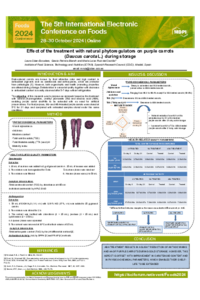
Introduction: Dark-colored carrots are known for their attractive color and high content in antioxidant pigments such as carotenoids and anthocyanins, which protect against pathologies. However, both organoleptic and health-promoting properties are altered during storage. In this respect, deterioration in sensorial quality, together with a decrease in antioxidant content, is usually observed after 5-7 days without refrigeration. The objective of this research was to propose an approach based on natural phytoregulators enabling purple carrot shelf-life to be extended with no need for artificial preservatives.
Methods: Visual appearance, juiciness, moisture content, total soluble solids, acidity and maturity index were measured as quality physicochemical parameters. Total and individual carotenoid contents were determined by absorbance at 485 nm and HPLC-DAD, respectively. Total anthocyanin content was measured by the pH differential method. Antioxidant activity was determined by DPPH and FRAP assays.
Results: Untreated purple carrots, used as a control, exhibited a natural increase in carotenoids over cold storage (three times higher) and an increase in the stability of anthocyanins, but a significant decrease (from 62% to 49%) in the maturity index. Treatment with natural phytoregulators (i.e., methyl jasmonate and abscisic acid) resulted in higher carotenoid content and a considerable improvement in quality parameters (maturity index of 75%). In contrast, anthocyanins and antioxidant activity mostly decreased with the treatments. In particular, a drop from 2.23 mg ECGg−1DW in fresh untreated samples to 0.30 mg ECGg−1DW in ABA-treated samples was measured.
Conclusions: Treatment with methyl jasmonate and abscisic acid enables purple carrot spoilage to be delayed over cold storage. This is reflected in the preservation of visual appearance and maturity index. Considering the commercial importance of these variables, these results are promising. The aim now is to optimize the procedure in such a way that the improvements in quality parameters and carotenoid content attained here are maintained while the partial loss of antioxidant properties is avoided.
Keywords
purple carrot
bioactive compounds
phytoregulators
storage
quality
shelf-life
Poster
POSTER PURPLE CARROTS.pdf
Cytoprotective and anti-inflammatory properties of the bioaccessible fractions of encapsulated, HPP-treated mango peel extracts
Supercritical fluid extraction of bioactive compounds from mango (Mangifera indica L.) by-products