Event submissions
Published
This submission belongs to the session S6. Emerging Methods of Food Analysis of the event The 5th International Electronic Conference on Foods
Published date
25 Oct, 2024
Academic Editor
'%3e%3cpath%20d='M12.6657%2010.9104C12.4185%2010.325%2012.0599%209.79327%2011.6097%209.34482C11.1609%208.89508%2010.6293%208.5365%2010.0442%208.28888C10.0389%208.28626%2010.0337%208.28495%2010.0285%208.28233C10.8446%207.69279%2011.3752%206.73249%2011.3752%205.64904C11.3752%203.8542%209.92103%202.39999%208.1262%202.39999C6.33136%202.39999%204.87715%203.8542%204.87715%205.64904C4.87715%206.73249%205.40774%207.69279%206.22393%208.28364C6.21869%208.28626%206.21345%208.28757%206.20821%208.29019C5.62129%208.5378%205.09463%208.89284%204.64265%209.34613C4.1929%209.79493%203.83432%2010.3266%203.58671%2010.9117C3.34345%2011.4845%203.21226%2012.0987%203.20023%2012.7209C3.19988%2012.7349%203.20233%2012.7488%203.20744%2012.7619C3.21255%2012.7749%203.22022%2012.7867%203.22998%2012.7968C3.23975%2012.8068%203.25142%2012.8147%203.26431%2012.8202C3.2772%2012.8256%203.29105%2012.8284%203.30504%2012.8284H4.09109C4.14874%2012.8284%204.19459%2012.7825%204.1959%2012.7262C4.2221%2011.7148%204.62823%2010.7676%205.34617%2010.0497C6.08899%209.30683%207.0755%208.89808%208.1262%208.89808C9.17689%208.89808%2010.1634%209.30683%2010.9062%2010.0497C11.6242%2010.7676%2012.0303%2011.7148%2012.0565%2012.7262C12.0578%2012.7838%2012.1037%2012.8284%2012.1613%2012.8284H12.9474C12.9613%2012.8284%2012.9752%2012.8256%2012.9881%2012.8202C13.001%2012.8147%2013.0126%2012.8068%2013.0224%2012.7968C13.0322%2012.7867%2013.0398%2012.7749%2013.0449%2012.7619C13.0501%2012.7488%2013.0525%2012.7349%2013.0522%2012.7209C13.0391%2012.0947%2012.9094%2011.4855%2012.6657%2010.9104ZM8.1262%207.9024C7.52486%207.9024%206.9589%207.6679%206.53312%207.24211C6.10733%206.81633%205.87283%206.25037%205.87283%205.64904C5.87283%205.0477%206.10733%204.48174%206.53312%204.05596C6.9589%203.63018%207.52486%203.39567%208.1262%203.39567C8.72753%203.39567%209.29349%203.63018%209.71927%204.05596C10.1451%204.48174%2010.3796%205.0477%2010.3796%205.64904C10.3796%206.25037%2010.1451%206.81633%209.71927%207.24211C9.29349%207.6679%208.72753%207.9024%208.1262%207.9024Z'%20fill='%235D1EE1'/%3e%3c/g%3e%3c/svg%3e) Susana Casal
Susana CasalCitation
Abdul Mueez Ahmad, Hassam Mehmood Sipra, Nimra Tanveer, Nabila Aslam, Ali Hassan, Almas Mustafa, Hafsa Hafsa, Asad Ali, Anas Afzal, Emerging and Advanced Technologies for Halal Food Authentication, in Proceedings of The 5th International Electronic Conference on Foods, 28 October–30 October 2024, MDPI: Basel, Switzerland
Share
Email
Facebook
Twitter
LinkedIn
Emerging and Advanced Technologies for Halal Food Authentication
'%3e%3cpath%20d='M12.6647%2010.9104C12.4176%2010.325%2012.0589%209.7933%2011.6088%209.34485C11.16%208.89511%2010.6283%208.53653%2010.0432%208.28891C10.038%208.28629%2010.0327%208.28498%2010.0275%208.28236C10.8437%207.69282%2011.3743%206.73252%2011.3743%205.64907C11.3743%203.85423%209.92005%202.40002%208.12522%202.40002C6.33038%202.40002%204.87618%203.85423%204.87618%205.64907C4.87618%206.73252%205.40677%207.69282%206.22296%208.28367C6.21772%208.28629%206.21248%208.2876%206.20724%208.29022C5.62031%208.53783%205.09365%208.89287%204.64167%209.34616C4.19192%209.79496%203.83334%2010.3266%203.58573%2010.9117C3.34247%2011.4846%203.21128%2012.0987%203.19925%2012.721C3.1989%2012.735%203.20135%2012.7489%203.20646%2012.7619C3.21157%2012.7749%203.21924%2012.7868%203.22901%2012.7968C3.23877%2012.8068%203.25045%2012.8148%203.26334%2012.8202C3.27623%2012.8256%203.29007%2012.8284%203.30406%2012.8284H4.09012C4.14776%2012.8284%204.19362%2012.7825%204.19493%2012.7262C4.22113%2011.7148%204.62726%2010.7676%205.34519%2010.0497C6.08802%209.30686%207.07452%208.89811%208.12522%208.89811C9.17592%208.89811%2010.1624%209.30686%2010.9052%2010.0497C11.6232%2010.7676%2012.0293%2011.7148%2012.0555%2012.7262C12.0568%2012.7839%2012.1027%2012.8284%2012.1603%2012.8284H12.9464C12.9604%2012.8284%2012.9742%2012.8256%2012.9871%2012.8202C13%2012.8148%2013.0117%2012.8068%2013.0214%2012.7968C13.0312%2012.7868%2013.0389%2012.7749%2013.044%2012.7619C13.0491%2012.7489%2013.0515%2012.735%2013.0512%2012.721C13.0381%2012.0947%2012.9084%2011.4856%2012.6647%2010.9104ZM8.12522%207.90243C7.52388%207.90243%206.95792%207.66793%206.53214%207.24215C6.10636%206.81636%205.87185%206.2504%205.87185%205.64907C5.87185%205.04773%206.10636%204.48177%206.53214%204.05599C6.95792%203.63021%207.52388%203.3957%208.12522%203.3957C8.72655%203.3957%209.29252%203.63021%209.7183%204.05599C10.1441%204.48177%2010.3786%205.04773%2010.3786%205.64907C10.3786%206.2504%2010.1441%206.81636%209.7183%207.24215C9.29252%207.66793%208.72655%207.90243%208.12522%207.90243Z'%20fill='%235D1EE1'/%3e%3c/g%3e%3c/svg%3e)
Abdul Mueez Ahmad 1
Hassam Mehmood Sipra 2
Nimra Tanveer 2
Nabila Aslam 1
Ali Hassan 1
Almas Mustafa 2
Hafsa Hafsa 3
Asad Ali 2
Anas Afzal 2
1. National Institute of Food Science and Technology, University of Agriculture, Faisalabad, Pakistan 38000.
2. National Institute of Food Science and Technology, University of Agriculture, Faisalabad, 38000, Pakistan.
3. Institute of Microbiology, University of Agriculture, Faisalabad, 38000, Pakistan.
Abstract
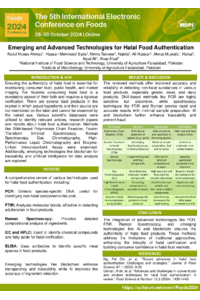
Ensuring food authenticity is crucial for consumer trust, public health and market integrity. For Muslims, consuming halal food is a mandatory aspect of their faith and requires rigorous verification. The global demand for halal food necessitates reliable authentication methods as adulteration and mislabeled ingredients are widespread issues. There are several food products on the market in which actual ingredients and their sources are not mentioned on the label and cannot be observed by the naked eye. Commonly non-halal items include pig derivatives like lard, pork, and gelatin; dead meat derivatives; alcohol; blood; and prohibited animals. Traditional methods, such as sensory evaluation and basic chemical analysis, are often inadequate for modern food production complexities, leading to cross-contamination and mislabeling risks. Therefore, advanced techniques are essential for accurate halal food authentication. Various scientific databases were utilized to identify relevant articles, research papers and reports about halal food authentication. Methods like DNA-based Polymerase Chain Reaction, Fourier-Transform Infrared Spectroscopy, Raman Spectroscopy, Gas Chromatography, High-Performance Liquid Chromatography and Enzyme-Linked Immunosorbent Assay were examined. Additionally, emerging technologies like blockchain for traceability and artificial intelligence for data analysis were explored. These advanced techniques sufficiently enhance the accuracy, reliability and efficiency of halal food authentication, offering precise species identification, detailed compositional analysis and rapid detection of non-halal substances. They address the limitations of traditional methods and support the integrity of halal food products, ensuring they meet Islamic dietary laws. This integration is vital for industry stakeholders, regulators and consumers in upholding halal standards and maintaining consumer confidence. Specific products analyzed include gelatin-based products, meat products and dairy items utilizing DNA sequencing and spectroscopy for verification.
Keywords
Halal food authentication
Food authenticity
DNA-based techniques
Spectroscopy
Emerging technologies
Poster
Poster Halal.pdf
Supercritical fluid extraction of bioactive compounds from mango (Mangifera indica L.) by-products
Soy isoflavones in soy food consumed in republic of serbia