Event submissions
Published
This submission belongs to the session S2. Food Nutrition and Functional Foods of the event The 5th International Electronic Conference on Foods
Published date
25 Oct, 2024
Academic Editor
'%3e%3cpath%20d='M12.6657%2010.9104C12.4185%2010.325%2012.0599%209.79327%2011.6097%209.34482C11.1609%208.89508%2010.6293%208.5365%2010.0442%208.28888C10.0389%208.28626%2010.0337%208.28495%2010.0285%208.28233C10.8446%207.69279%2011.3752%206.73249%2011.3752%205.64904C11.3752%203.8542%209.92103%202.39999%208.1262%202.39999C6.33136%202.39999%204.87715%203.8542%204.87715%205.64904C4.87715%206.73249%205.40774%207.69279%206.22393%208.28364C6.21869%208.28626%206.21345%208.28757%206.20821%208.29019C5.62129%208.5378%205.09463%208.89284%204.64265%209.34613C4.1929%209.79493%203.83432%2010.3266%203.58671%2010.9117C3.34345%2011.4845%203.21226%2012.0987%203.20023%2012.7209C3.19988%2012.7349%203.20233%2012.7488%203.20744%2012.7619C3.21255%2012.7749%203.22022%2012.7867%203.22998%2012.7968C3.23975%2012.8068%203.25142%2012.8147%203.26431%2012.8202C3.2772%2012.8256%203.29105%2012.8284%203.30504%2012.8284H4.09109C4.14874%2012.8284%204.19459%2012.7825%204.1959%2012.7262C4.2221%2011.7148%204.62823%2010.7676%205.34617%2010.0497C6.08899%209.30683%207.0755%208.89808%208.1262%208.89808C9.17689%208.89808%2010.1634%209.30683%2010.9062%2010.0497C11.6242%2010.7676%2012.0303%2011.7148%2012.0565%2012.7262C12.0578%2012.7838%2012.1037%2012.8284%2012.1613%2012.8284H12.9474C12.9613%2012.8284%2012.9752%2012.8256%2012.9881%2012.8202C13.001%2012.8147%2013.0126%2012.8068%2013.0224%2012.7968C13.0322%2012.7867%2013.0398%2012.7749%2013.0449%2012.7619C13.0501%2012.7488%2013.0525%2012.7349%2013.0522%2012.7209C13.0391%2012.0947%2012.9094%2011.4855%2012.6657%2010.9104ZM8.1262%207.9024C7.52486%207.9024%206.9589%207.6679%206.53312%207.24211C6.10733%206.81633%205.87283%206.25037%205.87283%205.64904C5.87283%205.0477%206.10733%204.48174%206.53312%204.05596C6.9589%203.63018%207.52486%203.39567%208.1262%203.39567C8.72753%203.39567%209.29349%203.63018%209.71927%204.05596C10.1451%204.48174%2010.3796%205.0477%2010.3796%205.64904C10.3796%206.25037%2010.1451%206.81633%209.71927%207.24211C9.29349%207.6679%208.72753%207.9024%208.1262%207.9024Z'%20fill='%235D1EE1'/%3e%3c/g%3e%3c/svg%3e) Antonello Santini
Antonello SantiniCitation
Nancy Noemí Esposito, Karen Florencia Irigoytía, Busch Verónica María, Juan Manuel Castagnini, María del Pilar Buera, Silvana Correa, Carolina Elizabeth Genevois, Multidimensional approach to understanding the effect of physicochemical, technological and sensorial properties on the quality of gluten-free breads with N. affinis flours, in Proceedings of The 5th International Electronic Conference on Foods, 28 October–30 October 2024, MDPI: Basel, Switzerland
Share
Email
Facebook
Twitter
LinkedIn
Multidimensional approach to understanding the effect of physicochemical, technological and sensorial properties on the quality of gluten-free breads with N. affinis flours
'%3e%3cpath%20d='M12.6647%2010.9104C12.4176%2010.325%2012.0589%209.7933%2011.6088%209.34485C11.16%208.89511%2010.6283%208.53653%2010.0432%208.28891C10.038%208.28629%2010.0327%208.28498%2010.0275%208.28236C10.8437%207.69282%2011.3743%206.73252%2011.3743%205.64907C11.3743%203.85423%209.92005%202.40002%208.12522%202.40002C6.33038%202.40002%204.87618%203.85423%204.87618%205.64907C4.87618%206.73252%205.40677%207.69282%206.22296%208.28367C6.21772%208.28629%206.21248%208.2876%206.20724%208.29022C5.62031%208.53783%205.09365%208.89287%204.64167%209.34616C4.19192%209.79496%203.83334%2010.3266%203.58573%2010.9117C3.34247%2011.4846%203.21128%2012.0987%203.19925%2012.721C3.1989%2012.735%203.20135%2012.7489%203.20646%2012.7619C3.21157%2012.7749%203.21924%2012.7868%203.22901%2012.7968C3.23877%2012.8068%203.25045%2012.8148%203.26334%2012.8202C3.27623%2012.8256%203.29007%2012.8284%203.30406%2012.8284H4.09012C4.14776%2012.8284%204.19362%2012.7825%204.19493%2012.7262C4.22113%2011.7148%204.62726%2010.7676%205.34519%2010.0497C6.08802%209.30686%207.07452%208.89811%208.12522%208.89811C9.17592%208.89811%2010.1624%209.30686%2010.9052%2010.0497C11.6232%2010.7676%2012.0293%2011.7148%2012.0555%2012.7262C12.0568%2012.7839%2012.1027%2012.8284%2012.1603%2012.8284H12.9464C12.9604%2012.8284%2012.9742%2012.8256%2012.9871%2012.8202C13%2012.8148%2013.0117%2012.8068%2013.0214%2012.7968C13.0312%2012.7868%2013.0389%2012.7749%2013.044%2012.7619C13.0491%2012.7489%2013.0515%2012.735%2013.0512%2012.721C13.0381%2012.0947%2012.9084%2011.4856%2012.6647%2010.9104ZM8.12522%207.90243C7.52388%207.90243%206.95792%207.66793%206.53214%207.24215C6.10636%206.81636%205.87185%206.2504%205.87185%205.64907C5.87185%205.04773%206.10636%204.48177%206.53214%204.05599C6.95792%203.63021%207.52388%203.3957%208.12522%203.3957C8.72655%203.3957%209.29252%203.63021%209.7183%204.05599C10.1441%204.48177%2010.3786%205.04773%2010.3786%205.64907C10.3786%206.2504%2010.1441%206.81636%209.7183%207.24215C9.29252%207.66793%208.72655%207.90243%208.12522%207.90243Z'%20fill='%235D1EE1'/%3e%3c/g%3e%3c/svg%3e)
Nancy Noemí Esposito 1
Karen Florencia Irigoytía 2,3

Busch Verónica María 2,3

Juan Manuel Castagnini 4
María del Pilar Buera 5
Silvana Correa 6
Carolina Elizabeth Genevois 2,3
1. Institute of Food Science and Technology of Entre Ríos (ICTAER UNER-CONICET), Gualeguaychú, 2820, Argentina.
2. Institute of Food Science and Technology of Entre Ríos (ICTAER UNER-CONICET), Gualeguaychú, Entre Ríos, Argentina.
3. National Council for Scientific and Technical Research (CONICET), Autonomous City of Buenos Aires, Argentina.
4. Research group in Innovative Technologies for Sustainable Food (ALISOST), Department of Preventive Medicine and Public Health, Food Science, Toxicology and Forensic Medicine, Faculty of Pharmacy, Universitat de València. Valencia, Spain.
5. Institute of Food Technology and Chemical Processes (ITAPROQ UBA-CONICET), Buenos Aires, Argentina.
6. Faculty of Bromatology (UNER), Gualeguaychú, Entre Ríos, 2820, Argentina
Abstract
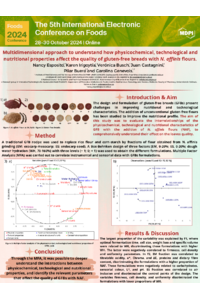
The design and formulation of gluten-free breads (GFBs) present challenges in improving nutritional and technological characteristics. The addition of unconventional gluten-free flours has been studied to improve the nutritional profile. The aim of this study was to evaluate the interrelationships of the physicochemical, technological and nutritional characteristics of GFB with the addition of N. affinis flours (NAFs), to comprehensively understand their effect on loaf quality. A traditional GFB recipe was used to replace rice flour and corn starch by fractions of flour obtained from N. affinis grinding (EM: exocarp-mesocarp; ES: endocarp-seed). A Box--Behnken design of three factors [EM, 0-20%; ES, 0-20%; dough water hydration (WH, 70-160%] with three levels (− 1; 0; + 1) was used to obtain the different formulations. Multiple Factor Analysis (MFA) was carried out to correlate instrumental and sensorial data with GFB formulations. The results showed that 72.32% of the data variation was explained by the first two dimensions (F1 and F2). The largest proportion of the variability was explained by F1, where optimal fermentation time, cell size, weight loss, and specific volume were related to WH, discriminating those formulations with higher WH. The latter were negatively correlated to firmness, cell density and uniformity parameters. In F2, EM fraction was correlated to titratable acidity, a*, Chroma and ΔE proteins and dietary fibre content, discriminating between the formulations with a higher proportion of NAF. These formulations were negatively related to carbohydrates, sensorial colour, L*, and pH. The ES fraction was correlated to air inclusion and was used to discriminate the central points of the design. The variables' firmness, cell density and uniformity discriminated the formulations with lower proportions of WH. Through the MFA, it was possible to gain a deeper understanding of the interactions between physicochemical, technological and nutritional properties, and to identify the relevant parameters that affect the quality of GFBs with NAF.
Keywords
Multiple Factor Analysis (MFA)
Neltuma affinis
gluten free breads
Poster
Sin título (60 x 80 cm).pdf
Use of agro-industrial waste for the development of a snack with an improved nutritional profile
Honey fraud detection: Use of electrochemical genosensors to determine the safety and quality of honeys