Event submissions
Published
This submission belongs to the session S1. Innovation in Food Technology and Engineering of the event The 5th International Electronic Conference on Foods
Published date
25 Oct, 2024
Academic Editor
'%3e%3cpath%20d='M12.6657%2010.9104C12.4185%2010.325%2012.0599%209.79327%2011.6097%209.34482C11.1609%208.89508%2010.6293%208.5365%2010.0442%208.28888C10.0389%208.28626%2010.0337%208.28495%2010.0285%208.28233C10.8446%207.69279%2011.3752%206.73249%2011.3752%205.64904C11.3752%203.8542%209.92103%202.39999%208.1262%202.39999C6.33136%202.39999%204.87715%203.8542%204.87715%205.64904C4.87715%206.73249%205.40774%207.69279%206.22393%208.28364C6.21869%208.28626%206.21345%208.28757%206.20821%208.29019C5.62129%208.5378%205.09463%208.89284%204.64265%209.34613C4.1929%209.79493%203.83432%2010.3266%203.58671%2010.9117C3.34345%2011.4845%203.21226%2012.0987%203.20023%2012.7209C3.19988%2012.7349%203.20233%2012.7488%203.20744%2012.7619C3.21255%2012.7749%203.22022%2012.7867%203.22998%2012.7968C3.23975%2012.8068%203.25142%2012.8147%203.26431%2012.8202C3.2772%2012.8256%203.29105%2012.8284%203.30504%2012.8284H4.09109C4.14874%2012.8284%204.19459%2012.7825%204.1959%2012.7262C4.2221%2011.7148%204.62823%2010.7676%205.34617%2010.0497C6.08899%209.30683%207.0755%208.89808%208.1262%208.89808C9.17689%208.89808%2010.1634%209.30683%2010.9062%2010.0497C11.6242%2010.7676%2012.0303%2011.7148%2012.0565%2012.7262C12.0578%2012.7838%2012.1037%2012.8284%2012.1613%2012.8284H12.9474C12.9613%2012.8284%2012.9752%2012.8256%2012.9881%2012.8202C13.001%2012.8147%2013.0126%2012.8068%2013.0224%2012.7968C13.0322%2012.7867%2013.0398%2012.7749%2013.0449%2012.7619C13.0501%2012.7488%2013.0525%2012.7349%2013.0522%2012.7209C13.0391%2012.0947%2012.9094%2011.4855%2012.6657%2010.9104ZM8.1262%207.9024C7.52486%207.9024%206.9589%207.6679%206.53312%207.24211C6.10733%206.81633%205.87283%206.25037%205.87283%205.64904C5.87283%205.0477%206.10733%204.48174%206.53312%204.05596C6.9589%203.63018%207.52486%203.39567%208.1262%203.39567C8.72753%203.39567%209.29349%203.63018%209.71927%204.05596C10.1451%204.48174%2010.3796%205.0477%2010.3796%205.64904C10.3796%206.25037%2010.1451%206.81633%209.71927%207.24211C9.29349%207.6679%208.72753%207.9024%208.1262%207.9024Z'%20fill='%235D1EE1'/%3e%3c/g%3e%3c/svg%3e) Moktar Hamdi
Moktar HamdiCitation
GIULIANA SILVINA SELING, Roy Cristian Rivero, Florencia Díaz, Agustín Sanguinetti, Verónica María Busch, Pilar Buera, Optimization of Extraction Technologies for obtaining bioactives from Schinus molle, in Proceedings of The 5th International Electronic Conference on Foods, 28 October–30 October 2024, MDPI: Basel, Switzerland
Share
Email
Facebook
Twitter
LinkedIn
Optimization of Extraction Technologies for obtaining bioactives from Schinus molle
'%3e%3cpath%20d='M12.6647%2010.9104C12.4176%2010.325%2012.0589%209.7933%2011.6088%209.34485C11.16%208.89511%2010.6283%208.53653%2010.0432%208.28891C10.038%208.28629%2010.0327%208.28498%2010.0275%208.28236C10.8437%207.69282%2011.3743%206.73252%2011.3743%205.64907C11.3743%203.85423%209.92005%202.40002%208.12522%202.40002C6.33038%202.40002%204.87618%203.85423%204.87618%205.64907C4.87618%206.73252%205.40677%207.69282%206.22296%208.28367C6.21772%208.28629%206.21248%208.2876%206.20724%208.29022C5.62031%208.53783%205.09365%208.89287%204.64167%209.34616C4.19192%209.79496%203.83334%2010.3266%203.58573%2010.9117C3.34247%2011.4846%203.21128%2012.0987%203.19925%2012.721C3.1989%2012.735%203.20135%2012.7489%203.20646%2012.7619C3.21157%2012.7749%203.21924%2012.7868%203.22901%2012.7968C3.23877%2012.8068%203.25045%2012.8148%203.26334%2012.8202C3.27623%2012.8256%203.29007%2012.8284%203.30406%2012.8284H4.09012C4.14776%2012.8284%204.19362%2012.7825%204.19493%2012.7262C4.22113%2011.7148%204.62726%2010.7676%205.34519%2010.0497C6.08802%209.30686%207.07452%208.89811%208.12522%208.89811C9.17592%208.89811%2010.1624%209.30686%2010.9052%2010.0497C11.6232%2010.7676%2012.0293%2011.7148%2012.0555%2012.7262C12.0568%2012.7839%2012.1027%2012.8284%2012.1603%2012.8284H12.9464C12.9604%2012.8284%2012.9742%2012.8256%2012.9871%2012.8202C13%2012.8148%2013.0117%2012.8068%2013.0214%2012.7968C13.0312%2012.7868%2013.0389%2012.7749%2013.044%2012.7619C13.0491%2012.7489%2013.0515%2012.735%2013.0512%2012.721C13.0381%2012.0947%2012.9084%2011.4856%2012.6647%2010.9104ZM8.12522%207.90243C7.52388%207.90243%206.95792%207.66793%206.53214%207.24215C6.10636%206.81636%205.87185%206.2504%205.87185%205.64907C5.87185%205.04773%206.10636%204.48177%206.53214%204.05599C6.95792%203.63021%207.52388%203.3957%208.12522%203.3957C8.72655%203.3957%209.29252%203.63021%209.7183%204.05599C10.1441%204.48177%2010.3786%205.04773%2010.3786%205.64907C10.3786%206.2504%2010.1441%206.81636%209.7183%207.24215C9.29252%207.66793%208.72655%207.90243%208.12522%207.90243Z'%20fill='%235D1EE1'/%3e%3c/g%3e%3c/svg%3e)
GIULIANA SILVINA SELING 1
Roy Cristian Rivero 2
Florencia Díaz 3
Agustín Sanguinetti 4

Verónica María Busch 2
Pilar Buera 5
1. Instituto de Tecnología de Alimentos y Proceso Químicos (ITAPROQ), Universidad de Buenos Aires, Facultad de Ciencias Exactas y Naturales, CONICET, Ciudad Autónoma de Buenos Aires, Argentina.
Facultad de Bromatología, Universidad Nacional de Entre Ríos, P
2. Instituto de Ciencia y Tecnología de Alimentos de Entre Ríos (ICTAER), Universidad Nacional de Entre Ríos- Consejo Nacional de Investigaciones Científicas y Técnicas, Pte. Perón 1152, Gualeguaychú, Entre Ríos, Argentina.
Facultad de Bromatología, Univers
3. Facultad de Bromatología, Universidad Nacional de Entre Ríos, Pte. Perón 1152, Gualeguaychú, Argentina.
Instituto de Ciencia y Tecnología de Alimentos de Entre Ríos (ICTAER), Universidad Nacional de Entre Ríos- Consejo Nacional de Investigaciones Cie
4. Instituto de Biodiversidad y Biología Experimental y Aplicada (IBBEA), Universidad de Buenos Aires- Consejo Nacional de Investigaciones Científicas y Técnicas, CABA, Argentina.
Facultad de Bromatología, Universidad Nacional de Entre Ríos, Pte. Perón 1152
5. Instituto de Tecnología de Alimentos y Proceso Químicos (ITAPROQ), Universidad de Buenos Aires, Facultad de Ciencias Exactas y Naturales, CONICET, Ciudad Autónoma de Buenos Aires, Argentina.
Abstract
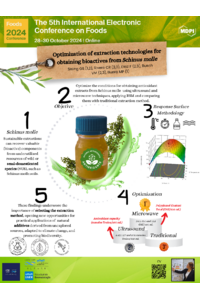
All countries have wild or semi-domesticated neglected species, limited to local markets. Recovering valuable components from these species by sustainable extractions can add value to these underutilized resources. Among these, Schinus molle (SM) stands out for its resilience and adaptability to climate change since it is resistant to drought and poor soils. The objective of this work was to optimize the conditions for obtaining antioxidant extracts from SM using ultrasound (US) and microwave (MW) techniques by applying response surface methodology and comparing them with traditional infusion methods (T). The design variables were time, % ethanol, temperature, and amplitude/frequency, evaluating antioxidant capacity (mmoles Trolox/100 mL -CA-), polyphenol content (GAE/100 mL -CPT-) and total flavonoids (mg quercetin/100 mL -FT-). Variable ranges for US: time: 1-15 min, ethanol: 0%-100%, and amplitude: 20%-100%; for MW: ethanol: 0%-100%, time: 10-40 min, and frequency: low, medium, and high; for T: ethanol: 40%, 65%, and 90% and time: 20 days, weighing 5 grams of powder/100 mL in all cases. The obtained optimal conditions were US [100% amplitude, 45% ethanol, and 15 minutes] and MW [low frequency, 50°C, 10 minutes, and 50% ethanol]. For maximum CA and CPT, the significant US variables were % ethanol, time, and temperature; and for MW, they were temperature and % ethanol. Significant differences among treatments were observed in CA: US>MW>T (6.43; 1.07 and 0.76 mmoles Trolox/100 mL), CPT: MW>T>US (24.1; 20.1 and 15.8 GAE/100 mL), and FT: T>MW>US (3.22; 2.33 and 1.82 mg quercetin/100 mL), indicating an inverse correlation with CA. The optimization designs identified the critical parameters to maximize the antioxidant activity of the extracts and allowed us to obtain extracts that surpass the traditional process in CPT (MW) and CA (US). These findings highlight the importance of carefully selecting the method according to specific extraction objectives, opening new opportunities for practical applications as an additive based on unexplored sources adapted to climate change and favoring biodiversity.
Keywords
Microwaves
ultrasound
sustainable extraction technologies
antioxidants
flavonoids
Poster
Optimization of Extraction Technologies for obtaining bioactives from Schinus molle (2).pdf
Technological Quality of Spent Hen Pectoralis major as Influenced by Ultrasonication
Bioactive protein hydrolysates derived from chayote (Sechium edule (Jacq.) Swartz) seeds using Subcritical Water Hydrolysis