Event submissions
Published
This submission belongs to the session S4. Food Microbiology of the event The 5th International Electronic Conference on Foods
Published date
25 Oct, 2024
Academic Editor
'%3e%3cpath%20d='M12.6657%2010.9104C12.4185%2010.325%2012.0599%209.79327%2011.6097%209.34482C11.1609%208.89508%2010.6293%208.5365%2010.0442%208.28888C10.0389%208.28626%2010.0337%208.28495%2010.0285%208.28233C10.8446%207.69279%2011.3752%206.73249%2011.3752%205.64904C11.3752%203.8542%209.92103%202.39999%208.1262%202.39999C6.33136%202.39999%204.87715%203.8542%204.87715%205.64904C4.87715%206.73249%205.40774%207.69279%206.22393%208.28364C6.21869%208.28626%206.21345%208.28757%206.20821%208.29019C5.62129%208.5378%205.09463%208.89284%204.64265%209.34613C4.1929%209.79493%203.83432%2010.3266%203.58671%2010.9117C3.34345%2011.4845%203.21226%2012.0987%203.20023%2012.7209C3.19988%2012.7349%203.20233%2012.7488%203.20744%2012.7619C3.21255%2012.7749%203.22022%2012.7867%203.22998%2012.7968C3.23975%2012.8068%203.25142%2012.8147%203.26431%2012.8202C3.2772%2012.8256%203.29105%2012.8284%203.30504%2012.8284H4.09109C4.14874%2012.8284%204.19459%2012.7825%204.1959%2012.7262C4.2221%2011.7148%204.62823%2010.7676%205.34617%2010.0497C6.08899%209.30683%207.0755%208.89808%208.1262%208.89808C9.17689%208.89808%2010.1634%209.30683%2010.9062%2010.0497C11.6242%2010.7676%2012.0303%2011.7148%2012.0565%2012.7262C12.0578%2012.7838%2012.1037%2012.8284%2012.1613%2012.8284H12.9474C12.9613%2012.8284%2012.9752%2012.8256%2012.9881%2012.8202C13.001%2012.8147%2013.0126%2012.8068%2013.0224%2012.7968C13.0322%2012.7867%2013.0398%2012.7749%2013.0449%2012.7619C13.0501%2012.7488%2013.0525%2012.7349%2013.0522%2012.7209C13.0391%2012.0947%2012.9094%2011.4855%2012.6657%2010.9104ZM8.1262%207.9024C7.52486%207.9024%206.9589%207.6679%206.53312%207.24211C6.10733%206.81633%205.87283%206.25037%205.87283%205.64904C5.87283%205.0477%206.10733%204.48174%206.53312%204.05596C6.9589%203.63018%207.52486%203.39567%208.1262%203.39567C8.72753%203.39567%209.29349%203.63018%209.71927%204.05596C10.1451%204.48174%2010.3796%205.0477%2010.3796%205.64904C10.3796%206.25037%2010.1451%206.81633%209.71927%207.24211C9.29349%207.6679%208.72753%207.9024%208.1262%207.9024Z'%20fill='%235D1EE1'/%3e%3c/g%3e%3c/svg%3e) Antonio Bevilacqua
Antonio BevilacquaCitation
Dimitra Kostoglou, Efstathios Giaouris, Screening of lactic acid bacteria isolated from foods for interference with bacterial quorum sensing systems, in Proceedings of The 5th International Electronic Conference on Foods, 28 October–30 October 2024, MDPI: Basel, Switzerland
Share
Email
Facebook
Twitter
LinkedIn
Screening of lactic acid bacteria isolated from foods for interference with bacterial quorum sensing systems

Dimitra Kostoglou 1

Efstathios Giaouris 1
1. Laboratory of Food Microbiology and Hygiene, Department of Food Science and Nutrition, School of the Environment, University of the Aegean, 81400 Myrina, Lemnos, Greece
Abstract
Quorum sensing (QS) is a cell-to-cell communication mechanism through which microorganisms can sense their own population density and adjust their physiology by producing and detecting small signalling molecules called autoinducers (AIs). QS influences various aspects of microbial physiology including virulence and pathogenesis by bacterial pathogens, biofilm formation, sporulation, antimicrobial resistance, etc. Lactic acid bacteria (LAB) have been used for centuries in food fermentation to improve sensory and nutritional profiles and preserve against spoilage and pathogenic microflora. This study investigated the potential of foodborne LAB of various genera, including Lactococcus, Lactobacillus, Leuconostoc, Streptococcus, and Enterococcus, to interfere with the QS system of bacterial pathogens. For this, cell-free supernatants (CFSs) of ninety LAB isolates from foods were collected by centrifugation following 20-hour culture (at 30 oC) in quarter-strength Brain Heart Infusion (BHI) broth. The pH of all CFSs was adjusted to 6.5 and sterilized by filtration. The anti-QS activity of the sterilized CFSs was initially screened, using the biosensor strains Chromobacterium violaceum 026 and Agrobacterium tumefaciens NTL4 (pZLR4), through an agar well diffusion assay that is able to detect the inhibition of the QS system that is based on acylated homoserine lactones (AHLs), which are used as AIs by Gram-negative bacteria. Additionally, all the CFSs were also screened for interference with the autoinducer 2 (AI-2) QS system that is mostly used for interspecies communication by both Gram-positive and Gram-negative bacteria. This was assessed using a luminescence bioassay with the Vibrio harveyi BAA-1117 biosensor strain. The results indicate that several LAB isolates were able to inhibit either AHL-based or AI-2 based QS. In addition, there were some LAB that were able to produce their own AI-2 molecules. In the next steps, these selected LAB isolates will be investigated for possible inhibition of biofilm formation by some important foodborne bacterial pathogens.
Keywords
lactic acid bacteria
cell-free supernatants (CFSs)
quorum sensing inhibition (QSI)
autoinducer (AI)
acylated homoserine lactones (AHLs)
bacterial communication
foodborne pathogens
Poster
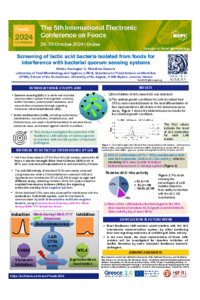
Poster 099348_Kostoglou & Giaouris_Foods_2024.pdf
Use of a time-to-failure model to evaluate the shelf-life of freeze-dried, carrot juice-fortified apples stored under controlled conditions
THE INFLUENCE OF THE APPLICATION OF ROSEMARY ESSENTIAL OIL (SALVIA ROSMARINUS) ON THE SENSORY CHARACTERISTICS AND MICROBIOLOGICAL QUALITY OF MINIMALLY PROCESSED PUMPKIN (CUCURBITA MOSCHATA)