Event submissions
Published
This submission belongs to the session S1. Innovation in Food Technology and Engineering of the event The 5th International Electronic Conference on Foods
Published date
25 Oct, 2024
Academic Editor
'%3e%3cpath%20d='M12.6657%2010.9104C12.4185%2010.325%2012.0599%209.79327%2011.6097%209.34482C11.1609%208.89508%2010.6293%208.5365%2010.0442%208.28888C10.0389%208.28626%2010.0337%208.28495%2010.0285%208.28233C10.8446%207.69279%2011.3752%206.73249%2011.3752%205.64904C11.3752%203.8542%209.92103%202.39999%208.1262%202.39999C6.33136%202.39999%204.87715%203.8542%204.87715%205.64904C4.87715%206.73249%205.40774%207.69279%206.22393%208.28364C6.21869%208.28626%206.21345%208.28757%206.20821%208.29019C5.62129%208.5378%205.09463%208.89284%204.64265%209.34613C4.1929%209.79493%203.83432%2010.3266%203.58671%2010.9117C3.34345%2011.4845%203.21226%2012.0987%203.20023%2012.7209C3.19988%2012.7349%203.20233%2012.7488%203.20744%2012.7619C3.21255%2012.7749%203.22022%2012.7867%203.22998%2012.7968C3.23975%2012.8068%203.25142%2012.8147%203.26431%2012.8202C3.2772%2012.8256%203.29105%2012.8284%203.30504%2012.8284H4.09109C4.14874%2012.8284%204.19459%2012.7825%204.1959%2012.7262C4.2221%2011.7148%204.62823%2010.7676%205.34617%2010.0497C6.08899%209.30683%207.0755%208.89808%208.1262%208.89808C9.17689%208.89808%2010.1634%209.30683%2010.9062%2010.0497C11.6242%2010.7676%2012.0303%2011.7148%2012.0565%2012.7262C12.0578%2012.7838%2012.1037%2012.8284%2012.1613%2012.8284H12.9474C12.9613%2012.8284%2012.9752%2012.8256%2012.9881%2012.8202C13.001%2012.8147%2013.0126%2012.8068%2013.0224%2012.7968C13.0322%2012.7867%2013.0398%2012.7749%2013.0449%2012.7619C13.0501%2012.7488%2013.0525%2012.7349%2013.0522%2012.7209C13.0391%2012.0947%2012.9094%2011.4855%2012.6657%2010.9104ZM8.1262%207.9024C7.52486%207.9024%206.9589%207.6679%206.53312%207.24211C6.10733%206.81633%205.87283%206.25037%205.87283%205.64904C5.87283%205.0477%206.10733%204.48174%206.53312%204.05596C6.9589%203.63018%207.52486%203.39567%208.1262%203.39567C8.72753%203.39567%209.29349%203.63018%209.71927%204.05596C10.1451%204.48174%2010.3796%205.0477%2010.3796%205.64904C10.3796%206.25037%2010.1451%206.81633%209.71927%207.24211C9.29349%207.6679%208.72753%207.9024%208.1262%207.9024Z'%20fill='%235D1EE1'/%3e%3c/g%3e%3c/svg%3e) Moktar Hamdi
Moktar HamdiCitation
Julio Federico Benites, Diego R. Gutierrez, Silvana Cecilia Ruiz, Silvia del Carmen Rodriguez, THE INFLUENCE OF THE APPLICATION OF ROSEMARY ESSENTIAL OIL (SALVIA ROSMARINUS) ON THE SENSORY CHARACTERISTICS AND MICROBIOLOGICAL QUALITY OF MINIMALLY PROCESSED PUMPKIN (CUCURBITA MOSCHATA), in Proceedings of The 5th International Electronic Conference on Foods, 28 October–30 October 2024, MDPI: Basel, Switzerland
Share
Email
Facebook
Twitter
LinkedIn
THE INFLUENCE OF THE APPLICATION OF ROSEMARY ESSENTIAL OIL (SALVIA ROSMARINUS) ON THE SENSORY CHARACTERISTICS AND MICROBIOLOGICAL QUALITY OF MINIMALLY PROCESSED PUMPKIN (CUCURBITA MOSCHATA)
'%3e%3cpath%20d='M12.6647%2010.9104C12.4176%2010.325%2012.0589%209.7933%2011.6088%209.34485C11.16%208.89511%2010.6283%208.53653%2010.0432%208.28891C10.038%208.28629%2010.0327%208.28498%2010.0275%208.28236C10.8437%207.69282%2011.3743%206.73252%2011.3743%205.64907C11.3743%203.85423%209.92005%202.40002%208.12522%202.40002C6.33038%202.40002%204.87618%203.85423%204.87618%205.64907C4.87618%206.73252%205.40677%207.69282%206.22296%208.28367C6.21772%208.28629%206.21248%208.2876%206.20724%208.29022C5.62031%208.53783%205.09365%208.89287%204.64167%209.34616C4.19192%209.79496%203.83334%2010.3266%203.58573%2010.9117C3.34247%2011.4846%203.21128%2012.0987%203.19925%2012.721C3.1989%2012.735%203.20135%2012.7489%203.20646%2012.7619C3.21157%2012.7749%203.21924%2012.7868%203.22901%2012.7968C3.23877%2012.8068%203.25045%2012.8148%203.26334%2012.8202C3.27623%2012.8256%203.29007%2012.8284%203.30406%2012.8284H4.09012C4.14776%2012.8284%204.19362%2012.7825%204.19493%2012.7262C4.22113%2011.7148%204.62726%2010.7676%205.34519%2010.0497C6.08802%209.30686%207.07452%208.89811%208.12522%208.89811C9.17592%208.89811%2010.1624%209.30686%2010.9052%2010.0497C11.6232%2010.7676%2012.0293%2011.7148%2012.0555%2012.7262C12.0568%2012.7839%2012.1027%2012.8284%2012.1603%2012.8284H12.9464C12.9604%2012.8284%2012.9742%2012.8256%2012.9871%2012.8202C13%2012.8148%2013.0117%2012.8068%2013.0214%2012.7968C13.0312%2012.7868%2013.0389%2012.7749%2013.044%2012.7619C13.0491%2012.7489%2013.0515%2012.735%2013.0512%2012.721C13.0381%2012.0947%2012.9084%2011.4856%2012.6647%2010.9104ZM8.12522%207.90243C7.52388%207.90243%206.95792%207.66793%206.53214%207.24215C6.10636%206.81636%205.87185%206.2504%205.87185%205.64907C5.87185%205.04773%206.10636%204.48177%206.53214%204.05599C6.95792%203.63021%207.52388%203.3957%208.12522%203.3957C8.72655%203.3957%209.29252%203.63021%209.7183%204.05599C10.1441%204.48177%2010.3786%205.04773%2010.3786%205.64907C10.3786%206.2504%2010.1441%206.81636%209.7183%207.24215C9.29252%207.66793%208.72655%207.90243%208.12522%207.90243Z'%20fill='%235D1EE1'/%3e%3c/g%3e%3c/svg%3e)
Julio Federico Benites 1,2
Diego R. Gutierrez 3

Silvana Cecilia Ruiz 4
Silvia del Carmen Rodriguez 3
1. Instituto de Ciencia y Tecnología de los Alimentos.
2. Facultad de Agronomía y Agroindustrias, Universidad Nacional de Santiago del Estero (UNSE).
3. Instituto de Ciencia y Tecnología de los Alimentos. Facultad de Agronomía y Agroindustrias, Universidad Nacional de Santiago del Estero (UNSE). CIBAAL CONICET-UNSE, Villa El Zanjón, Santiago del Estero, Argentina.
4. Instituto Nacional de Tecnología Agropecuaria, Estación Experimental Agropecuaria Santiago del Estero (INTA-EEASE)
Abstract
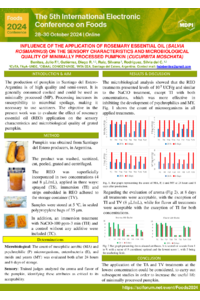
Pumpkin (P) produced in Santiago del Estero, Argentina, is of high quality and semi-sweet. It is generally consumed cooked and can be used in its minimally processed (MP) form. Processing increases its susceptibility to microbial spoilage, making it necessary to use sanitizers. The effect of rosemary essential oil (REO)'s application on the sensory characteristics and microbiological quality of grated P was studied. The product was washed, sanitized, cut, peeled, grated and centrifuged, and then REO was superficially incorporated at two concentrations (4 and 8 μL/mL) and applied in three ways: spraying (TS), immersion (TI) and adhering strips embedded in REO to the storage container (TV). The samples were subsequently stored at 5 °C in sealed 35 mm polypropylene bags. In addition, an immersion treatment with NaClO at100 ppm for 3 min and a control without any additive were included. The samples were taken at 24 h and 8 days of storage, evaluating the mesophilic aerobic microorganism, psychrophilic, enterobacteria and mold and yeast (MY) counts. The sensory evaluation was carried out by trained judges, determining that aroma and flavor were the critical attributes for the acceptability of the product. At the end of storage, the microbiological analysis showed that the REO treatments presented levels of 107UCF/g, similar to those for the NaClO treatment, except TI at both concentrations, which was more effective in inhibiting the development of psychrophils and MY. Regarding the evaluation of the aroma, at 8 days, all of the treatments were acceptable, with the exception of TI and TV (8 μL/mL), while for flavor, all of the treatments were acceptable with the exception of TI at both concentrations. Therefore, the application of TA and TV treatments at the lowest concentrations could be considered in further studies for increasing the shelf life of MP P.
Keywords
Sensory Evaluation
cucurbitaceae
rosemary essential oil
conservation
Poster
PUMPKIN + REO - Poster.pdf
Screening of lactic acid bacteria isolated from foods for interference with bacterial quorum sensing systems
Extraction of astaxanthin from shrimp (Parapenaeus longirostris) waste in sunflower oil