Event submissions
Published
This submission belongs to the session S1. Innovation in Food Technology and Engineering of the event The 5th International Electronic Conference on Foods
Published date
25 Oct, 2024
Academic Editor
'%3e%3cpath%20d='M12.6657%2010.9104C12.4185%2010.325%2012.0599%209.79327%2011.6097%209.34482C11.1609%208.89508%2010.6293%208.5365%2010.0442%208.28888C10.0389%208.28626%2010.0337%208.28495%2010.0285%208.28233C10.8446%207.69279%2011.3752%206.73249%2011.3752%205.64904C11.3752%203.8542%209.92103%202.39999%208.1262%202.39999C6.33136%202.39999%204.87715%203.8542%204.87715%205.64904C4.87715%206.73249%205.40774%207.69279%206.22393%208.28364C6.21869%208.28626%206.21345%208.28757%206.20821%208.29019C5.62129%208.5378%205.09463%208.89284%204.64265%209.34613C4.1929%209.79493%203.83432%2010.3266%203.58671%2010.9117C3.34345%2011.4845%203.21226%2012.0987%203.20023%2012.7209C3.19988%2012.7349%203.20233%2012.7488%203.20744%2012.7619C3.21255%2012.7749%203.22022%2012.7867%203.22998%2012.7968C3.23975%2012.8068%203.25142%2012.8147%203.26431%2012.8202C3.2772%2012.8256%203.29105%2012.8284%203.30504%2012.8284H4.09109C4.14874%2012.8284%204.19459%2012.7825%204.1959%2012.7262C4.2221%2011.7148%204.62823%2010.7676%205.34617%2010.0497C6.08899%209.30683%207.0755%208.89808%208.1262%208.89808C9.17689%208.89808%2010.1634%209.30683%2010.9062%2010.0497C11.6242%2010.7676%2012.0303%2011.7148%2012.0565%2012.7262C12.0578%2012.7838%2012.1037%2012.8284%2012.1613%2012.8284H12.9474C12.9613%2012.8284%2012.9752%2012.8256%2012.9881%2012.8202C13.001%2012.8147%2013.0126%2012.8068%2013.0224%2012.7968C13.0322%2012.7867%2013.0398%2012.7749%2013.0449%2012.7619C13.0501%2012.7488%2013.0525%2012.7349%2013.0522%2012.7209C13.0391%2012.0947%2012.9094%2011.4855%2012.6657%2010.9104ZM8.1262%207.9024C7.52486%207.9024%206.9589%207.6679%206.53312%207.24211C6.10733%206.81633%205.87283%206.25037%205.87283%205.64904C5.87283%205.0477%206.10733%204.48174%206.53312%204.05596C6.9589%203.63018%207.52486%203.39567%208.1262%203.39567C8.72753%203.39567%209.29349%203.63018%209.71927%204.05596C10.1451%204.48174%2010.3796%205.0477%2010.3796%205.64904C10.3796%206.25037%2010.1451%206.81633%209.71927%207.24211C9.29349%207.6679%208.72753%207.9024%208.1262%207.9024Z'%20fill='%235D1EE1'/%3e%3c/g%3e%3c/svg%3e) Moktar Hamdi
Moktar HamdiCitation
Toni Jurić Šolto, Martina Čagalj, Danijela Skroza, Ivana Generalić Mekinić, Vida Šimat, Extraction of astaxanthin from shrimp (Parapenaeus longirostris) waste in sunflower oil, in Proceedings of The 5th International Electronic Conference on Foods, 28 October–30 October 2024, MDPI: Basel, Switzerland
Share
Email
Facebook
Twitter
LinkedIn
Extraction of astaxanthin from shrimp (Parapenaeus longirostris) waste in sunflower oil
'%3e%3cpath%20d='M12.6647%2010.9104C12.4176%2010.325%2012.0589%209.7933%2011.6088%209.34485C11.16%208.89511%2010.6283%208.53653%2010.0432%208.28891C10.038%208.28629%2010.0327%208.28498%2010.0275%208.28236C10.8437%207.69282%2011.3743%206.73252%2011.3743%205.64907C11.3743%203.85423%209.92005%202.40002%208.12522%202.40002C6.33038%202.40002%204.87618%203.85423%204.87618%205.64907C4.87618%206.73252%205.40677%207.69282%206.22296%208.28367C6.21772%208.28629%206.21248%208.2876%206.20724%208.29022C5.62031%208.53783%205.09365%208.89287%204.64167%209.34616C4.19192%209.79496%203.83334%2010.3266%203.58573%2010.9117C3.34247%2011.4846%203.21128%2012.0987%203.19925%2012.721C3.1989%2012.735%203.20135%2012.7489%203.20646%2012.7619C3.21157%2012.7749%203.21924%2012.7868%203.22901%2012.7968C3.23877%2012.8068%203.25045%2012.8148%203.26334%2012.8202C3.27623%2012.8256%203.29007%2012.8284%203.30406%2012.8284H4.09012C4.14776%2012.8284%204.19362%2012.7825%204.19493%2012.7262C4.22113%2011.7148%204.62726%2010.7676%205.34519%2010.0497C6.08802%209.30686%207.07452%208.89811%208.12522%208.89811C9.17592%208.89811%2010.1624%209.30686%2010.9052%2010.0497C11.6232%2010.7676%2012.0293%2011.7148%2012.0555%2012.7262C12.0568%2012.7839%2012.1027%2012.8284%2012.1603%2012.8284H12.9464C12.9604%2012.8284%2012.9742%2012.8256%2012.9871%2012.8202C13%2012.8148%2013.0117%2012.8068%2013.0214%2012.7968C13.0312%2012.7868%2013.0389%2012.7749%2013.044%2012.7619C13.0491%2012.7489%2013.0515%2012.735%2013.0512%2012.721C13.0381%2012.0947%2012.9084%2011.4856%2012.6647%2010.9104ZM8.12522%207.90243C7.52388%207.90243%206.95792%207.66793%206.53214%207.24215C6.10636%206.81636%205.87185%206.2504%205.87185%205.64907C5.87185%205.04773%206.10636%204.48177%206.53214%204.05599C6.95792%203.63021%207.52388%203.3957%208.12522%203.3957C8.72655%203.3957%209.29252%203.63021%209.7183%204.05599C10.1441%204.48177%2010.3786%205.04773%2010.3786%205.64907C10.3786%206.2504%2010.1441%206.81636%209.7183%207.24215C9.29252%207.66793%208.72655%207.90243%208.12522%207.90243Z'%20fill='%235D1EE1'/%3e%3c/g%3e%3c/svg%3e)
Toni Jurić Šolto 1

Martina Čagalj 1

Danijela Skroza 2

Ivana Generalić Mekinić 2

Vida Šimat 1
1. University Department of Marine Studies, University of Split
2. University of Split, Faculty of Chemistry and Technology
Abstract
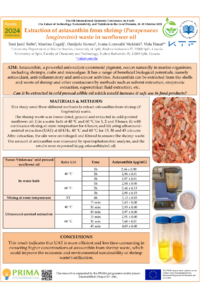
Astaxanthin, a powerful antioxidant carotenoid pigment, occurs naturally in marine organisms, including shrimps, crabs and microalgae. It has a range of beneficial biological potentials, namely antioxidant, anti-inflammatory and anti-cancer activities. Astaxanthin can be extracted from the shells and waste of shrimp and other crustaceans by methods such as solvent extraction, enzymatic extraction, supercritical fluid extraction, etc. This study used three different methods to extract astaxanthin from shrimp (P. longirostris) waste. The shrimp waste was freeze-dried, ground and extracted in cold-pressed sunflower oil i) in a water bath at 40 °C and 60 °C for 1, 2 and 3 hours; ii) with continuous stirring at room temperature for 6 hours; and iii) using ultrasound-assisted extraction (UAE) at 40 kHz, 40 °C and 60 °C for 15, 30 and 45 minutes. After extraction, the oils were centrifuged and filtered to remove the shrimp waste. The amount of astaxanthin was measured by spectrophotometric analysis, and the results were expressed in µg astaxanthin/mL oil. The extraction efficiency values showed the highest amount of astaxanthin in the sunflower oil was extracted with UAE at 60 °C for 45 minutes (4,03 ± 0,00 µg/mL), followed by the sample extracted with the same method at 60 °C for 30 minutes (3,68 ± 0,01 µg/mL). The lowest amount of astaxanthin was found for water bath extraction and ranged from 1,97 ± 0,01 to 2,98 ± 0,15 µg/mL, while the amount of astaxanthin in the extract prepared by constant stirring for 6 h was 3,13 ± 0,03 µg/mL. This result indicates that UAE is more efficient and less time-consuming in extracting higher concentrations of astaxanthin from shrimp waste, which could improve the economic and environmental sustainability of shrimp waste's utilization.
Keywords
green extraction
astaxanthin
shrimp waste
Parapenaeus longirostris
seafood by-products
waste valorization
Poster
Poster FOODS2024 Martina.pdf
THE INFLUENCE OF THE APPLICATION OF ROSEMARY ESSENTIAL OIL (SALVIA ROSMARINUS) ON THE SENSORY CHARACTERISTICS AND MICROBIOLOGICAL QUALITY OF MINIMALLY PROCESSED PUMPKIN (CUCURBITA MOSCHATA)
Evaluation of probiotic fermentative capability of Sri Lankan traditional rice variety “Sudu Heenati”: compositional and physico-chemical characterization