Event submissions
Published
This submission belongs to the session S4. Food Microbiology of the event The 5th International Electronic Conference on Foods
Published date
25 Oct, 2024
Academic Editor
'%3e%3cpath%20d='M12.6657%2010.9104C12.4185%2010.325%2012.0599%209.79327%2011.6097%209.34482C11.1609%208.89508%2010.6293%208.5365%2010.0442%208.28888C10.0389%208.28626%2010.0337%208.28495%2010.0285%208.28233C10.8446%207.69279%2011.3752%206.73249%2011.3752%205.64904C11.3752%203.8542%209.92103%202.39999%208.1262%202.39999C6.33136%202.39999%204.87715%203.8542%204.87715%205.64904C4.87715%206.73249%205.40774%207.69279%206.22393%208.28364C6.21869%208.28626%206.21345%208.28757%206.20821%208.29019C5.62129%208.5378%205.09463%208.89284%204.64265%209.34613C4.1929%209.79493%203.83432%2010.3266%203.58671%2010.9117C3.34345%2011.4845%203.21226%2012.0987%203.20023%2012.7209C3.19988%2012.7349%203.20233%2012.7488%203.20744%2012.7619C3.21255%2012.7749%203.22022%2012.7867%203.22998%2012.7968C3.23975%2012.8068%203.25142%2012.8147%203.26431%2012.8202C3.2772%2012.8256%203.29105%2012.8284%203.30504%2012.8284H4.09109C4.14874%2012.8284%204.19459%2012.7825%204.1959%2012.7262C4.2221%2011.7148%204.62823%2010.7676%205.34617%2010.0497C6.08899%209.30683%207.0755%208.89808%208.1262%208.89808C9.17689%208.89808%2010.1634%209.30683%2010.9062%2010.0497C11.6242%2010.7676%2012.0303%2011.7148%2012.0565%2012.7262C12.0578%2012.7838%2012.1037%2012.8284%2012.1613%2012.8284H12.9474C12.9613%2012.8284%2012.9752%2012.8256%2012.9881%2012.8202C13.001%2012.8147%2013.0126%2012.8068%2013.0224%2012.7968C13.0322%2012.7867%2013.0398%2012.7749%2013.0449%2012.7619C13.0501%2012.7488%2013.0525%2012.7349%2013.0522%2012.7209C13.0391%2012.0947%2012.9094%2011.4855%2012.6657%2010.9104ZM8.1262%207.9024C7.52486%207.9024%206.9589%207.6679%206.53312%207.24211C6.10733%206.81633%205.87283%206.25037%205.87283%205.64904C5.87283%205.0477%206.10733%204.48174%206.53312%204.05596C6.9589%203.63018%207.52486%203.39567%208.1262%203.39567C8.72753%203.39567%209.29349%203.63018%209.71927%204.05596C10.1451%204.48174%2010.3796%205.0477%2010.3796%205.64904C10.3796%206.25037%2010.1451%206.81633%209.71927%207.24211C9.29349%207.6679%208.72753%207.9024%208.1262%207.9024Z'%20fill='%235D1EE1'/%3e%3c/g%3e%3c/svg%3e) Antonio Bevilacqua
Antonio BevilacquaCitation
Dilini Jayawardana, Upeka Rajawardana, Theja Herath, Chandrika Nanayakkara, Savidya Liyanage, Madara Samaranayake, Evaluation of probiotic fermentative capability of Sri Lankan traditional rice variety “Sudu Heenati”: compositional and physico-chemical characterization, in Proceedings of The 5th International Electronic Conference on Foods, 28 October–30 October 2024, MDPI: Basel, Switzerland
Share
Email
Facebook
Twitter
LinkedIn
Evaluation of probiotic fermentative capability of Sri Lankan traditional rice variety “Sudu Heenati”: compositional and physico-chemical characterization
'%3e%3cpath%20d='M12.6647%2010.9104C12.4176%2010.325%2012.0589%209.7933%2011.6088%209.34485C11.16%208.89511%2010.6283%208.53653%2010.0432%208.28891C10.038%208.28629%2010.0327%208.28498%2010.0275%208.28236C10.8437%207.69282%2011.3743%206.73252%2011.3743%205.64907C11.3743%203.85423%209.92005%202.40002%208.12522%202.40002C6.33038%202.40002%204.87618%203.85423%204.87618%205.64907C4.87618%206.73252%205.40677%207.69282%206.22296%208.28367C6.21772%208.28629%206.21248%208.2876%206.20724%208.29022C5.62031%208.53783%205.09365%208.89287%204.64167%209.34616C4.19192%209.79496%203.83334%2010.3266%203.58573%2010.9117C3.34247%2011.4846%203.21128%2012.0987%203.19925%2012.721C3.1989%2012.735%203.20135%2012.7489%203.20646%2012.7619C3.21157%2012.7749%203.21924%2012.7868%203.22901%2012.7968C3.23877%2012.8068%203.25045%2012.8148%203.26334%2012.8202C3.27623%2012.8256%203.29007%2012.8284%203.30406%2012.8284H4.09012C4.14776%2012.8284%204.19362%2012.7825%204.19493%2012.7262C4.22113%2011.7148%204.62726%2010.7676%205.34519%2010.0497C6.08802%209.30686%207.07452%208.89811%208.12522%208.89811C9.17592%208.89811%2010.1624%209.30686%2010.9052%2010.0497C11.6232%2010.7676%2012.0293%2011.7148%2012.0555%2012.7262C12.0568%2012.7839%2012.1027%2012.8284%2012.1603%2012.8284H12.9464C12.9604%2012.8284%2012.9742%2012.8256%2012.9871%2012.8202C13%2012.8148%2013.0117%2012.8068%2013.0214%2012.7968C13.0312%2012.7868%2013.0389%2012.7749%2013.044%2012.7619C13.0491%2012.7489%2013.0515%2012.735%2013.0512%2012.721C13.0381%2012.0947%2012.9084%2011.4856%2012.6647%2010.9104ZM8.12522%207.90243C7.52388%207.90243%206.95792%207.66793%206.53214%207.24215C6.10636%206.81636%205.87185%206.2504%205.87185%205.64907C5.87185%205.04773%206.10636%204.48177%206.53214%204.05599C6.95792%203.63021%207.52388%203.3957%208.12522%203.3957C8.72655%203.3957%209.29252%203.63021%209.7183%204.05599C10.1441%204.48177%2010.3786%205.04773%2010.3786%205.64907C10.3786%206.2504%2010.1441%206.81636%209.7183%207.24215C9.29252%207.66793%208.72655%207.90243%208.12522%207.90243Z'%20fill='%235D1EE1'/%3e%3c/g%3e%3c/svg%3e)
Dilini Jayawardana 1
Upeka Rajawardana 1
Theja Herath 2
Chandrika Nanayakkara 3
Savidya Liyanage 1
Madara Samaranayake 1
1. Food Technology Section, Modern Research and Development Complex, Industrial Technology Institute, No.503/A, Halbarawa Gardens, Malabe, 10115, Sri Lanka
2. Food Technology Section, Modern Research and Development Complex, Industrial Technology Institute, No.503/A, Halbarawa Gardens, Malabe, 10115, Sri Lanka
3. Department of Plant Sciences, Faculty of Science, University of Colombo 03, 00300, Sri Lanka
Abstract
Rice is an Asian crop and a staple food in Sri Lanka. Rice varieties passed from generation to generation are known as “traditional” rice varieties that offer health benefits such as relief from diabetes, heart diseases and cancers. Past research has proven that “Sudu Heenati” contains high amounts of resistant starch and protein and antioxidants and has other nutritional properties. Resistant starch is a prebiotic ingredient that promotes the growth of probiotics and allows fermentation. According to the International Scientific Association for Probiotics and Prebiotics (ISSAP), probiotics are “live microorganisms that, when administered in adequate amounts, confer a health benefit on the host”. Probiotics play a significant role in diarrhea, lactose intolerance and irritable bowel syndrome. The probiotic fermentative capability of “Sudu Heenati” was evaluated through the viable probiotic cell count and selected physico-chemical and compositional parameters of fermented and unfermented slurries. Rice flour slurry was prepared at 121ºC for 15 minutes, inoculated with 2% (w/w) Lactobacillus acidophilus (LA 5) freeze-dried culture and incubated at 44ºC. The viable cell count of the fermented slurry was 9.26±0.43 colony forming units per gram in log10 (log10cfu/g), which exceeded the required limit (8.0log10cfu/g) to label it a probiotic food. During the fermentation, the titrable acidity, pH and viscosity of the unfermented slurry, 0.09±0.00 (% by weight), 6.62±0.00 and 818.26±6.01 cP, significantly varied (p<0.05) to 0.14±0.01 (% by weight), 4.71±0.00 and 1701.70±3.12 cP in the fermented slurry, respectively. Probiotic fermentation enhances the production of organic acids, which reduces the medium pH. Viscosity was increased due to the exopolysaccharide (EPS) production by LA 5. Compositionally, only the ash content (% weight on a dry basis) was significantly increased (p<0.05) from 1.89±0.04 to 2.45±0.17 in the fermented slurry. Significant changes in carbohydrate, protein or fat were not observed in the fermented slurry. However, the “Sudu Heenati” variety is a suitable substrate for LA 5-incorporated probiotic functional foods with favorable technological properties.
Keywords
Sudu Heenati
traditional rice varieties
probiotics
Lactobacillus acidophilus
Poster
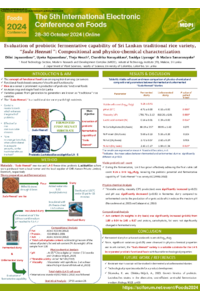
Dilini Jayawardana_poster.pdf
Extraction of astaxanthin from shrimp (Parapenaeus longirostris) waste in sunflower oil
Exploring DNA markers for species identification in honey