Event submissions
Published
This submission belongs to the session S2. Food Nutrition and Functional Foods of the event The 5th International Electronic Conference on Foods
Published date
25 Oct, 2024
Academic Editor
'%3e%3cpath%20d='M12.6657%2010.9104C12.4185%2010.325%2012.0599%209.79327%2011.6097%209.34482C11.1609%208.89508%2010.6293%208.5365%2010.0442%208.28888C10.0389%208.28626%2010.0337%208.28495%2010.0285%208.28233C10.8446%207.69279%2011.3752%206.73249%2011.3752%205.64904C11.3752%203.8542%209.92103%202.39999%208.1262%202.39999C6.33136%202.39999%204.87715%203.8542%204.87715%205.64904C4.87715%206.73249%205.40774%207.69279%206.22393%208.28364C6.21869%208.28626%206.21345%208.28757%206.20821%208.29019C5.62129%208.5378%205.09463%208.89284%204.64265%209.34613C4.1929%209.79493%203.83432%2010.3266%203.58671%2010.9117C3.34345%2011.4845%203.21226%2012.0987%203.20023%2012.7209C3.19988%2012.7349%203.20233%2012.7488%203.20744%2012.7619C3.21255%2012.7749%203.22022%2012.7867%203.22998%2012.7968C3.23975%2012.8068%203.25142%2012.8147%203.26431%2012.8202C3.2772%2012.8256%203.29105%2012.8284%203.30504%2012.8284H4.09109C4.14874%2012.8284%204.19459%2012.7825%204.1959%2012.7262C4.2221%2011.7148%204.62823%2010.7676%205.34617%2010.0497C6.08899%209.30683%207.0755%208.89808%208.1262%208.89808C9.17689%208.89808%2010.1634%209.30683%2010.9062%2010.0497C11.6242%2010.7676%2012.0303%2011.7148%2012.0565%2012.7262C12.0578%2012.7838%2012.1037%2012.8284%2012.1613%2012.8284H12.9474C12.9613%2012.8284%2012.9752%2012.8256%2012.9881%2012.8202C13.001%2012.8147%2013.0126%2012.8068%2013.0224%2012.7968C13.0322%2012.7867%2013.0398%2012.7749%2013.0449%2012.7619C13.0501%2012.7488%2013.0525%2012.7349%2013.0522%2012.7209C13.0391%2012.0947%2012.9094%2011.4855%2012.6657%2010.9104ZM8.1262%207.9024C7.52486%207.9024%206.9589%207.6679%206.53312%207.24211C6.10733%206.81633%205.87283%206.25037%205.87283%205.64904C5.87283%205.0477%206.10733%204.48174%206.53312%204.05596C6.9589%203.63018%207.52486%203.39567%208.1262%203.39567C8.72753%203.39567%209.29349%203.63018%209.71927%204.05596C10.1451%204.48174%2010.3796%205.0477%2010.3796%205.64904C10.3796%206.25037%2010.1451%206.81633%209.71927%207.24211C9.29349%207.6679%208.72753%207.9024%208.1262%207.9024Z'%20fill='%235D1EE1'/%3e%3c/g%3e%3c/svg%3e) Antonello Santini
Antonello SantiniCitation
Lizbeth Rosas-Ordoñez, Taisa S.S. Pereira, Oscar Jiménez-González, An evaluation of the potential of Inga paterno sarcotesta and its seeds for the production of probiotic beverages: their effect on antioxidants and Lactiplantibacillus plantarum viability at refrigeration storage temperatures, in Proceedings of The 5th International Electronic Conference on Foods, 28 October–30 October 2024, MDPI: Basel, Switzerland
Share
Email
Facebook
Twitter
LinkedIn
An evaluation of the potential of Inga paterno sarcotesta and its seeds for the production of probiotic beverages: their effect on antioxidants and Lactiplantibacillus plantarum viability at refrigeration storage temperatures

Lizbeth Rosas-Ordoñez 1
'%3e%3cpath%20d='M12.6647%2010.9104C12.4176%2010.325%2012.0589%209.7933%2011.6088%209.34485C11.16%208.89511%2010.6283%208.53653%2010.0432%208.28891C10.038%208.28629%2010.0327%208.28498%2010.0275%208.28236C10.8437%207.69282%2011.3743%206.73252%2011.3743%205.64907C11.3743%203.85423%209.92005%202.40002%208.12522%202.40002C6.33038%202.40002%204.87618%203.85423%204.87618%205.64907C4.87618%206.73252%205.40677%207.69282%206.22296%208.28367C6.21772%208.28629%206.21248%208.2876%206.20724%208.29022C5.62031%208.53783%205.09365%208.89287%204.64167%209.34616C4.19192%209.79496%203.83334%2010.3266%203.58573%2010.9117C3.34247%2011.4846%203.21128%2012.0987%203.19925%2012.721C3.1989%2012.735%203.20135%2012.7489%203.20646%2012.7619C3.21157%2012.7749%203.21924%2012.7868%203.22901%2012.7968C3.23877%2012.8068%203.25045%2012.8148%203.26334%2012.8202C3.27623%2012.8256%203.29007%2012.8284%203.30406%2012.8284H4.09012C4.14776%2012.8284%204.19362%2012.7825%204.19493%2012.7262C4.22113%2011.7148%204.62726%2010.7676%205.34519%2010.0497C6.08802%209.30686%207.07452%208.89811%208.12522%208.89811C9.17592%208.89811%2010.1624%209.30686%2010.9052%2010.0497C11.6232%2010.7676%2012.0293%2011.7148%2012.0555%2012.7262C12.0568%2012.7839%2012.1027%2012.8284%2012.1603%2012.8284H12.9464C12.9604%2012.8284%2012.9742%2012.8256%2012.9871%2012.8202C13%2012.8148%2013.0117%2012.8068%2013.0214%2012.7968C13.0312%2012.7868%2013.0389%2012.7749%2013.044%2012.7619C13.0491%2012.7489%2013.0515%2012.735%2013.0512%2012.721C13.0381%2012.0947%2012.9084%2011.4856%2012.6647%2010.9104ZM8.12522%207.90243C7.52388%207.90243%206.95792%207.66793%206.53214%207.24215C6.10636%206.81636%205.87185%206.2504%205.87185%205.64907C5.87185%205.04773%206.10636%204.48177%206.53214%204.05599C6.95792%203.63021%207.52388%203.3957%208.12522%203.3957C8.72655%203.3957%209.29252%203.63021%209.7183%204.05599C10.1441%204.48177%2010.3786%205.04773%2010.3786%205.64907C10.3786%206.2504%2010.1441%206.81636%209.7183%207.24215C9.29252%207.66793%208.72655%207.90243%208.12522%207.90243Z'%20fill='%235D1EE1'/%3e%3c/g%3e%3c/svg%3e)
Taisa S.S. Pereira 2
Oscar Jiménez-González 2
1. Department of Chemical, Food and Environmental Engineering, Universidad de las Américas Puebla, Puebla, 72810, Mexico
2. Universidad de las Américas Puebla
Abstract
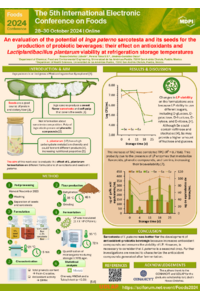
The sarcotesta and seeds of Inga paterno are good sources of nutrients but are rarely explored. Meanwhile, Lactiplantibacillus plantarum (LP) is widely used for probiotic beverage production. The aim of this work was to evaluate the flavonoid content, antioxidant stability, and L. plantarum viability in different formulations of the I. paterno beverage under refrigeration conditions.
The three beverages were prepared using I. paterno 5% w/v sarcotesta (Sa), 5% w/v seed (Se), or a 1:1 mixture of (Ae) and water. All were sterilized for LP inoculation (2.1×10⁶ CFU/ml), incubated (72h), and stored at 5°C. LP quantification was carried out in MRS agar (0, 4, 11, 18, and 25d). The total phenolic content (TPC) was determined by the Folin–Ciocalteu method, and antioxidant activity (TAC) was determined by DPPH•. Experiments were carried out in triplicate. Data were analyzed by one-way ANOVA and Tukey’s test (p < 0.05).
LP concentration increased in Se, Sa, and Ea (2.77×10⁷, 8.67×10⁶, and 3.97×10⁷ CFU/ml) compared to the initial amount. Microorganisms decreased in Ea every week until 8.67×10⁴ CFU/ml; however, microorganisms were stable in Se but decreased after 11d of storage (2.67×10⁴ CFU/ml). On the contrary, a slight increase was observed in Sa (2.10×10⁷ CFU/ml), which may be due to a greater presence of carbohydrates. Sa presented the highest TPC (69.54±9.13-376.42±7.07 ug gallic acid equivalents (GAE)/ml) and TAC (84.34±2.23-106.32±3.91 ug Trolox equivalents (TE)/ml). Se reaches the lowest TPC and TAC values (29.75±3.54-146.00±10.02 ug GAE/ml; 34.47±1.67-69.91±1.183 ug TE/ml, respectively). TPC and TAC presented the same tendency for Sa and Ea. The data showed that the sarcotesta of I. paterno was a better ingredient for the development of an antioxidant–probiotic beverage because it increases the antioxidant compounds and ensures the viability of LP. However, for the use of I. paterno, it is necessary to consider that it is a seasonal crop. Further investigations are needed to characterize the antioxidant compounds generated after fermentation.
Keywords
Total phenolic compounds
Antioxidant activity
Lactic acid fermentation
symbiotic beverage
Poster
Poster sciforum-099092.pdf
Exploring DNA markers for species identification in honey
Phase behavior and synergistic gelation of scallop (Patinopecten yessoensis) male gonad hydrolysates and gellan gum driven by pH