Event submissions
Published
This submission belongs to the session S1. Innovation in Food Technology and Engineering of the event The 5th International Electronic Conference on Foods
Published date
25 Oct, 2024
Academic Editor
'%3e%3cpath%20d='M12.6657%2010.9104C12.4185%2010.325%2012.0599%209.79327%2011.6097%209.34482C11.1609%208.89508%2010.6293%208.5365%2010.0442%208.28888C10.0389%208.28626%2010.0337%208.28495%2010.0285%208.28233C10.8446%207.69279%2011.3752%206.73249%2011.3752%205.64904C11.3752%203.8542%209.92103%202.39999%208.1262%202.39999C6.33136%202.39999%204.87715%203.8542%204.87715%205.64904C4.87715%206.73249%205.40774%207.69279%206.22393%208.28364C6.21869%208.28626%206.21345%208.28757%206.20821%208.29019C5.62129%208.5378%205.09463%208.89284%204.64265%209.34613C4.1929%209.79493%203.83432%2010.3266%203.58671%2010.9117C3.34345%2011.4845%203.21226%2012.0987%203.20023%2012.7209C3.19988%2012.7349%203.20233%2012.7488%203.20744%2012.7619C3.21255%2012.7749%203.22022%2012.7867%203.22998%2012.7968C3.23975%2012.8068%203.25142%2012.8147%203.26431%2012.8202C3.2772%2012.8256%203.29105%2012.8284%203.30504%2012.8284H4.09109C4.14874%2012.8284%204.19459%2012.7825%204.1959%2012.7262C4.2221%2011.7148%204.62823%2010.7676%205.34617%2010.0497C6.08899%209.30683%207.0755%208.89808%208.1262%208.89808C9.17689%208.89808%2010.1634%209.30683%2010.9062%2010.0497C11.6242%2010.7676%2012.0303%2011.7148%2012.0565%2012.7262C12.0578%2012.7838%2012.1037%2012.8284%2012.1613%2012.8284H12.9474C12.9613%2012.8284%2012.9752%2012.8256%2012.9881%2012.8202C13.001%2012.8147%2013.0126%2012.8068%2013.0224%2012.7968C13.0322%2012.7867%2013.0398%2012.7749%2013.0449%2012.7619C13.0501%2012.7488%2013.0525%2012.7349%2013.0522%2012.7209C13.0391%2012.0947%2012.9094%2011.4855%2012.6657%2010.9104ZM8.1262%207.9024C7.52486%207.9024%206.9589%207.6679%206.53312%207.24211C6.10733%206.81633%205.87283%206.25037%205.87283%205.64904C5.87283%205.0477%206.10733%204.48174%206.53312%204.05596C6.9589%203.63018%207.52486%203.39567%208.1262%203.39567C8.72753%203.39567%209.29349%203.63018%209.71927%204.05596C10.1451%204.48174%2010.3796%205.0477%2010.3796%205.64904C10.3796%206.25037%2010.1451%206.81633%209.71927%207.24211C9.29349%207.6679%208.72753%207.9024%208.1262%207.9024Z'%20fill='%235D1EE1'/%3e%3c/g%3e%3c/svg%3e) Francisco Artés-Hernández
Francisco Artés-HernándezCitation
Nadia SMIRANI, Souhir Bouazizi, Emna BETTAIEB, Moktar HAMDI, Effect of different non-conventional betalain extraction techniques on bioactive compounds and antioxidant properties of fresh and dried Opuntia stricta fruit, in Proceedings of The 5th International Electronic Conference on Foods, 28 October–30 October 2024, MDPI: Basel, Switzerland
Share
Email
Facebook
Twitter
LinkedIn
Effect of different non-conventional betalain extraction techniques on bioactive compounds and antioxidant properties of fresh and dried Opuntia stricta fruit
'%3e%3cpath%20d='M12.6647%2010.9104C12.4176%2010.325%2012.0589%209.7933%2011.6088%209.34485C11.16%208.89511%2010.6283%208.53653%2010.0432%208.28891C10.038%208.28629%2010.0327%208.28498%2010.0275%208.28236C10.8437%207.69282%2011.3743%206.73252%2011.3743%205.64907C11.3743%203.85423%209.92005%202.40002%208.12522%202.40002C6.33038%202.40002%204.87618%203.85423%204.87618%205.64907C4.87618%206.73252%205.40677%207.69282%206.22296%208.28367C6.21772%208.28629%206.21248%208.2876%206.20724%208.29022C5.62031%208.53783%205.09365%208.89287%204.64167%209.34616C4.19192%209.79496%203.83334%2010.3266%203.58573%2010.9117C3.34247%2011.4846%203.21128%2012.0987%203.19925%2012.721C3.1989%2012.735%203.20135%2012.7489%203.20646%2012.7619C3.21157%2012.7749%203.21924%2012.7868%203.22901%2012.7968C3.23877%2012.8068%203.25045%2012.8148%203.26334%2012.8202C3.27623%2012.8256%203.29007%2012.8284%203.30406%2012.8284H4.09012C4.14776%2012.8284%204.19362%2012.7825%204.19493%2012.7262C4.22113%2011.7148%204.62726%2010.7676%205.34519%2010.0497C6.08802%209.30686%207.07452%208.89811%208.12522%208.89811C9.17592%208.89811%2010.1624%209.30686%2010.9052%2010.0497C11.6232%2010.7676%2012.0293%2011.7148%2012.0555%2012.7262C12.0568%2012.7839%2012.1027%2012.8284%2012.1603%2012.8284H12.9464C12.9604%2012.8284%2012.9742%2012.8256%2012.9871%2012.8202C13%2012.8148%2013.0117%2012.8068%2013.0214%2012.7968C13.0312%2012.7868%2013.0389%2012.7749%2013.044%2012.7619C13.0491%2012.7489%2013.0515%2012.735%2013.0512%2012.721C13.0381%2012.0947%2012.9084%2011.4856%2012.6647%2010.9104ZM8.12522%207.90243C7.52388%207.90243%206.95792%207.66793%206.53214%207.24215C6.10636%206.81636%205.87185%206.2504%205.87185%205.64907C5.87185%205.04773%206.10636%204.48177%206.53214%204.05599C6.95792%203.63021%207.52388%203.3957%208.12522%203.3957C8.72655%203.3957%209.29252%203.63021%209.7183%204.05599C10.1441%204.48177%2010.3786%205.04773%2010.3786%205.64907C10.3786%206.2504%2010.1441%206.81636%209.7183%207.24215C9.29252%207.66793%208.72655%207.90243%208.12522%207.90243Z'%20fill='%235D1EE1'/%3e%3c/g%3e%3c/svg%3e)
Nadia SMIRANI 1
Souhir Bouazizi 1
Emna BETTAIEB 1

Moktar HAMDI 1
1. Laboratory of Microbial Ecology and Technology LETMi-INSAT, The National Institute of Applied Science and Technology INSAT, University of Carthage, BP 676, 1080 Tunis.
Abstract
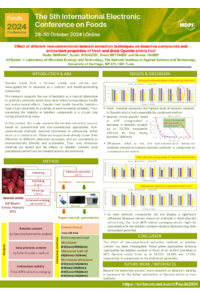
A Tunisian cactus pear cultivar was studied for its betalains as a colorant- and health-promoting compound. Maintaining the stability of betalains during dehydration processes is crucial for their utilization in the food industry. This research supports the use of betalains as a natural alternative to synthetic colorants. The extraction procedure primarily focused on the purple fruit of Opuntia stricta, involving a total of nine techniques, encompassing both conventional and non-conventional approaches. Non-conventional methods involved microwave (MW) or ultrasound (US), either alone or in combination. In total, there were eight non-conventional methods and one conventional approach used for the extraction of betalains. Among these, four methods utilized a combination of MW (1 or 2min) and US (10 or 20min), while four methods employed either MW (1min) and MW (2min) or US (10min) and US (20min). The experimental conditions were optimized to maintain a constant temperature of 50°C for the extraction procedure, and water was utilized as a solvent. The extraction procedure used both fresh and dried plant material at two different drying temperatures, 40°C and 60°C, in order to evaluate the stability of betalain molecules. The potential of the colorant was assessed by examining the content of betalains and total phenolic content. The antioxidant properties were evaluated through the measurement of total ABTS radical scavenging. Among the fresh Opuntia stricta samples, the highest content of betalains was found in the MW (2 mn) and MW (2 mn)+US (10 mn) extraction methods, with 48.54±0.29 mg/100 g FW and 51.01±0.16 mg/100 g FW, respectively. However, the MW (2 mn) extraction method exhibited the greatest ABTS scavenging, with 128.78±4.32 mmol Trolox/100 g FW. Furthermore, the results indicated a significant decrease in betalain content when the plant material was dried at 40°C and 60°C, representing a reduction of 53.75% and 24.82%, respectively, compared to the content of betalains for fresh material.
Keywords
Betalains
colorant
antioxidant potential
non-conventional extraction
stability
Opuntia stricta
Poster
099404.pdf
Phase behavior and synergistic gelation of scallop (Patinopecten yessoensis) male gonad hydrolysates and gellan gum driven by pH
Modelling the microbial competition of Listeria monocytogenes and selected lactic acid bacteria strains in reconstituted milk