Event submissions
Published
This submission belongs to the session S1. Innovation in Food Technology and Engineering of the event The 5th International Electronic Conference on Foods
Published date
25 Oct, 2024
Academic Editor
'%3e%3cpath%20d='M12.6657%2010.9104C12.4185%2010.325%2012.0599%209.79327%2011.6097%209.34482C11.1609%208.89508%2010.6293%208.5365%2010.0442%208.28888C10.0389%208.28626%2010.0337%208.28495%2010.0285%208.28233C10.8446%207.69279%2011.3752%206.73249%2011.3752%205.64904C11.3752%203.8542%209.92103%202.39999%208.1262%202.39999C6.33136%202.39999%204.87715%203.8542%204.87715%205.64904C4.87715%206.73249%205.40774%207.69279%206.22393%208.28364C6.21869%208.28626%206.21345%208.28757%206.20821%208.29019C5.62129%208.5378%205.09463%208.89284%204.64265%209.34613C4.1929%209.79493%203.83432%2010.3266%203.58671%2010.9117C3.34345%2011.4845%203.21226%2012.0987%203.20023%2012.7209C3.19988%2012.7349%203.20233%2012.7488%203.20744%2012.7619C3.21255%2012.7749%203.22022%2012.7867%203.22998%2012.7968C3.23975%2012.8068%203.25142%2012.8147%203.26431%2012.8202C3.2772%2012.8256%203.29105%2012.8284%203.30504%2012.8284H4.09109C4.14874%2012.8284%204.19459%2012.7825%204.1959%2012.7262C4.2221%2011.7148%204.62823%2010.7676%205.34617%2010.0497C6.08899%209.30683%207.0755%208.89808%208.1262%208.89808C9.17689%208.89808%2010.1634%209.30683%2010.9062%2010.0497C11.6242%2010.7676%2012.0303%2011.7148%2012.0565%2012.7262C12.0578%2012.7838%2012.1037%2012.8284%2012.1613%2012.8284H12.9474C12.9613%2012.8284%2012.9752%2012.8256%2012.9881%2012.8202C13.001%2012.8147%2013.0126%2012.8068%2013.0224%2012.7968C13.0322%2012.7867%2013.0398%2012.7749%2013.0449%2012.7619C13.0501%2012.7488%2013.0525%2012.7349%2013.0522%2012.7209C13.0391%2012.0947%2012.9094%2011.4855%2012.6657%2010.9104ZM8.1262%207.9024C7.52486%207.9024%206.9589%207.6679%206.53312%207.24211C6.10733%206.81633%205.87283%206.25037%205.87283%205.64904C5.87283%205.0477%206.10733%204.48174%206.53312%204.05596C6.9589%203.63018%207.52486%203.39567%208.1262%203.39567C8.72753%203.39567%209.29349%203.63018%209.71927%204.05596C10.1451%204.48174%2010.3796%205.0477%2010.3796%205.64904C10.3796%206.25037%2010.1451%206.81633%209.71927%207.24211C9.29349%207.6679%208.72753%207.9024%208.1262%207.9024Z'%20fill='%235D1EE1'/%3e%3c/g%3e%3c/svg%3e) Moktar Hamdi
Moktar HamdiCitation
Silvana Cecilia Ruiz, Diego Ricardo Gutiérrez, Federico Benitez, Silvia Del Carmen Rodriguez, Obtaining carrot flour with functional properties, in Proceedings of The 5th International Electronic Conference on Foods, 28 October–30 October 2024, MDPI: Basel, Switzerland
Share
Email
Facebook
Twitter
LinkedIn
Obtaining carrot flour with functional properties

Silvana Cecilia Ruiz 1
'%3e%3cpath%20d='M12.6647%2010.9104C12.4176%2010.325%2012.0589%209.7933%2011.6088%209.34485C11.16%208.89511%2010.6283%208.53653%2010.0432%208.28891C10.038%208.28629%2010.0327%208.28498%2010.0275%208.28236C10.8437%207.69282%2011.3743%206.73252%2011.3743%205.64907C11.3743%203.85423%209.92005%202.40002%208.12522%202.40002C6.33038%202.40002%204.87618%203.85423%204.87618%205.64907C4.87618%206.73252%205.40677%207.69282%206.22296%208.28367C6.21772%208.28629%206.21248%208.2876%206.20724%208.29022C5.62031%208.53783%205.09365%208.89287%204.64167%209.34616C4.19192%209.79496%203.83334%2010.3266%203.58573%2010.9117C3.34247%2011.4846%203.21128%2012.0987%203.19925%2012.721C3.1989%2012.735%203.20135%2012.7489%203.20646%2012.7619C3.21157%2012.7749%203.21924%2012.7868%203.22901%2012.7968C3.23877%2012.8068%203.25045%2012.8148%203.26334%2012.8202C3.27623%2012.8256%203.29007%2012.8284%203.30406%2012.8284H4.09012C4.14776%2012.8284%204.19362%2012.7825%204.19493%2012.7262C4.22113%2011.7148%204.62726%2010.7676%205.34519%2010.0497C6.08802%209.30686%207.07452%208.89811%208.12522%208.89811C9.17592%208.89811%2010.1624%209.30686%2010.9052%2010.0497C11.6232%2010.7676%2012.0293%2011.7148%2012.0555%2012.7262C12.0568%2012.7839%2012.1027%2012.8284%2012.1603%2012.8284H12.9464C12.9604%2012.8284%2012.9742%2012.8256%2012.9871%2012.8202C13%2012.8148%2013.0117%2012.8068%2013.0214%2012.7968C13.0312%2012.7868%2013.0389%2012.7749%2013.044%2012.7619C13.0491%2012.7489%2013.0515%2012.735%2013.0512%2012.721C13.0381%2012.0947%2012.9084%2011.4856%2012.6647%2010.9104ZM8.12522%207.90243C7.52388%207.90243%206.95792%207.66793%206.53214%207.24215C6.10636%206.81636%205.87185%206.2504%205.87185%205.64907C5.87185%205.04773%206.10636%204.48177%206.53214%204.05599C6.95792%203.63021%207.52388%203.3957%208.12522%203.3957C8.72655%203.3957%209.29252%203.63021%209.7183%204.05599C10.1441%204.48177%2010.3786%205.04773%2010.3786%205.64907C10.3786%206.2504%2010.1441%206.81636%209.7183%207.24215C9.29252%207.66793%208.72655%207.90243%208.12522%207.90243Z'%20fill='%235D1EE1'/%3e%3c/g%3e%3c/svg%3e)
Diego Ricardo Gutiérrez 2,3
Federico Benitez 2
Silvia Del Carmen Rodriguez 2,3
1. Instituto Nacional de Tecnología Agropecuaria, Estación Experimental Agropecuaria Santiago del Estero (INTA-EEASE)
2. Instituto de Ciencia y Tecnología de los Alimentos. Facultad de Agronomía y Agroindustrias, Universidad Nacional de Santiago del Estero (UNSE).
3. CIBAAL CONICET-UNSE, Villa El Zanjón, Santiago del Estero, Argentina
Abstract
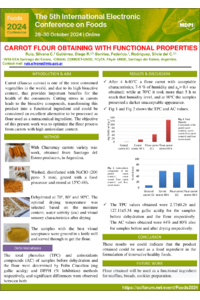
Carrot (Daucus carota) is one of the most widely consumed vegetables in the world, providing important health benefits to consumers due to its high bioactive content. Wounding stress in carrots induces the accumulation of bioactive compounds, transforming this product into a functional ingredient that could be considered an excellent alternative to be processed as flour and used as a nutraceutical ingredient. The objective of this work was to optimize the process of obtaining carrot flour with high antioxidant content. Carrots of the Chantenay variety, obtained from Santiago del Estero-Argentina producers, were washed, disinfected, cut (grated) and stored at 15°C for 48h. The stressed tissue was dehydrated at different temperatures, 70°, 80° and 90ºC, and the optimal temperature was selected based on the moisture content, water activity (aw) and visual sensory characteristics after drying. It was determined that after 4h at 80°C, a product with very good characteristics was obtained, with 7-8% of humidity and aw:0.4;,while at 70°C it took more than 5 h to reach that humidity level, and at 90°C the samples presented a darker and unacceptable appearance. The samples dehydrated at 80°C for 4h were ground in a knife mill and sieved to obtain the flour. The total phenolic content (TPC) and antioxidant compounds (ACs) of samples before dehydration and the flour were determined by the Folin–Cioucalteu (mg gallic acid/g) and DPPH (%inhibition) methods, respectively, and significant differences were observed between both. The carrot flour obtained had a content of approximately 90% more total phenols and 20% more antioxidant compounds than the carrot stressed before dehydration (13.88 mg gallic acid/g and 58%, respectively). These results indicate that the product obtained could be used as a food ingredient in the formulation of healthy innovative foods.
Keywords
Carrots
flour
processing.
Poster
CARROT FLOUR-Poster 03-10-2024.pdf
Modelling the microbial competition of Listeria monocytogenes and selected lactic acid bacteria strains in reconstituted milk
The valorization of orange by-products in food systems as additives and functional ingredients: A review