Event submissions
Published
This submission belongs to the session S3. Sustainable Food Security and Food System of the event The 5th International Electronic Conference on Foods
Published date
25 Oct, 2024
Academic Editor
'%3e%3cpath%20d='M12.6657%2010.9104C12.4185%2010.325%2012.0599%209.79327%2011.6097%209.34482C11.1609%208.89508%2010.6293%208.5365%2010.0442%208.28888C10.0389%208.28626%2010.0337%208.28495%2010.0285%208.28233C10.8446%207.69279%2011.3752%206.73249%2011.3752%205.64904C11.3752%203.8542%209.92103%202.39999%208.1262%202.39999C6.33136%202.39999%204.87715%203.8542%204.87715%205.64904C4.87715%206.73249%205.40774%207.69279%206.22393%208.28364C6.21869%208.28626%206.21345%208.28757%206.20821%208.29019C5.62129%208.5378%205.09463%208.89284%204.64265%209.34613C4.1929%209.79493%203.83432%2010.3266%203.58671%2010.9117C3.34345%2011.4845%203.21226%2012.0987%203.20023%2012.7209C3.19988%2012.7349%203.20233%2012.7488%203.20744%2012.7619C3.21255%2012.7749%203.22022%2012.7867%203.22998%2012.7968C3.23975%2012.8068%203.25142%2012.8147%203.26431%2012.8202C3.2772%2012.8256%203.29105%2012.8284%203.30504%2012.8284H4.09109C4.14874%2012.8284%204.19459%2012.7825%204.1959%2012.7262C4.2221%2011.7148%204.62823%2010.7676%205.34617%2010.0497C6.08899%209.30683%207.0755%208.89808%208.1262%208.89808C9.17689%208.89808%2010.1634%209.30683%2010.9062%2010.0497C11.6242%2010.7676%2012.0303%2011.7148%2012.0565%2012.7262C12.0578%2012.7838%2012.1037%2012.8284%2012.1613%2012.8284H12.9474C12.9613%2012.8284%2012.9752%2012.8256%2012.9881%2012.8202C13.001%2012.8147%2013.0126%2012.8068%2013.0224%2012.7968C13.0322%2012.7867%2013.0398%2012.7749%2013.0449%2012.7619C13.0501%2012.7488%2013.0525%2012.7349%2013.0522%2012.7209C13.0391%2012.0947%2012.9094%2011.4855%2012.6657%2010.9104ZM8.1262%207.9024C7.52486%207.9024%206.9589%207.6679%206.53312%207.24211C6.10733%206.81633%205.87283%206.25037%205.87283%205.64904C5.87283%205.0477%206.10733%204.48174%206.53312%204.05596C6.9589%203.63018%207.52486%203.39567%208.1262%203.39567C8.72753%203.39567%209.29349%203.63018%209.71927%204.05596C10.1451%204.48174%2010.3796%205.0477%2010.3796%205.64904C10.3796%206.25037%2010.1451%206.81633%209.71927%207.24211C9.29349%207.6679%208.72753%207.9024%208.1262%207.9024Z'%20fill='%235D1EE1'/%3e%3c/g%3e%3c/svg%3e) Theodoros Varzakas
Theodoros VarzakasCitation
Lynda Messaoudene, Khokha Mouhoubi, Yasmine Djedjiga Bradai, Feriel Zebiri, Amina Ouchene, Lamia Medouni-Haroun, Samira Negrichi, Khodir Madani, The valorization of orange by-products in food systems as additives and functional ingredients: A review, in Proceedings of The 5th International Electronic Conference on Foods, 28 October–30 October 2024, MDPI: Basel, Switzerland
Share
Email
Facebook
Twitter
LinkedIn
The valorization of orange by-products in food systems as additives and functional ingredients: A review
'%3e%3cpath%20d='M12.6647%2010.9104C12.4176%2010.325%2012.0589%209.7933%2011.6088%209.34485C11.16%208.89511%2010.6283%208.53653%2010.0432%208.28891C10.038%208.28629%2010.0327%208.28498%2010.0275%208.28236C10.8437%207.69282%2011.3743%206.73252%2011.3743%205.64907C11.3743%203.85423%209.92005%202.40002%208.12522%202.40002C6.33038%202.40002%204.87618%203.85423%204.87618%205.64907C4.87618%206.73252%205.40677%207.69282%206.22296%208.28367C6.21772%208.28629%206.21248%208.2876%206.20724%208.29022C5.62031%208.53783%205.09365%208.89287%204.64167%209.34616C4.19192%209.79496%203.83334%2010.3266%203.58573%2010.9117C3.34247%2011.4846%203.21128%2012.0987%203.19925%2012.721C3.1989%2012.735%203.20135%2012.7489%203.20646%2012.7619C3.21157%2012.7749%203.21924%2012.7868%203.22901%2012.7968C3.23877%2012.8068%203.25045%2012.8148%203.26334%2012.8202C3.27623%2012.8256%203.29007%2012.8284%203.30406%2012.8284H4.09012C4.14776%2012.8284%204.19362%2012.7825%204.19493%2012.7262C4.22113%2011.7148%204.62726%2010.7676%205.34519%2010.0497C6.08802%209.30686%207.07452%208.89811%208.12522%208.89811C9.17592%208.89811%2010.1624%209.30686%2010.9052%2010.0497C11.6232%2010.7676%2012.0293%2011.7148%2012.0555%2012.7262C12.0568%2012.7839%2012.1027%2012.8284%2012.1603%2012.8284H12.9464C12.9604%2012.8284%2012.9742%2012.8256%2012.9871%2012.8202C13%2012.8148%2013.0117%2012.8068%2013.0214%2012.7968C13.0312%2012.7868%2013.0389%2012.7749%2013.044%2012.7619C13.0491%2012.7489%2013.0515%2012.735%2013.0512%2012.721C13.0381%2012.0947%2012.9084%2011.4856%2012.6647%2010.9104ZM8.12522%207.90243C7.52388%207.90243%206.95792%207.66793%206.53214%207.24215C6.10636%206.81636%205.87185%206.2504%205.87185%205.64907C5.87185%205.04773%206.10636%204.48177%206.53214%204.05599C6.95792%203.63021%207.52388%203.3957%208.12522%203.3957C8.72655%203.3957%209.29252%203.63021%209.7183%204.05599C10.1441%204.48177%2010.3786%205.04773%2010.3786%205.64907C10.3786%206.2504%2010.1441%206.81636%209.7183%207.24215C9.29252%207.66793%208.72655%207.90243%208.12522%207.90243Z'%20fill='%235D1EE1'/%3e%3c/g%3e%3c/svg%3e)
Lynda Messaoudene 1
Khokha Mouhoubi 1
Yasmine Djedjiga Bradai 1
Feriel Zebiri 1
Amina Ouchene 1
Lamia Medouni-Haroun 1

Samira Negrichi 1
Khodir Madani 1
1. Centre de Recherche en Technologies Agroalimentaires. Route de Targa Ouzemmour, Campus Universitaire, Bejaia, 06000. Algeria.
Abstract
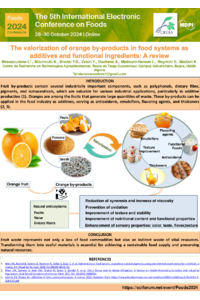
Fruit by-products contain several industrially important components, such as polyphenols, dietary fiber, pigments, and nutraceuticals, which are valuable for various industrial applications, particularly in additive production (Wani et al., 2021).
Oranges are among the fruits that generate large quantities of waste. These by-products are applied as additives in the food industry, serving as antioxidants, emulsifiers, flavoring agents, and thickeners (Wadhwa et al., 2016; Khan et al., 2021; and Varmie and Thakur, 2021). Orange pomace, due to its high fiber content, is successfully used in the development of innovative "whole food" products (Oduntan and Arueya, 2019) and also serves as a valuable source for producing fiber-rich yogurt with enhanced functional and nutritional benefits. In addition, the high water content of orange pomace gives it the ability to reduce syneresis and improve the viscosity of yogurt, while also maintaining or enhancing sensory properties (Acharjee et al., 2021). Like pomace, orange peels offer significant benefits and have diverse applications in the food industry. They are used in the preparation of sweets (Mohanta et al., 2021) and incorporated into a range of products, such as healthy biscuits (Teke et al., 2023), functional cupcakes and crackers (Zoair et al., 2019), brewed beers (Pereira et al., 2020), marmalades (Sicari et al., 2018), and orange jam (Teixeira et al., 2020). Orange peels enhance the color, taste, and flavor of these products (Verma et al., 2020). Additionally, they improve the quality of cakes (El-Beltagi et al., 2022) and help preserve products such as corn against Sitophilus zeamais (Yves et al., 2021) and ice cream by enriching it with antioxidants (Ademosun et al., 2021).
Fruit waste represents not only a loss of food commodities but also an indirect waste of vital resources. Transforming these wastes into useful products is essential for achieving a sustainable food supply and preserving natural resources.
Keywords
Orange
by-product
valorisation
additives
functional foods
Poster
Foods poster.pdf
Obtaining carrot flour with functional properties
Innovative technologies to increase bioactive compounds in carrots of the chantenay variety