Event submissions
Published
This submission belongs to the session S1. Innovation in Food Technology and Engineering of the event The 5th International Electronic Conference on Foods
Published date
25 Oct, 2024
Academic Editor
'%3e%3cpath%20d='M12.6657%2010.9104C12.4185%2010.325%2012.0599%209.79327%2011.6097%209.34482C11.1609%208.89508%2010.6293%208.5365%2010.0442%208.28888C10.0389%208.28626%2010.0337%208.28495%2010.0285%208.28233C10.8446%207.69279%2011.3752%206.73249%2011.3752%205.64904C11.3752%203.8542%209.92103%202.39999%208.1262%202.39999C6.33136%202.39999%204.87715%203.8542%204.87715%205.64904C4.87715%206.73249%205.40774%207.69279%206.22393%208.28364C6.21869%208.28626%206.21345%208.28757%206.20821%208.29019C5.62129%208.5378%205.09463%208.89284%204.64265%209.34613C4.1929%209.79493%203.83432%2010.3266%203.58671%2010.9117C3.34345%2011.4845%203.21226%2012.0987%203.20023%2012.7209C3.19988%2012.7349%203.20233%2012.7488%203.20744%2012.7619C3.21255%2012.7749%203.22022%2012.7867%203.22998%2012.7968C3.23975%2012.8068%203.25142%2012.8147%203.26431%2012.8202C3.2772%2012.8256%203.29105%2012.8284%203.30504%2012.8284H4.09109C4.14874%2012.8284%204.19459%2012.7825%204.1959%2012.7262C4.2221%2011.7148%204.62823%2010.7676%205.34617%2010.0497C6.08899%209.30683%207.0755%208.89808%208.1262%208.89808C9.17689%208.89808%2010.1634%209.30683%2010.9062%2010.0497C11.6242%2010.7676%2012.0303%2011.7148%2012.0565%2012.7262C12.0578%2012.7838%2012.1037%2012.8284%2012.1613%2012.8284H12.9474C12.9613%2012.8284%2012.9752%2012.8256%2012.9881%2012.8202C13.001%2012.8147%2013.0126%2012.8068%2013.0224%2012.7968C13.0322%2012.7867%2013.0398%2012.7749%2013.0449%2012.7619C13.0501%2012.7488%2013.0525%2012.7349%2013.0522%2012.7209C13.0391%2012.0947%2012.9094%2011.4855%2012.6657%2010.9104ZM8.1262%207.9024C7.52486%207.9024%206.9589%207.6679%206.53312%207.24211C6.10733%206.81633%205.87283%206.25037%205.87283%205.64904C5.87283%205.0477%206.10733%204.48174%206.53312%204.05596C6.9589%203.63018%207.52486%203.39567%208.1262%203.39567C8.72753%203.39567%209.29349%203.63018%209.71927%204.05596C10.1451%204.48174%2010.3796%205.0477%2010.3796%205.64904C10.3796%206.25037%2010.1451%206.81633%209.71927%207.24211C9.29349%207.6679%208.72753%207.9024%208.1262%207.9024Z'%20fill='%235D1EE1'/%3e%3c/g%3e%3c/svg%3e) Moktar Hamdi
Moktar HamdiCitation
Diego Ricardo Gutiérrez, Silvana Cecilia Ruiz, Federico Benitez, Silvia Del Carmen Rodriguez, Innovative technologies to increase bioactive compounds in carrots of the chantenay variety, in Proceedings of The 5th International Electronic Conference on Foods, 28 October–30 October 2024, MDPI: Basel, Switzerland
Share
Email
Facebook
Twitter
LinkedIn
Innovative technologies to increase bioactive compounds in carrots of the chantenay variety
'%3e%3cpath%20d='M12.6647%2010.9104C12.4176%2010.325%2012.0589%209.7933%2011.6088%209.34485C11.16%208.89511%2010.6283%208.53653%2010.0432%208.28891C10.038%208.28629%2010.0327%208.28498%2010.0275%208.28236C10.8437%207.69282%2011.3743%206.73252%2011.3743%205.64907C11.3743%203.85423%209.92005%202.40002%208.12522%202.40002C6.33038%202.40002%204.87618%203.85423%204.87618%205.64907C4.87618%206.73252%205.40677%207.69282%206.22296%208.28367C6.21772%208.28629%206.21248%208.2876%206.20724%208.29022C5.62031%208.53783%205.09365%208.89287%204.64167%209.34616C4.19192%209.79496%203.83334%2010.3266%203.58573%2010.9117C3.34247%2011.4846%203.21128%2012.0987%203.19925%2012.721C3.1989%2012.735%203.20135%2012.7489%203.20646%2012.7619C3.21157%2012.7749%203.21924%2012.7868%203.22901%2012.7968C3.23877%2012.8068%203.25045%2012.8148%203.26334%2012.8202C3.27623%2012.8256%203.29007%2012.8284%203.30406%2012.8284H4.09012C4.14776%2012.8284%204.19362%2012.7825%204.19493%2012.7262C4.22113%2011.7148%204.62726%2010.7676%205.34519%2010.0497C6.08802%209.30686%207.07452%208.89811%208.12522%208.89811C9.17592%208.89811%2010.1624%209.30686%2010.9052%2010.0497C11.6232%2010.7676%2012.0293%2011.7148%2012.0555%2012.7262C12.0568%2012.7839%2012.1027%2012.8284%2012.1603%2012.8284H12.9464C12.9604%2012.8284%2012.9742%2012.8256%2012.9871%2012.8202C13%2012.8148%2013.0117%2012.8068%2013.0214%2012.7968C13.0312%2012.7868%2013.0389%2012.7749%2013.044%2012.7619C13.0491%2012.7489%2013.0515%2012.735%2013.0512%2012.721C13.0381%2012.0947%2012.9084%2011.4856%2012.6647%2010.9104ZM8.12522%207.90243C7.52388%207.90243%206.95792%207.66793%206.53214%207.24215C6.10636%206.81636%205.87185%206.2504%205.87185%205.64907C5.87185%205.04773%206.10636%204.48177%206.53214%204.05599C6.95792%203.63021%207.52388%203.3957%208.12522%203.3957C8.72655%203.3957%209.29252%203.63021%209.7183%204.05599C10.1441%204.48177%2010.3786%205.04773%2010.3786%205.64907C10.3786%206.2504%2010.1441%206.81636%209.7183%207.24215C9.29252%207.66793%208.72655%207.90243%208.12522%207.90243Z'%20fill='%235D1EE1'/%3e%3c/g%3e%3c/svg%3e)
Diego Ricardo Gutiérrez 1,2

Silvana Cecilia Ruiz 3
Federico Benitez 1
Silvia Del Carmen Rodriguez 1,2
1. Instituto de Ciencia y Tecnología de los Alimentos. Facultad de Agronomía y Agroindustrias, Universidad Nacional de Santiago del Estero (UNSE).
2. CIBAAL CONICET-UNSE, Villa El Zanjón, Santiago del Estero, Argentina
3. Instituto Nacional de Tecnología Agropecuaria, Estación Experimental Agropecuaria Santiago del Estero (INTA-EEASE)
Abstract
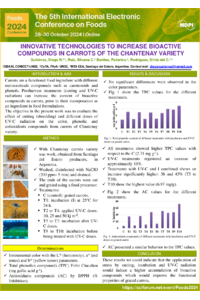
Carrots have become a functional food ingredient, providing various nutraceuticals such as carotenoids and phenols. Postharvest treatments (cutting and UV-C radiation) can increase the content of bioactive compounds in carrots, prior to their incorporation as an ingredient in food formulations. In this work, the effect of cutting (shredding) and different doses of UV-C radiation on the content of phenolic compounds and antioxidants, as well as the color of carrots of the Chantenay variety, was evaluated. Carrots, obtained from producers in Santiago del Estero-Argentina, were washed, disinfected in a chlorine solution (200 ppm, 5 min) and drained. The ends of the carrots were cut and grated using a food processor. The samples were then subjected to the different treatments: T1 (control): grated carrots; T2 (control + I): samples incubated at 25 ºC for 24 h; T3-5 (UV-C): carrots with applied doses of UV-C: 10, 25 and 50 kJ/m2; T6-8 (UV-C + I): carrots incubated after being treated with the UV-C doses; T9-11 (I + UV-C): carrots incubated before UV-C. All treatments showed higher total phenol content with respect to the control (2.71 mg/g). UV-C treatments registered an increase of approximately 10%; however, when UV-C was combined with incubation, the increase was significantly higher, approximately 56 and 45% when performed before and after UV-C, respectively. I + 50 kJ/m2 treatment exhibited the highest value (6.97 mg/g). Antioxidant capacity presented similar behavior to total phenols. As for color parameters, no significant differences were observed without deterioration of visual quality. Thus, the application of stress by cutting followed by incubation and UV-C radiation would induce a higher accumulation of bioactive compounds, which would benefit the obtention of a carrot flour to be used as a new food ingredient with improved functional properties.
Keywords
Cut
postharvest
UV-C radiation.
Poster
CARROT- I+ UV-C-poster 03-10-2024.pdf
The valorization of orange by-products in food systems as additives and functional ingredients: A review
Antimicrobial susceptibility of Staphylococcus aureus strains against Melipona bicolor honey