Event submissions
Published
This submission belongs to the session S8. Food Quality and Safety of the event The 5th International Electronic Conference on Foods
Published date
25 Oct, 2024
Academic Editor
'%3e%3cpath%20d='M12.6657%2010.9104C12.4185%2010.325%2012.0599%209.79327%2011.6097%209.34482C11.1609%208.89508%2010.6293%208.5365%2010.0442%208.28888C10.0389%208.28626%2010.0337%208.28495%2010.0285%208.28233C10.8446%207.69279%2011.3752%206.73249%2011.3752%205.64904C11.3752%203.8542%209.92103%202.39999%208.1262%202.39999C6.33136%202.39999%204.87715%203.8542%204.87715%205.64904C4.87715%206.73249%205.40774%207.69279%206.22393%208.28364C6.21869%208.28626%206.21345%208.28757%206.20821%208.29019C5.62129%208.5378%205.09463%208.89284%204.64265%209.34613C4.1929%209.79493%203.83432%2010.3266%203.58671%2010.9117C3.34345%2011.4845%203.21226%2012.0987%203.20023%2012.7209C3.19988%2012.7349%203.20233%2012.7488%203.20744%2012.7619C3.21255%2012.7749%203.22022%2012.7867%203.22998%2012.7968C3.23975%2012.8068%203.25142%2012.8147%203.26431%2012.8202C3.2772%2012.8256%203.29105%2012.8284%203.30504%2012.8284H4.09109C4.14874%2012.8284%204.19459%2012.7825%204.1959%2012.7262C4.2221%2011.7148%204.62823%2010.7676%205.34617%2010.0497C6.08899%209.30683%207.0755%208.89808%208.1262%208.89808C9.17689%208.89808%2010.1634%209.30683%2010.9062%2010.0497C11.6242%2010.7676%2012.0303%2011.7148%2012.0565%2012.7262C12.0578%2012.7838%2012.1037%2012.8284%2012.1613%2012.8284H12.9474C12.9613%2012.8284%2012.9752%2012.8256%2012.9881%2012.8202C13.001%2012.8147%2013.0126%2012.8068%2013.0224%2012.7968C13.0322%2012.7867%2013.0398%2012.7749%2013.0449%2012.7619C13.0501%2012.7488%2013.0525%2012.7349%2013.0522%2012.7209C13.0391%2012.0947%2012.9094%2011.4855%2012.6657%2010.9104ZM8.1262%207.9024C7.52486%207.9024%206.9589%207.6679%206.53312%207.24211C6.10733%206.81633%205.87283%206.25037%205.87283%205.64904C5.87283%205.0477%206.10733%204.48174%206.53312%204.05596C6.9589%203.63018%207.52486%203.39567%208.1262%203.39567C8.72753%203.39567%209.29349%203.63018%209.71927%204.05596C10.1451%204.48174%2010.3796%205.0477%2010.3796%205.64904C10.3796%206.25037%2010.1451%206.81633%209.71927%207.24211C9.29349%207.6679%208.72753%207.9024%208.1262%207.9024Z'%20fill='%235D1EE1'/%3e%3c/g%3e%3c/svg%3e) Antonello Santini
Antonello SantiniCitation
Jose Manuel Silvan, Raúl Hurtado-Ribeira, Diana Martín, Adolfo J. Martinez-Rodriguez, Antibacterial activity of fat extracts from black soldier fly fat larvae (Hermetia illucens) against antibiotic-resistant Campylobacter spp strains, in Proceedings of The 5th International Electronic Conference on Foods, 28 October–30 October 2024, MDPI: Basel, Switzerland
Share
Email
Facebook
Twitter
LinkedIn
Antibacterial activity of fat extracts from black soldier fly fat larvae (Hermetia illucens) against antibiotic-resistant Campylobacter spp strains

Jose Manuel Silvan 1
'%3e%3cpath%20d='M12.6647%2010.9104C12.4176%2010.325%2012.0589%209.7933%2011.6088%209.34485C11.16%208.89511%2010.6283%208.53653%2010.0432%208.28891C10.038%208.28629%2010.0327%208.28498%2010.0275%208.28236C10.8437%207.69282%2011.3743%206.73252%2011.3743%205.64907C11.3743%203.85423%209.92005%202.40002%208.12522%202.40002C6.33038%202.40002%204.87618%203.85423%204.87618%205.64907C4.87618%206.73252%205.40677%207.69282%206.22296%208.28367C6.21772%208.28629%206.21248%208.2876%206.20724%208.29022C5.62031%208.53783%205.09365%208.89287%204.64167%209.34616C4.19192%209.79496%203.83334%2010.3266%203.58573%2010.9117C3.34247%2011.4846%203.21128%2012.0987%203.19925%2012.721C3.1989%2012.735%203.20135%2012.7489%203.20646%2012.7619C3.21157%2012.7749%203.21924%2012.7868%203.22901%2012.7968C3.23877%2012.8068%203.25045%2012.8148%203.26334%2012.8202C3.27623%2012.8256%203.29007%2012.8284%203.30406%2012.8284H4.09012C4.14776%2012.8284%204.19362%2012.7825%204.19493%2012.7262C4.22113%2011.7148%204.62726%2010.7676%205.34519%2010.0497C6.08802%209.30686%207.07452%208.89811%208.12522%208.89811C9.17592%208.89811%2010.1624%209.30686%2010.9052%2010.0497C11.6232%2010.7676%2012.0293%2011.7148%2012.0555%2012.7262C12.0568%2012.7839%2012.1027%2012.8284%2012.1603%2012.8284H12.9464C12.9604%2012.8284%2012.9742%2012.8256%2012.9871%2012.8202C13%2012.8148%2013.0117%2012.8068%2013.0214%2012.7968C13.0312%2012.7868%2013.0389%2012.7749%2013.044%2012.7619C13.0491%2012.7489%2013.0515%2012.735%2013.0512%2012.721C13.0381%2012.0947%2012.9084%2011.4856%2012.6647%2010.9104ZM8.12522%207.90243C7.52388%207.90243%206.95792%207.66793%206.53214%207.24215C6.10636%206.81636%205.87185%206.2504%205.87185%205.64907C5.87185%205.04773%206.10636%204.48177%206.53214%204.05599C6.95792%203.63021%207.52388%203.3957%208.12522%203.3957C8.72655%203.3957%209.29252%203.63021%209.7183%204.05599C10.1441%204.48177%2010.3786%205.04773%2010.3786%205.64907C10.3786%206.2504%2010.1441%206.81636%209.7183%207.24215C9.29252%207.66793%208.72655%207.90243%208.12522%207.90243Z'%20fill='%235D1EE1'/%3e%3c/g%3e%3c/svg%3e)
Raúl Hurtado-Ribeira 2,3

Diana Martín 2,3

Adolfo J. Martinez-Rodriguez 1
1. Grupo de Microbiología y Biocatálisis (MICROBIO), Departamento de Biotecnología y Microbiología, Instituto de Investigación en Ciencias de la Alimentación (CIAL) (CSIC-UAM), Madrid, Spain
2. Departamento de Producción y Caracterización de Nuevos Alimentos, Instituto de Investigación en Ciencias de la Alimentación (CIAL, CSIC-UAM), Madrid, Spain
3. Sección Departamental de Ciencias de la Alimentación, Facultad de Ciencias, Universidad Autónoma de Madrid, Madrid, Spain
Abstract
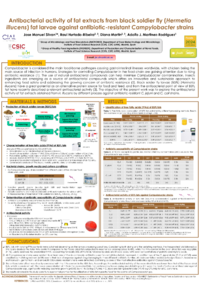
Campylobacter is considered the main food-borne pathogen causing gastrointestinal illnesses worldwide, with chicken being the main source of infection in humans. Strategies for controlling Campylobacter in the food chain are gaining attention due to rising antibiotic resistance. The use of natural antibacterial compounds can help minimize Campylobacter contamination. Insect ingredients are emerging as a source of antibacterial compounds which offers an innovative and sustainable approach to enhancing food safety and addressing the growing concern of antibiotic resistance. Black soldier fly larvae (BSFL) (Hermetia illucens) have a great potential as an alternative protein source for food and feed, and from an antibacterial point of view, BSFL fat has recently been reported to exhibit relevant antibacterial activity. Our main objective was to explore the antibacterial activity of fat extracts obtained from H. illucens using different processes against antibiotic-resistant C. jejuni and C. coli strains. Three different C. jejuni and three C. coli strains were used. Bacterial strains were incubated with fat extracts at 37ºC for 24 h, and the number of CFUs was counted. The free fatty acid content of insect fat extracts was analysed by means of GC-MS-FID. Results showed that the antibacterial activity of BSFL fat extracts was related to the free fatty acid content. The fat extract obtained after slaughter by means of blanching, drying using freeze-drying, and defatting using supercritical fluid extraction was the most effective, being bactericidal for all C. coli strains and significantly reducing bacterial growth from 4.1 to 5.6 log CFU/mL for C. jejuni strains. The evaluation of the antibacterial activity of the main fatty acids present in the BSFL fat extracts showed that lauric and linoleic acids were both bactericidal. The antibacterial activity of BSFL fat extracts against Campylobacter indicates that these fat extracts may be useful as a source of bioactive compounds, which could potentially be applicable in the chicken food chain.
Keywords
antibacterial activity
black soldier fly
Campylobacter
fat extracts
lauric acid
linoleic acid
Poster
Silvan et al..pdf
The stability of saffron stamen anthocyanin extracts in oxidation and reduction media
Effect of fermentation processes and starters on phenolic compounds in legume protein creams