Event submissions
Published
This submission belongs to the session S2. Food Nutrition and Functional Foods of the event The 5th International Electronic Conference on Foods
Published date
25 Oct, 2024
Academic Editor
'%3e%3cpath%20d='M12.6657%2010.9104C12.4185%2010.325%2012.0599%209.79327%2011.6097%209.34482C11.1609%208.89508%2010.6293%208.5365%2010.0442%208.28888C10.0389%208.28626%2010.0337%208.28495%2010.0285%208.28233C10.8446%207.69279%2011.3752%206.73249%2011.3752%205.64904C11.3752%203.8542%209.92103%202.39999%208.1262%202.39999C6.33136%202.39999%204.87715%203.8542%204.87715%205.64904C4.87715%206.73249%205.40774%207.69279%206.22393%208.28364C6.21869%208.28626%206.21345%208.28757%206.20821%208.29019C5.62129%208.5378%205.09463%208.89284%204.64265%209.34613C4.1929%209.79493%203.83432%2010.3266%203.58671%2010.9117C3.34345%2011.4845%203.21226%2012.0987%203.20023%2012.7209C3.19988%2012.7349%203.20233%2012.7488%203.20744%2012.7619C3.21255%2012.7749%203.22022%2012.7867%203.22998%2012.7968C3.23975%2012.8068%203.25142%2012.8147%203.26431%2012.8202C3.2772%2012.8256%203.29105%2012.8284%203.30504%2012.8284H4.09109C4.14874%2012.8284%204.19459%2012.7825%204.1959%2012.7262C4.2221%2011.7148%204.62823%2010.7676%205.34617%2010.0497C6.08899%209.30683%207.0755%208.89808%208.1262%208.89808C9.17689%208.89808%2010.1634%209.30683%2010.9062%2010.0497C11.6242%2010.7676%2012.0303%2011.7148%2012.0565%2012.7262C12.0578%2012.7838%2012.1037%2012.8284%2012.1613%2012.8284H12.9474C12.9613%2012.8284%2012.9752%2012.8256%2012.9881%2012.8202C13.001%2012.8147%2013.0126%2012.8068%2013.0224%2012.7968C13.0322%2012.7867%2013.0398%2012.7749%2013.0449%2012.7619C13.0501%2012.7488%2013.0525%2012.7349%2013.0522%2012.7209C13.0391%2012.0947%2012.9094%2011.4855%2012.6657%2010.9104ZM8.1262%207.9024C7.52486%207.9024%206.9589%207.6679%206.53312%207.24211C6.10733%206.81633%205.87283%206.25037%205.87283%205.64904C5.87283%205.0477%206.10733%204.48174%206.53312%204.05596C6.9589%203.63018%207.52486%203.39567%208.1262%203.39567C8.72753%203.39567%209.29349%203.63018%209.71927%204.05596C10.1451%204.48174%2010.3796%205.0477%2010.3796%205.64904C10.3796%206.25037%2010.1451%206.81633%209.71927%207.24211C9.29349%207.6679%208.72753%207.9024%208.1262%207.9024Z'%20fill='%235D1EE1'/%3e%3c/g%3e%3c/svg%3e) Antonello Santini
Antonello SantiniCitation
Marina Roldán-Muñoz, Concepción Sánchez-Moreno, Begoña de Ancos, Valorization of apple bagasse using sustainable technologies and encapsulation, in Proceedings of The 5th International Electronic Conference on Foods, 28 October–30 October 2024, MDPI: Basel, Switzerland
Share
Email
Facebook
Twitter
LinkedIn
Valorization of apple bagasse using sustainable technologies and encapsulation
'%3e%3cpath%20d='M12.6647%2010.9104C12.4176%2010.325%2012.0589%209.7933%2011.6088%209.34485C11.16%208.89511%2010.6283%208.53653%2010.0432%208.28891C10.038%208.28629%2010.0327%208.28498%2010.0275%208.28236C10.8437%207.69282%2011.3743%206.73252%2011.3743%205.64907C11.3743%203.85423%209.92005%202.40002%208.12522%202.40002C6.33038%202.40002%204.87618%203.85423%204.87618%205.64907C4.87618%206.73252%205.40677%207.69282%206.22296%208.28367C6.21772%208.28629%206.21248%208.2876%206.20724%208.29022C5.62031%208.53783%205.09365%208.89287%204.64167%209.34616C4.19192%209.79496%203.83334%2010.3266%203.58573%2010.9117C3.34247%2011.4846%203.21128%2012.0987%203.19925%2012.721C3.1989%2012.735%203.20135%2012.7489%203.20646%2012.7619C3.21157%2012.7749%203.21924%2012.7868%203.22901%2012.7968C3.23877%2012.8068%203.25045%2012.8148%203.26334%2012.8202C3.27623%2012.8256%203.29007%2012.8284%203.30406%2012.8284H4.09012C4.14776%2012.8284%204.19362%2012.7825%204.19493%2012.7262C4.22113%2011.7148%204.62726%2010.7676%205.34519%2010.0497C6.08802%209.30686%207.07452%208.89811%208.12522%208.89811C9.17592%208.89811%2010.1624%209.30686%2010.9052%2010.0497C11.6232%2010.7676%2012.0293%2011.7148%2012.0555%2012.7262C12.0568%2012.7839%2012.1027%2012.8284%2012.1603%2012.8284H12.9464C12.9604%2012.8284%2012.9742%2012.8256%2012.9871%2012.8202C13%2012.8148%2013.0117%2012.8068%2013.0214%2012.7968C13.0312%2012.7868%2013.0389%2012.7749%2013.044%2012.7619C13.0491%2012.7489%2013.0515%2012.735%2013.0512%2012.721C13.0381%2012.0947%2012.9084%2011.4856%2012.6647%2010.9104ZM8.12522%207.90243C7.52388%207.90243%206.95792%207.66793%206.53214%207.24215C6.10636%206.81636%205.87185%206.2504%205.87185%205.64907C5.87185%205.04773%206.10636%204.48177%206.53214%204.05599C6.95792%203.63021%207.52388%203.3957%208.12522%203.3957C8.72655%203.3957%209.29252%203.63021%209.7183%204.05599C10.1441%204.48177%2010.3786%205.04773%2010.3786%205.64907C10.3786%206.2504%2010.1441%206.81636%209.7183%207.24215C9.29252%207.66793%208.72655%207.90243%208.12522%207.90243Z'%20fill='%235D1EE1'/%3e%3c/g%3e%3c/svg%3e)
Marina Roldán-Muñoz 1
Concepción Sánchez-Moreno 1

Begoña de Ancos 1
1. Department of Characterization, Quality and Safety, Institute of Food Science, Technology and Nutrition (ICTAN-CSIC), Madrid, Spain.
Abstract
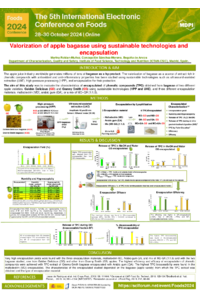
Introduction: The apple juice industry worldwide generates millions of tons of bagasse as a by-product. The valorization of bagasse as a source of extract rich in phenolic compounds (TPCs) with antioxidant and anti-inflammatory properties has been studied using sustainable technologies such as ultrasound-assisted extraction (UAE), high-pressure processing (HPP), and encapsulation for their protection. TPC encapsulation could be used for food functionalization.
Methodology: HPP-treated (200-400 MPa/25ºC/5 min) dried bagasse (6 g) of Granny Smith (BGS) (3.19 mg gallic acid equivalents (GAEs)) and Golden Delicious (BGD) apples (2.9 mg GAEs) were extracted using UAE (amplitude = 42µm/20min; EtOH/H2O, 50:50) and the extracts were encapsulated by lyophilization with 200 ml of an 8% solution of maltodextrin (MD), gum Arabic (GA), or a mix of MD–GA (1:1.5). The yield (%), efficiency (% TPC inside compared to the total in the capsules), and efficacy (% TPC encapsulated compared to the total in the initial solution) of the encapsulation process were evaluated. In addition, the moisture content, hygroscopicity of the capsules, and the release of TPC during gastrointestinal digestion (GID) were determined.
Results: The yield of the encapsulation was a bit higher in BGD-encapsulated (99%) than in BGS-encapsulated (96%) samples. The humidity was similar in all the encapsulated samples (9-10%). GA-encapsulated samples (BGS = 34% and BGD = 39%) showed a higher hygroscopicity than MD- and MD–GA-encapsulated samples(~30%). The efficiency was higher in GA-encapsulated (~84%) than in MD–GA- (~70%) and MD-encapsulated samples (~23%). The maximum efficacy was found in GA-encapsulated samples (85% = BGS; 53% = BGD) compared to MD–GA-encapsulated (66%-BGS, 36%-BGD) and MD-encapsulated sampkes (127% = BGS; 6% = BGD). The highest TPC bioaccessibility was found in MD-encapsulated samples (BGS = 17% and BGD = 29%).
Conclusions: Very high lyophilization encapsulation yields were found with the three encapsulation materials (MD, GA, and MD–GA) and with the bagasse of two apples. The highest efficiency and effectiveness were achieved with Granny Smith bagasse and gum Arabic. The characteristics of the encapsulated bagasse phenolic extracts depended on the apple variety and the encapsulation material.
Keywords
Apple bagasse
phenolic compounds
ultrasound-assited extraction
high-pressure processing
encapsulation
lyophilization
Poster
Roldan-Muñoz et al. Valorization of apple bagasse.pdf
137Cs and 40K radioactivity of wild edible mushrooms from Podlaskie Voivodeship, Poland
Comparison between two different mass spectrometry platforms (MALDI-TOF MS) for rapid Shiga toxin-producing Escherichia coli O157:H7 detection in food.