Event submissions
Published
This submission belongs to the session S1. Innovation in Food Technology and Engineering of the event The 5th International Electronic Conference on Foods
Published date
25 Oct, 2024
Academic Editor
'%3e%3cpath%20d='M12.6657%2010.9104C12.4185%2010.325%2012.0599%209.79327%2011.6097%209.34482C11.1609%208.89508%2010.6293%208.5365%2010.0442%208.28888C10.0389%208.28626%2010.0337%208.28495%2010.0285%208.28233C10.8446%207.69279%2011.3752%206.73249%2011.3752%205.64904C11.3752%203.8542%209.92103%202.39999%208.1262%202.39999C6.33136%202.39999%204.87715%203.8542%204.87715%205.64904C4.87715%206.73249%205.40774%207.69279%206.22393%208.28364C6.21869%208.28626%206.21345%208.28757%206.20821%208.29019C5.62129%208.5378%205.09463%208.89284%204.64265%209.34613C4.1929%209.79493%203.83432%2010.3266%203.58671%2010.9117C3.34345%2011.4845%203.21226%2012.0987%203.20023%2012.7209C3.19988%2012.7349%203.20233%2012.7488%203.20744%2012.7619C3.21255%2012.7749%203.22022%2012.7867%203.22998%2012.7968C3.23975%2012.8068%203.25142%2012.8147%203.26431%2012.8202C3.2772%2012.8256%203.29105%2012.8284%203.30504%2012.8284H4.09109C4.14874%2012.8284%204.19459%2012.7825%204.1959%2012.7262C4.2221%2011.7148%204.62823%2010.7676%205.34617%2010.0497C6.08899%209.30683%207.0755%208.89808%208.1262%208.89808C9.17689%208.89808%2010.1634%209.30683%2010.9062%2010.0497C11.6242%2010.7676%2012.0303%2011.7148%2012.0565%2012.7262C12.0578%2012.7838%2012.1037%2012.8284%2012.1613%2012.8284H12.9474C12.9613%2012.8284%2012.9752%2012.8256%2012.9881%2012.8202C13.001%2012.8147%2013.0126%2012.8068%2013.0224%2012.7968C13.0322%2012.7867%2013.0398%2012.7749%2013.0449%2012.7619C13.0501%2012.7488%2013.0525%2012.7349%2013.0522%2012.7209C13.0391%2012.0947%2012.9094%2011.4855%2012.6657%2010.9104ZM8.1262%207.9024C7.52486%207.9024%206.9589%207.6679%206.53312%207.24211C6.10733%206.81633%205.87283%206.25037%205.87283%205.64904C5.87283%205.0477%206.10733%204.48174%206.53312%204.05596C6.9589%203.63018%207.52486%203.39567%208.1262%203.39567C8.72753%203.39567%209.29349%203.63018%209.71927%204.05596C10.1451%204.48174%2010.3796%205.0477%2010.3796%205.64904C10.3796%206.25037%2010.1451%206.81633%209.71927%207.24211C9.29349%207.6679%208.72753%207.9024%208.1262%207.9024Z'%20fill='%235D1EE1'/%3e%3c/g%3e%3c/svg%3e) Moktar Hamdi
Moktar HamdiCitation
Jiaxin Zuo, Xu Lu, Song Miao, Essam Hebishy, Mucoadhesion ability of protein and starch from lotus (Nelumbo nucifera Gaertn.) seeds, relative to milk casein, gelatine and gum arabic as well-recognized mucoadhesive biopolymers, in Proceedings of The 5th International Electronic Conference on Foods, 28 October–30 October 2024, MDPI: Basel, Switzerland
Share
Email
Facebook
Twitter
LinkedIn
Mucoadhesion ability of protein and starch from lotus (Nelumbo nucifera Gaertn.) seeds, relative to milk casein, gelatine and gum arabic as well-recognized mucoadhesive biopolymers
'%3e%3cpath%20d='M12.6647%2010.9104C12.4176%2010.325%2012.0589%209.7933%2011.6088%209.34485C11.16%208.89511%2010.6283%208.53653%2010.0432%208.28891C10.038%208.28629%2010.0327%208.28498%2010.0275%208.28236C10.8437%207.69282%2011.3743%206.73252%2011.3743%205.64907C11.3743%203.85423%209.92005%202.40002%208.12522%202.40002C6.33038%202.40002%204.87618%203.85423%204.87618%205.64907C4.87618%206.73252%205.40677%207.69282%206.22296%208.28367C6.21772%208.28629%206.21248%208.2876%206.20724%208.29022C5.62031%208.53783%205.09365%208.89287%204.64167%209.34616C4.19192%209.79496%203.83334%2010.3266%203.58573%2010.9117C3.34247%2011.4846%203.21128%2012.0987%203.19925%2012.721C3.1989%2012.735%203.20135%2012.7489%203.20646%2012.7619C3.21157%2012.7749%203.21924%2012.7868%203.22901%2012.7968C3.23877%2012.8068%203.25045%2012.8148%203.26334%2012.8202C3.27623%2012.8256%203.29007%2012.8284%203.30406%2012.8284H4.09012C4.14776%2012.8284%204.19362%2012.7825%204.19493%2012.7262C4.22113%2011.7148%204.62726%2010.7676%205.34519%2010.0497C6.08802%209.30686%207.07452%208.89811%208.12522%208.89811C9.17592%208.89811%2010.1624%209.30686%2010.9052%2010.0497C11.6232%2010.7676%2012.0293%2011.7148%2012.0555%2012.7262C12.0568%2012.7839%2012.1027%2012.8284%2012.1603%2012.8284H12.9464C12.9604%2012.8284%2012.9742%2012.8256%2012.9871%2012.8202C13%2012.8148%2013.0117%2012.8068%2013.0214%2012.7968C13.0312%2012.7868%2013.0389%2012.7749%2013.044%2012.7619C13.0491%2012.7489%2013.0515%2012.735%2013.0512%2012.721C13.0381%2012.0947%2012.9084%2011.4856%2012.6647%2010.9104ZM8.12522%207.90243C7.52388%207.90243%206.95792%207.66793%206.53214%207.24215C6.10636%206.81636%205.87185%206.2504%205.87185%205.64907C5.87185%205.04773%206.10636%204.48177%206.53214%204.05599C6.95792%203.63021%207.52388%203.3957%208.12522%203.3957C8.72655%203.3957%209.29252%203.63021%209.7183%204.05599C10.1441%204.48177%2010.3786%205.04773%2010.3786%205.64907C10.3786%206.2504%2010.1441%206.81636%209.7183%207.24215C9.29252%207.66793%208.72655%207.90243%208.12522%207.90243Z'%20fill='%235D1EE1'/%3e%3c/g%3e%3c/svg%3e)
Jiaxin Zuo 1
Xu Lu 2,3,4
Song Miao 2,5

Essam Hebishy 1
1. Centre of Excellence in Agri-food Technologies, National Centre for Food Manufacturing, College of Sciences, University of Lincoln, Holbeach, Spalding, PE12 7FJ, United Kingdom
2. China-Ireland International Cooperation Center for Food Material Science and Structure Design, Fujian Agriculture and Forestry University, 350002 Fuzhou, China
3. College of Food Science, Fujian Agriculture and Forestry University, 15 Shangxiadian Road, 350002 Fuzhou, China
4. Institute of Food Science and Technology, Fujian Agriculture and Forestry University, 18 Simon Pit Road, 350002 Fuzhou, China
5. Teagasc Food Research Centre, Moorepark, Fermoy, Co. Cork, Ireland
Abstract
This study investigated the mucoadhesive properties of two polysaccharides [lotus seed starch (LS) and gum Arabic (GA)] and three proteins [lotus seed protein (LP), casein (CA), and gelatine (G)]. Different in vitro tests were carried-out to study the biopolymeric mucin interactions including mucin adsorption assay, turbidity development over 6 hours, and viscosity increase ("force of bioadhesion"). The free thiol content of proteins was also measured as one of the underlying mechanisms for adhesion. The biopolymers were studied at different concentrations (0.25-1% for polysaccharides and 2-10% for proteins, except G, which was studied at 1-5% due to its high gelling capacity). The effect of biopolymer modification on its ability as a mucoadhesive was also studied. Proteins underwent thermal treatment (H, 85⁰C/30 min), ultrasounds (US, 50% amplitude at 40⁰C/30 min), or heating followed by ultrasounds (H+US), while polysaccharides were treated with US only. The results showed a descending order of mucoadhesion: GA > LS > CA > G > LP. GA and CA had higher mucin adsorption than LP and LS. Increasing LP concentration decreased mucoadhesion, while CA increased adhesion, peaking at 10% protein content. However, gelatine showed maximum adhesion at 3%, which declined at higher concentrations; GA and LS had optimal mucin adsorption at 0.5%, with no improvement beyond this concentration. In addition, Casein's higher thiol content correlated with stronger mucoadhesion. Intact or heat-treated gelatine had high mucoadhesion, unlike US or H+US treatments, which reduced it. However, US treatment increased LS's ability to bind mucin, while LP showed no significant changes with any treatment. Therefore, these findings suggest the potential for using mucoadhesive biopolymers in food applications to prolong retention time on the mucosa, aiding in salt reduction without compromising taste.
Keywords
Mucoadhesion
protein
polysaccharides
reduce salt
Poster
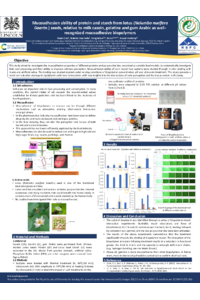
Poster_Jiaxin Zuo.pdf
Comparison between two different mass spectrometry platforms (MALDI-TOF MS) for rapid Shiga toxin-producing Escherichia coli O157:H7 detection in food.
Prevalence of Antimicrobial Resistance in Organized Dairy Production Systems