Event submissions
Published
This submission belongs to the session S2. Food Nutrition and Functional Foods of the event The 5th International Electronic Conference on Foods
Published date
25 Oct, 2024
Academic Editor
'%3e%3cpath%20d='M12.6657%2010.9104C12.4185%2010.325%2012.0599%209.79327%2011.6097%209.34482C11.1609%208.89508%2010.6293%208.5365%2010.0442%208.28888C10.0389%208.28626%2010.0337%208.28495%2010.0285%208.28233C10.8446%207.69279%2011.3752%206.73249%2011.3752%205.64904C11.3752%203.8542%209.92103%202.39999%208.1262%202.39999C6.33136%202.39999%204.87715%203.8542%204.87715%205.64904C4.87715%206.73249%205.40774%207.69279%206.22393%208.28364C6.21869%208.28626%206.21345%208.28757%206.20821%208.29019C5.62129%208.5378%205.09463%208.89284%204.64265%209.34613C4.1929%209.79493%203.83432%2010.3266%203.58671%2010.9117C3.34345%2011.4845%203.21226%2012.0987%203.20023%2012.7209C3.19988%2012.7349%203.20233%2012.7488%203.20744%2012.7619C3.21255%2012.7749%203.22022%2012.7867%203.22998%2012.7968C3.23975%2012.8068%203.25142%2012.8147%203.26431%2012.8202C3.2772%2012.8256%203.29105%2012.8284%203.30504%2012.8284H4.09109C4.14874%2012.8284%204.19459%2012.7825%204.1959%2012.7262C4.2221%2011.7148%204.62823%2010.7676%205.34617%2010.0497C6.08899%209.30683%207.0755%208.89808%208.1262%208.89808C9.17689%208.89808%2010.1634%209.30683%2010.9062%2010.0497C11.6242%2010.7676%2012.0303%2011.7148%2012.0565%2012.7262C12.0578%2012.7838%2012.1037%2012.8284%2012.1613%2012.8284H12.9474C12.9613%2012.8284%2012.9752%2012.8256%2012.9881%2012.8202C13.001%2012.8147%2013.0126%2012.8068%2013.0224%2012.7968C13.0322%2012.7867%2013.0398%2012.7749%2013.0449%2012.7619C13.0501%2012.7488%2013.0525%2012.7349%2013.0522%2012.7209C13.0391%2012.0947%2012.9094%2011.4855%2012.6657%2010.9104ZM8.1262%207.9024C7.52486%207.9024%206.9589%207.6679%206.53312%207.24211C6.10733%206.81633%205.87283%206.25037%205.87283%205.64904C5.87283%205.0477%206.10733%204.48174%206.53312%204.05596C6.9589%203.63018%207.52486%203.39567%208.1262%203.39567C8.72753%203.39567%209.29349%203.63018%209.71927%204.05596C10.1451%204.48174%2010.3796%205.0477%2010.3796%205.64904C10.3796%206.25037%2010.1451%206.81633%209.71927%207.24211C9.29349%207.6679%208.72753%207.9024%208.1262%207.9024Z'%20fill='%235D1EE1'/%3e%3c/g%3e%3c/svg%3e) Antonello Santini
Antonello SantiniCitation
Victoria Ramírez, Claudia Bautista, Cesaré Ovando-Vázquez, Daniela Joyce Trujillo Silva, PHYSIOLOGICAL RESPONSE AND ORGANIC INTERACTIONS OF BERRYCACTUS IN WISTAR RATS WITH METABOLIC SYNDROME (MS)., in Proceedings of The 5th International Electronic Conference on Foods, 28 October–30 October 2024, MDPI: Basel, Switzerland
Share
Email
Facebook
Twitter
LinkedIn
PHYSIOLOGICAL RESPONSE AND ORGANIC INTERACTIONS OF BERRYCACTUS IN WISTAR RATS WITH METABOLIC SYNDROME (MS).
'%3e%3cpath%20d='M12.6647%2010.9104C12.4176%2010.325%2012.0589%209.7933%2011.6088%209.34485C11.16%208.89511%2010.6283%208.53653%2010.0432%208.28891C10.038%208.28629%2010.0327%208.28498%2010.0275%208.28236C10.8437%207.69282%2011.3743%206.73252%2011.3743%205.64907C11.3743%203.85423%209.92005%202.40002%208.12522%202.40002C6.33038%202.40002%204.87618%203.85423%204.87618%205.64907C4.87618%206.73252%205.40677%207.69282%206.22296%208.28367C6.21772%208.28629%206.21248%208.2876%206.20724%208.29022C5.62031%208.53783%205.09365%208.89287%204.64167%209.34616C4.19192%209.79496%203.83334%2010.3266%203.58573%2010.9117C3.34247%2011.4846%203.21128%2012.0987%203.19925%2012.721C3.1989%2012.735%203.20135%2012.7489%203.20646%2012.7619C3.21157%2012.7749%203.21924%2012.7868%203.22901%2012.7968C3.23877%2012.8068%203.25045%2012.8148%203.26334%2012.8202C3.27623%2012.8256%203.29007%2012.8284%203.30406%2012.8284H4.09012C4.14776%2012.8284%204.19362%2012.7825%204.19493%2012.7262C4.22113%2011.7148%204.62726%2010.7676%205.34519%2010.0497C6.08802%209.30686%207.07452%208.89811%208.12522%208.89811C9.17592%208.89811%2010.1624%209.30686%2010.9052%2010.0497C11.6232%2010.7676%2012.0293%2011.7148%2012.0555%2012.7262C12.0568%2012.7839%2012.1027%2012.8284%2012.1603%2012.8284H12.9464C12.9604%2012.8284%2012.9742%2012.8256%2012.9871%2012.8202C13%2012.8148%2013.0117%2012.8068%2013.0214%2012.7968C13.0312%2012.7868%2013.0389%2012.7749%2013.044%2012.7619C13.0491%2012.7489%2013.0515%2012.735%2013.0512%2012.721C13.0381%2012.0947%2012.9084%2011.4856%2012.6647%2010.9104ZM8.12522%207.90243C7.52388%207.90243%206.95792%207.66793%206.53214%207.24215C6.10636%206.81636%205.87185%206.2504%205.87185%205.64907C5.87185%205.04773%206.10636%204.48177%206.53214%204.05599C6.95792%203.63021%207.52388%203.3957%208.12522%203.3957C8.72655%203.3957%209.29252%203.63021%209.7183%204.05599C10.1441%204.48177%2010.3786%205.04773%2010.3786%205.64907C10.3786%206.2504%2010.1441%206.81636%209.7183%207.24215C9.29252%207.66793%208.72655%207.90243%208.12522%207.90243Z'%20fill='%235D1EE1'/%3e%3c/g%3e%3c/svg%3e)
Victoria Ramírez 1
Claudia Bautista 2
Cesaré Ovando-Vázquez 3,4
Daniela Joyce Trujillo Silva 5,6
1. Departamento de Cirugía Experimental. Instituto Nacional de Ciencias Médicas y Nutrición Salvador Zubirán (INCMNSZ). Tlalpan, CDMX 14080. México
2. Departamento de Biología de la Reproducción. INCMNSZ. Tlalpan, CDMX 14080. México
3. Centro Nacional de Supercomputo, Instituto Potosino de Investigación Científica y Tecnológica (CNS-IPICYT), San Luis Potosí, 78216. México
4. Consejo Nacional de Humanidades, Ciencias y Tecnologías (CONAHCyT)
5. División de Materiales Avanzados, IPICYT (DMA), San Luis Potosí, S.L.P. 78216. México.
6. Consejo Nacional de Humanidades, Ciencias y Tecnologías (CONAHCyT), CDMX, México.
Abstract
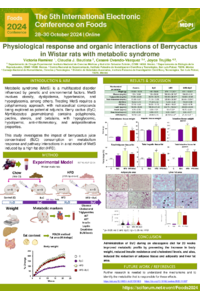
Background: Metabolic syndrome (MS) is a cluster of abnormalities affecting multiple systems in the human body, including the cardiovascular, endocrine, and metabolic systems; MS is present in ~24% of the general population. MS involves genetic and environmental factors, including abdominal obesity with visceral fat accumulation and an excess of free fatty acids. Treating MS requires a polypharmacy approach, with nutraceutical biocompounds being explored as potential adjuncts. Berrycactus juice concentrate (ByC; Myrtillocactus geometrizans) contains carbohydrates, proteins, fiber, vitamins, minerals, betalains (betanin and phyllocactin, among others), and phenolic compounds (caffeic acid, gallic acid, and peniocerol, among others); it is associated with hypolipidemic, anti-inflammatory, and antiproliferative properties. Aim: This study investigates the impact of ByC consumption on metabolism response and pathway interactions in a rat model of MS induced by a high-fat diet. Methods: Twenty Wistar rats were divided into the following four groups: control (water), ByC (200 mg/kg), high-fat diet 45% (HFD), and HFD plus ByC. This study was approved by the Animal Care Committee (BGFMUASLP-22-24), as per the NIH guidelines (Publication No. 80-23). After 140 days, metabolic markers were analyzed in plasma, including glucose, cholesterol, triglycerides, insulin, leptin, ALT, AST, creatinine, and BUN levels. The fat content in the liver and adipose tissue (FOLCH method), and the percentage of fat in the liver, were analyzed using morphometry. Results: HFD groups presented significant increases in body weight, glycemia, insulinemia, triglyceridemia, cholesterolemia, and leptinemia, as well as an increased fat content in hepatic and adipose tissues. ByC fed to HFD rats induced a decrease in triglycerides, cholesterol, insulin, and leptin levels without modifying glucose, liver enzymes, and renal function markers. Conclusion: ByC included within an obesogenic diet for 20 weeks showed an improvement by decreasing the metabolic markers of MS. These results suggest that ByC contains biomolecules that may be useful as adjunct treatments of metabolic diseases like obesity and MS. Further research is needed to understand the mechanisms and to identify the metabolite that is responsible for these effects.
Keywords
Metabolic syndrome
Obesogenic diet
Visceral fat accumulation
Nutraceutical biocompounds
Berrycactus
Polyphenols
Metabolic markers
Poster
sciforum-099650.pdf
Trends and Perspectives of AI-based technology in food safety and toxicity prediction
Broccoli’s sulforaphane, pathways and mechanisms against Lymphoma according to a Bioinformatic assay