Event submissions
Published
This submission belongs to the session S2. Food Nutrition and Functional Foods of the event The 5th International Electronic Conference on Foods
Published date
25 Oct, 2024
Academic Editor
'%3e%3cpath%20d='M12.6657%2010.9104C12.4185%2010.325%2012.0599%209.79327%2011.6097%209.34482C11.1609%208.89508%2010.6293%208.5365%2010.0442%208.28888C10.0389%208.28626%2010.0337%208.28495%2010.0285%208.28233C10.8446%207.69279%2011.3752%206.73249%2011.3752%205.64904C11.3752%203.8542%209.92103%202.39999%208.1262%202.39999C6.33136%202.39999%204.87715%203.8542%204.87715%205.64904C4.87715%206.73249%205.40774%207.69279%206.22393%208.28364C6.21869%208.28626%206.21345%208.28757%206.20821%208.29019C5.62129%208.5378%205.09463%208.89284%204.64265%209.34613C4.1929%209.79493%203.83432%2010.3266%203.58671%2010.9117C3.34345%2011.4845%203.21226%2012.0987%203.20023%2012.7209C3.19988%2012.7349%203.20233%2012.7488%203.20744%2012.7619C3.21255%2012.7749%203.22022%2012.7867%203.22998%2012.7968C3.23975%2012.8068%203.25142%2012.8147%203.26431%2012.8202C3.2772%2012.8256%203.29105%2012.8284%203.30504%2012.8284H4.09109C4.14874%2012.8284%204.19459%2012.7825%204.1959%2012.7262C4.2221%2011.7148%204.62823%2010.7676%205.34617%2010.0497C6.08899%209.30683%207.0755%208.89808%208.1262%208.89808C9.17689%208.89808%2010.1634%209.30683%2010.9062%2010.0497C11.6242%2010.7676%2012.0303%2011.7148%2012.0565%2012.7262C12.0578%2012.7838%2012.1037%2012.8284%2012.1613%2012.8284H12.9474C12.9613%2012.8284%2012.9752%2012.8256%2012.9881%2012.8202C13.001%2012.8147%2013.0126%2012.8068%2013.0224%2012.7968C13.0322%2012.7867%2013.0398%2012.7749%2013.0449%2012.7619C13.0501%2012.7488%2013.0525%2012.7349%2013.0522%2012.7209C13.0391%2012.0947%2012.9094%2011.4855%2012.6657%2010.9104ZM8.1262%207.9024C7.52486%207.9024%206.9589%207.6679%206.53312%207.24211C6.10733%206.81633%205.87283%206.25037%205.87283%205.64904C5.87283%205.0477%206.10733%204.48174%206.53312%204.05596C6.9589%203.63018%207.52486%203.39567%208.1262%203.39567C8.72753%203.39567%209.29349%203.63018%209.71927%204.05596C10.1451%204.48174%2010.3796%205.0477%2010.3796%205.64904C10.3796%206.25037%2010.1451%206.81633%209.71927%207.24211C9.29349%207.6679%208.72753%207.9024%208.1262%207.9024Z'%20fill='%235D1EE1'/%3e%3c/g%3e%3c/svg%3e) Antonello Santini
Antonello SantiniCitation
JAYSHREE MAJUMDAR, Hari Niwas Mishra, Digestibility, nutritional and sensory qualities of pearl millet-based extruded legumes containing balanced essential amino acids, in Proceedings of The 5th International Electronic Conference on Foods, 28 October–30 October 2024, MDPI: Basel, Switzerland
Share
Email
Facebook
Twitter
LinkedIn
Digestibility, nutritional and sensory qualities of pearl millet-based extruded legumes containing balanced essential amino acids
'%3e%3cpath%20d='M12.6647%2010.9104C12.4176%2010.325%2012.0589%209.7933%2011.6088%209.34485C11.16%208.89511%2010.6283%208.53653%2010.0432%208.28891C10.038%208.28629%2010.0327%208.28498%2010.0275%208.28236C10.8437%207.69282%2011.3743%206.73252%2011.3743%205.64907C11.3743%203.85423%209.92005%202.40002%208.12522%202.40002C6.33038%202.40002%204.87618%203.85423%204.87618%205.64907C4.87618%206.73252%205.40677%207.69282%206.22296%208.28367C6.21772%208.28629%206.21248%208.2876%206.20724%208.29022C5.62031%208.53783%205.09365%208.89287%204.64167%209.34616C4.19192%209.79496%203.83334%2010.3266%203.58573%2010.9117C3.34247%2011.4846%203.21128%2012.0987%203.19925%2012.721C3.1989%2012.735%203.20135%2012.7489%203.20646%2012.7619C3.21157%2012.7749%203.21924%2012.7868%203.22901%2012.7968C3.23877%2012.8068%203.25045%2012.8148%203.26334%2012.8202C3.27623%2012.8256%203.29007%2012.8284%203.30406%2012.8284H4.09012C4.14776%2012.8284%204.19362%2012.7825%204.19493%2012.7262C4.22113%2011.7148%204.62726%2010.7676%205.34519%2010.0497C6.08802%209.30686%207.07452%208.89811%208.12522%208.89811C9.17592%208.89811%2010.1624%209.30686%2010.9052%2010.0497C11.6232%2010.7676%2012.0293%2011.7148%2012.0555%2012.7262C12.0568%2012.7839%2012.1027%2012.8284%2012.1603%2012.8284H12.9464C12.9604%2012.8284%2012.9742%2012.8256%2012.9871%2012.8202C13%2012.8148%2013.0117%2012.8068%2013.0214%2012.7968C13.0312%2012.7868%2013.0389%2012.7749%2013.044%2012.7619C13.0491%2012.7489%2013.0515%2012.735%2013.0512%2012.721C13.0381%2012.0947%2012.9084%2011.4856%2012.6647%2010.9104ZM8.12522%207.90243C7.52388%207.90243%206.95792%207.66793%206.53214%207.24215C6.10636%206.81636%205.87185%206.2504%205.87185%205.64907C5.87185%205.04773%206.10636%204.48177%206.53214%204.05599C6.95792%203.63021%207.52388%203.3957%208.12522%203.3957C8.72655%203.3957%209.29252%203.63021%209.7183%204.05599C10.1441%204.48177%2010.3786%205.04773%2010.3786%205.64907C10.3786%206.2504%2010.1441%206.81636%209.7183%207.24215C9.29252%207.66793%208.72655%207.90243%208.12522%207.90243Z'%20fill='%235D1EE1'/%3e%3c/g%3e%3c/svg%3e)
JAYSHREE MAJUMDAR 1,2

Hari Niwas Mishra 3
1. Research scholar
Agricultural and Food Engineering Department
Indian Institute of Technology Kharagpur
2. Assistant professor, Department of Food Technology Guru Nanak Institute of Technology
3. Professor of Food Technology
Agricultural and Food Engineering Department
Indian Institute of Technology Kharagpur
Abstract
This global study aims to develop a plant-based protein source. However, legume protein is not recommended due to its low digestibility, antinutrient, and incomplete amino acid composition. Pearl millet, a drought-resistant superfood contains the crucial sulphur-containing amino acid. Thus, combining cereals with legumes could combat protein shortfalls.
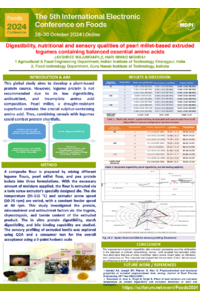
A composite flour is prepared by mixing different legume flours, pearl millet flour, and pea protein isolate into three formulations. With the necessary amount of moisture supplied, the flour is extruded via a twin screw extruder's specially designed die. The die temperature (95-115 °C) and extruder screw speed (50-70 rpm) are varied, with a constant feeder speed at 40 rpm; the flour is then extruded and dried at 55 °C for 2 hours. This study investigated the percentage of protein, micronutrient and antinutrient factors viz. the trypsin, chymotrypsin, and tannin content of the extruded product. The in vitro protein digestibility, starch digestibility, and bile binding capability are studied. The sensory profiling of extruded lentils was explored using Quantitative Descriptive Analysis (QDA) and a consumer test for the overall acceptance using a 9-point hedonic scale.
The bile acid binding capacity, in vitro protein digestibility, and starch digestibility of the extruded lentil was found to be considerably increased from 0.43 to 0.67 μmol/100g DM, 81 to 89%, and 232 to 292 mg of maltose/g in comparison to its raw lentil, at 0.18 μmol/100g DM, 73.2%, and 181.8 mg of maltose/g, respectively. Trypsin (91.46%), chymotrypsin (94.73%), and tannin (96.12%) were significantly reduced in lentils due to extrusion without altering the protein content from 351 to 394 g/kg. The improvement of protein digestibility after extrusion processing could be attributable to the reduction in different antinutritional factors. QDA revealed that extruded lentils have descriptive features of sticky mouthfeel, beany aroma, beany taste, an aftertaste, and crunchy texture. The consumer test showed that the extrusion of lentil did not cause any difference in terms of overall acceptability.
Keywords
extrusion
in vitro digestibilty
nutrient
plant protein
Poster
Jayshree_iit kgp.pdf
Involvement of bread melanoidins in cellular pathways against ischemia
Quantitative and qualitative evaluation of microplastic contamination of shrimp using Vis-NIR multispectral imaging technology combined with a modified self-organizing map