Event submissions
Published
This submission belongs to the session S2. Food Nutrition and Functional Foods of the event The 5th International Electronic Conference on Foods
Published date
25 Oct, 2024
Academic Editor
'%3e%3cpath%20d='M12.6657%2010.9104C12.4185%2010.325%2012.0599%209.79327%2011.6097%209.34482C11.1609%208.89508%2010.6293%208.5365%2010.0442%208.28888C10.0389%208.28626%2010.0337%208.28495%2010.0285%208.28233C10.8446%207.69279%2011.3752%206.73249%2011.3752%205.64904C11.3752%203.8542%209.92103%202.39999%208.1262%202.39999C6.33136%202.39999%204.87715%203.8542%204.87715%205.64904C4.87715%206.73249%205.40774%207.69279%206.22393%208.28364C6.21869%208.28626%206.21345%208.28757%206.20821%208.29019C5.62129%208.5378%205.09463%208.89284%204.64265%209.34613C4.1929%209.79493%203.83432%2010.3266%203.58671%2010.9117C3.34345%2011.4845%203.21226%2012.0987%203.20023%2012.7209C3.19988%2012.7349%203.20233%2012.7488%203.20744%2012.7619C3.21255%2012.7749%203.22022%2012.7867%203.22998%2012.7968C3.23975%2012.8068%203.25142%2012.8147%203.26431%2012.8202C3.2772%2012.8256%203.29105%2012.8284%203.30504%2012.8284H4.09109C4.14874%2012.8284%204.19459%2012.7825%204.1959%2012.7262C4.2221%2011.7148%204.62823%2010.7676%205.34617%2010.0497C6.08899%209.30683%207.0755%208.89808%208.1262%208.89808C9.17689%208.89808%2010.1634%209.30683%2010.9062%2010.0497C11.6242%2010.7676%2012.0303%2011.7148%2012.0565%2012.7262C12.0578%2012.7838%2012.1037%2012.8284%2012.1613%2012.8284H12.9474C12.9613%2012.8284%2012.9752%2012.8256%2012.9881%2012.8202C13.001%2012.8147%2013.0126%2012.8068%2013.0224%2012.7968C13.0322%2012.7867%2013.0398%2012.7749%2013.0449%2012.7619C13.0501%2012.7488%2013.0525%2012.7349%2013.0522%2012.7209C13.0391%2012.0947%2012.9094%2011.4855%2012.6657%2010.9104ZM8.1262%207.9024C7.52486%207.9024%206.9589%207.6679%206.53312%207.24211C6.10733%206.81633%205.87283%206.25037%205.87283%205.64904C5.87283%205.0477%206.10733%204.48174%206.53312%204.05596C6.9589%203.63018%207.52486%203.39567%208.1262%203.39567C8.72753%203.39567%209.29349%203.63018%209.71927%204.05596C10.1451%204.48174%2010.3796%205.0477%2010.3796%205.64904C10.3796%206.25037%2010.1451%206.81633%209.71927%207.24211C9.29349%207.6679%208.72753%207.9024%208.1262%207.9024Z'%20fill='%235D1EE1'/%3e%3c/g%3e%3c/svg%3e) Antonello Santini
Antonello SantiniCitation
Roxana Elizabeth González, Veronica Carolina Soto, Nutritional and functional composition of microgreens: A comparison of various species, in Proceedings of The 5th International Electronic Conference on Foods, 28 October–30 October 2024, MDPI: Basel, Switzerland
Share
Email
Facebook
Twitter
LinkedIn
Nutritional and functional composition of microgreens: A comparison of various species
'%3e%3cpath%20d='M12.6647%2010.9104C12.4176%2010.325%2012.0589%209.7933%2011.6088%209.34485C11.16%208.89511%2010.6283%208.53653%2010.0432%208.28891C10.038%208.28629%2010.0327%208.28498%2010.0275%208.28236C10.8437%207.69282%2011.3743%206.73252%2011.3743%205.64907C11.3743%203.85423%209.92005%202.40002%208.12522%202.40002C6.33038%202.40002%204.87618%203.85423%204.87618%205.64907C4.87618%206.73252%205.40677%207.69282%206.22296%208.28367C6.21772%208.28629%206.21248%208.2876%206.20724%208.29022C5.62031%208.53783%205.09365%208.89287%204.64167%209.34616C4.19192%209.79496%203.83334%2010.3266%203.58573%2010.9117C3.34247%2011.4846%203.21128%2012.0987%203.19925%2012.721C3.1989%2012.735%203.20135%2012.7489%203.20646%2012.7619C3.21157%2012.7749%203.21924%2012.7868%203.22901%2012.7968C3.23877%2012.8068%203.25045%2012.8148%203.26334%2012.8202C3.27623%2012.8256%203.29007%2012.8284%203.30406%2012.8284H4.09012C4.14776%2012.8284%204.19362%2012.7825%204.19493%2012.7262C4.22113%2011.7148%204.62726%2010.7676%205.34519%2010.0497C6.08802%209.30686%207.07452%208.89811%208.12522%208.89811C9.17592%208.89811%2010.1624%209.30686%2010.9052%2010.0497C11.6232%2010.7676%2012.0293%2011.7148%2012.0555%2012.7262C12.0568%2012.7839%2012.1027%2012.8284%2012.1603%2012.8284H12.9464C12.9604%2012.8284%2012.9742%2012.8256%2012.9871%2012.8202C13%2012.8148%2013.0117%2012.8068%2013.0214%2012.7968C13.0312%2012.7868%2013.0389%2012.7749%2013.044%2012.7619C13.0491%2012.7489%2013.0515%2012.735%2013.0512%2012.721C13.0381%2012.0947%2012.9084%2011.4856%2012.6647%2010.9104ZM8.12522%207.90243C7.52388%207.90243%206.95792%207.66793%206.53214%207.24215C6.10636%206.81636%205.87185%206.2504%205.87185%205.64907C5.87185%205.04773%206.10636%204.48177%206.53214%204.05599C6.95792%203.63021%207.52388%203.3957%208.12522%203.3957C8.72655%203.3957%209.29252%203.63021%209.7183%204.05599C10.1441%204.48177%2010.3786%205.04773%2010.3786%205.64907C10.3786%206.2504%2010.1441%206.81636%209.7183%207.24215C9.29252%207.66793%208.72655%207.90243%208.12522%207.90243Z'%20fill='%235D1EE1'/%3e%3c/g%3e%3c/svg%3e)
Roxana Elizabeth González 1,2
Veronica Carolina Soto 3
1. Instituto Nacional de Tecnología Agropecuaria (INTA), EEA La Consulta, Mendoza
2. Facultad de Ciencias Exactas, Universidad Nacional de Cuyo, Ciudad, Mendoza
3. Instituto de Biología Agrícola de Mendoza (IBAM), CONICET, Facultad de Ciencias Agrarias, Mendoza.
Abstract
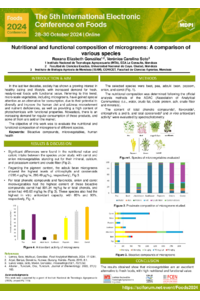
In the last few decades, society has shown a growing interest in healthy eating and lifestyle, with increased demand for fresh, ready-to-eat foods with functional value. Referring to this trend, micro-scale vegetables, including microgreens, have gained special attention as an alternative for consumption, due to their potential to diversify and improve the human diet and address microelement and nutrient deficiencies, as well as providing a high content of phytochemicals with functional properties. Nowadays, there is an increasing demand for regular consumption of these products, and some of them are sold on the market. The objective of this work was to evaluate the nutritional and functional composition of microgreens of different species. The selected species were beet, pea, adzuki bean, popcorn, onion, and carrot. The nutritional composition was determined following the official analysis methods of the AOAC (Association of Analytical Communities) (i.e., water, crude fat, crude protein, ash, crude fiber and minerals). The content of total phenolic compounds, flavonoids, chlorophylls a and b, and total carotenoids and in vitro antioxidant activity were evaluated by spectrophotometry. Significant differences were found in the nutritional value and caloric intake between the species under study, with carrot and onion microvegetables standing out for their mineral, calcium, and potassium content and crude fiber. Regarding the pigment content, the adzuki bean microgreens showed the highest levels of chlorophylls and carotenoids (1295.4 µg%g fw, 295.49 µg%g, respectively). For total phenolic compounds and flavonoids, onion and carrot microvegetables had the highest content of these bioactive compounds; carrot had 891.34 mg%g fw of total phenols, and onion had 445.68 mg%g fw. These species also had the highest in vitro antioxidant capacity, with 85% and 95%, respectively. The results obtained show that microvegetables are an excellent alternative to fresh foods, with high nutritional and functional value.
Keywords
Biactive compounds
micro vegetables
human health
Poster
sciforum-101386.pdf
Quantitative and qualitative evaluation of microplastic contamination of shrimp using Vis-NIR multispectral imaging technology combined with a modified self-organizing map
Effect of different Gas Nanobubbles on fermentation pattern of yoghurt starter culture