Event submissions
Published
This submission belongs to the session S2. Food Nutrition and Functional Foods of the event The 5th International Electronic Conference on Foods
Published date
25 Oct, 2024
Academic Editor
'%3e%3cpath%20d='M12.6657%2010.9104C12.4185%2010.325%2012.0599%209.79327%2011.6097%209.34482C11.1609%208.89508%2010.6293%208.5365%2010.0442%208.28888C10.0389%208.28626%2010.0337%208.28495%2010.0285%208.28233C10.8446%207.69279%2011.3752%206.73249%2011.3752%205.64904C11.3752%203.8542%209.92103%202.39999%208.1262%202.39999C6.33136%202.39999%204.87715%203.8542%204.87715%205.64904C4.87715%206.73249%205.40774%207.69279%206.22393%208.28364C6.21869%208.28626%206.21345%208.28757%206.20821%208.29019C5.62129%208.5378%205.09463%208.89284%204.64265%209.34613C4.1929%209.79493%203.83432%2010.3266%203.58671%2010.9117C3.34345%2011.4845%203.21226%2012.0987%203.20023%2012.7209C3.19988%2012.7349%203.20233%2012.7488%203.20744%2012.7619C3.21255%2012.7749%203.22022%2012.7867%203.22998%2012.7968C3.23975%2012.8068%203.25142%2012.8147%203.26431%2012.8202C3.2772%2012.8256%203.29105%2012.8284%203.30504%2012.8284H4.09109C4.14874%2012.8284%204.19459%2012.7825%204.1959%2012.7262C4.2221%2011.7148%204.62823%2010.7676%205.34617%2010.0497C6.08899%209.30683%207.0755%208.89808%208.1262%208.89808C9.17689%208.89808%2010.1634%209.30683%2010.9062%2010.0497C11.6242%2010.7676%2012.0303%2011.7148%2012.0565%2012.7262C12.0578%2012.7838%2012.1037%2012.8284%2012.1613%2012.8284H12.9474C12.9613%2012.8284%2012.9752%2012.8256%2012.9881%2012.8202C13.001%2012.8147%2013.0126%2012.8068%2013.0224%2012.7968C13.0322%2012.7867%2013.0398%2012.7749%2013.0449%2012.7619C13.0501%2012.7488%2013.0525%2012.7349%2013.0522%2012.7209C13.0391%2012.0947%2012.9094%2011.4855%2012.6657%2010.9104ZM8.1262%207.9024C7.52486%207.9024%206.9589%207.6679%206.53312%207.24211C6.10733%206.81633%205.87283%206.25037%205.87283%205.64904C5.87283%205.0477%206.10733%204.48174%206.53312%204.05596C6.9589%203.63018%207.52486%203.39567%208.1262%203.39567C8.72753%203.39567%209.29349%203.63018%209.71927%204.05596C10.1451%204.48174%2010.3796%205.0477%2010.3796%205.64904C10.3796%206.25037%2010.1451%206.81633%209.71927%207.24211C9.29349%207.6679%208.72753%207.9024%208.1262%207.9024Z'%20fill='%235D1EE1'/%3e%3c/g%3e%3c/svg%3e) Antonello Santini
Antonello SantiniCitation
Lourdes Inés Pascual, María Belén Hapon, Carlos Gamarra-Luques, Nutraceutical potential of Tessaria absinthioides combined with Camellia sinensis in controlling tumoral growth, in Proceedings of The 5th International Electronic Conference on Foods, 28 October–30 October 2024, MDPI: Basel, Switzerland
Share
Email
Facebook
Twitter
LinkedIn
Nutraceutical potential of Tessaria absinthioides combined with Camellia sinensis in controlling tumoral growth
'%3e%3cpath%20d='M12.6647%2010.9104C12.4176%2010.325%2012.0589%209.7933%2011.6088%209.34485C11.16%208.89511%2010.6283%208.53653%2010.0432%208.28891C10.038%208.28629%2010.0327%208.28498%2010.0275%208.28236C10.8437%207.69282%2011.3743%206.73252%2011.3743%205.64907C11.3743%203.85423%209.92005%202.40002%208.12522%202.40002C6.33038%202.40002%204.87618%203.85423%204.87618%205.64907C4.87618%206.73252%205.40677%207.69282%206.22296%208.28367C6.21772%208.28629%206.21248%208.2876%206.20724%208.29022C5.62031%208.53783%205.09365%208.89287%204.64167%209.34616C4.19192%209.79496%203.83334%2010.3266%203.58573%2010.9117C3.34247%2011.4846%203.21128%2012.0987%203.19925%2012.721C3.1989%2012.735%203.20135%2012.7489%203.20646%2012.7619C3.21157%2012.7749%203.21924%2012.7868%203.22901%2012.7968C3.23877%2012.8068%203.25045%2012.8148%203.26334%2012.8202C3.27623%2012.8256%203.29007%2012.8284%203.30406%2012.8284H4.09012C4.14776%2012.8284%204.19362%2012.7825%204.19493%2012.7262C4.22113%2011.7148%204.62726%2010.7676%205.34519%2010.0497C6.08802%209.30686%207.07452%208.89811%208.12522%208.89811C9.17592%208.89811%2010.1624%209.30686%2010.9052%2010.0497C11.6232%2010.7676%2012.0293%2011.7148%2012.0555%2012.7262C12.0568%2012.7839%2012.1027%2012.8284%2012.1603%2012.8284H12.9464C12.9604%2012.8284%2012.9742%2012.8256%2012.9871%2012.8202C13%2012.8148%2013.0117%2012.8068%2013.0214%2012.7968C13.0312%2012.7868%2013.0389%2012.7749%2013.044%2012.7619C13.0491%2012.7489%2013.0515%2012.735%2013.0512%2012.721C13.0381%2012.0947%2012.9084%2011.4856%2012.6647%2010.9104ZM8.12522%207.90243C7.52388%207.90243%206.95792%207.66793%206.53214%207.24215C6.10636%206.81636%205.87185%206.2504%205.87185%205.64907C5.87185%205.04773%206.10636%204.48177%206.53214%204.05599C6.95792%203.63021%207.52388%203.3957%208.12522%203.3957C8.72655%203.3957%209.29252%203.63021%209.7183%204.05599C10.1441%204.48177%2010.3786%205.04773%2010.3786%205.64907C10.3786%206.2504%2010.1441%206.81636%209.7183%207.24215C9.29252%207.66793%208.72655%207.90243%208.12522%207.90243Z'%20fill='%235D1EE1'/%3e%3c/g%3e%3c/svg%3e)
Lourdes Inés Pascual 1,2

María Belén Hapon 1,2

Carlos Gamarra-Luques 1,3
1. Instituto de Medicina y Biología Experimental de Cuyo (IMBECU) – Universidad Nacional de Cuyo (UNCuyo), CCT CONICET Mendoza. Av. Ruiz Leal s/n, Parque General San Martín. Mendoza, Argentina, CP 5500.
2. Facultad de Ciencias Exactas y Naturales, UNCuyo. Padre Jorge Contreras 1300, Parque General San Martín. Mendoza, Argentina, M5502JMA.
3. Facultad de Ciencias Médicas, UNCuyo. Centro Universitario, Parque General San Martín. Mendoza, Argentina, M5502JMA.
Abstract
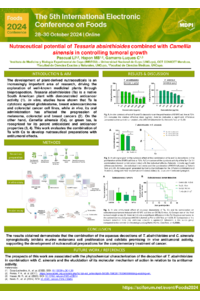
The development of plant-derived nutraceuticals is an increasingly popular research area, driving the exploration of well-known medicinal plants through bioprospection. Tessaria absinthioides (Ta) is a native plant from South America, which demonstrates anticancer activity. In vitro, Ta was cytotoxic against glioblastoma, adenocarcinoma, and colorectal cancer cell lines, while in vivo, its oral administration affects melanoma, colorectal, and breast cancer growth. Moreover, Camellia sinensis (Cs)—green tea—is known for its potent antioxidant and anticancer activity. This work evaluates the combination of Ta with Cs to obtain nutraceutical preparations with antitumoral properties. Ta and Cs aqueous decoctions were prepared at 5% w/v and were combined in different ratios. Cytotoxicity was determined using the MTT assay on the B16F0 cell line (non-metastatic murine melanoma; from ATCC, VA-USA) treated with Ta, Cs, and Ta+Cs (1:1, 2:1, 4:1) for 72h. The median effective dose and combination index were calculated using CompuSyn Software (values <1 indicate synergism). In vivo, C57BL/6 mice with subcutaneous B16F0-induced tumors were orally treated with Ta, Cs, or Ta+Cs (1:1), at doses of 150 mg/animal/day for 22 days; tap water was used as the control. Tumor growth was monitored daily, followed by necropsy and tumor weight measurement. Ta and Cs decoctions inhibited B16F0 cell proliferation dose-dependently, with median dose values of 1391.4 and 655.8 µg/mL, respectively. The Ta+Cs combination (1:1, 2:1 and 4:1) was synergistic, particularly at a 1:1 ratio (combination index = 0.43, 0.86, and 0.93, respectively). In vivo, Ta+Cs showed a significant decrease in tumor weight compared to the control (0.81g vs. 1.87g, respectively; ANOVA followed by Fisher’s test, p<0.0421), as well as a prolonged tumor detection time (21 vs. 14.5 days in control; Log Rank test, p=0.0088). These results demonstrate that the decoction of T. absinthioides combined with C. sinensis synergistically inhibits murine melanoma cell proliferation and exhibits a promising in vivo antitumoral activity, supporting nutraceutical preparation development as a complementary method of treatment for cancer.
Keywords
TESSARIA – ANTITUMORAL – COMPLEMENTARY TREATMENT - CANCER
Poster
Foods Conference_poster_Pascual et al.pdf
Effect of different Gas Nanobubbles on fermentation pattern of yoghurt starter culture
Safety of organic herbs and spices – overview of rasff notifications