Event submissions
Published
This submission belongs to the session S3. Sustainable Food Security and Food System of the event The 5th International Electronic Conference on Foods
Published date
25 Oct, 2024
Academic Editor
'%3e%3cpath%20d='M12.6657%2010.9104C12.4185%2010.325%2012.0599%209.79327%2011.6097%209.34482C11.1609%208.89508%2010.6293%208.5365%2010.0442%208.28888C10.0389%208.28626%2010.0337%208.28495%2010.0285%208.28233C10.8446%207.69279%2011.3752%206.73249%2011.3752%205.64904C11.3752%203.8542%209.92103%202.39999%208.1262%202.39999C6.33136%202.39999%204.87715%203.8542%204.87715%205.64904C4.87715%206.73249%205.40774%207.69279%206.22393%208.28364C6.21869%208.28626%206.21345%208.28757%206.20821%208.29019C5.62129%208.5378%205.09463%208.89284%204.64265%209.34613C4.1929%209.79493%203.83432%2010.3266%203.58671%2010.9117C3.34345%2011.4845%203.21226%2012.0987%203.20023%2012.7209C3.19988%2012.7349%203.20233%2012.7488%203.20744%2012.7619C3.21255%2012.7749%203.22022%2012.7867%203.22998%2012.7968C3.23975%2012.8068%203.25142%2012.8147%203.26431%2012.8202C3.2772%2012.8256%203.29105%2012.8284%203.30504%2012.8284H4.09109C4.14874%2012.8284%204.19459%2012.7825%204.1959%2012.7262C4.2221%2011.7148%204.62823%2010.7676%205.34617%2010.0497C6.08899%209.30683%207.0755%208.89808%208.1262%208.89808C9.17689%208.89808%2010.1634%209.30683%2010.9062%2010.0497C11.6242%2010.7676%2012.0303%2011.7148%2012.0565%2012.7262C12.0578%2012.7838%2012.1037%2012.8284%2012.1613%2012.8284H12.9474C12.9613%2012.8284%2012.9752%2012.8256%2012.9881%2012.8202C13.001%2012.8147%2013.0126%2012.8068%2013.0224%2012.7968C13.0322%2012.7867%2013.0398%2012.7749%2013.0449%2012.7619C13.0501%2012.7488%2013.0525%2012.7349%2013.0522%2012.7209C13.0391%2012.0947%2012.9094%2011.4855%2012.6657%2010.9104ZM8.1262%207.9024C7.52486%207.9024%206.9589%207.6679%206.53312%207.24211C6.10733%206.81633%205.87283%206.25037%205.87283%205.64904C5.87283%205.0477%206.10733%204.48174%206.53312%204.05596C6.9589%203.63018%207.52486%203.39567%208.1262%203.39567C8.72753%203.39567%209.29349%203.63018%209.71927%204.05596C10.1451%204.48174%2010.3796%205.0477%2010.3796%205.64904C10.3796%206.25037%2010.1451%206.81633%209.71927%207.24211C9.29349%207.6679%208.72753%207.9024%208.1262%207.9024Z'%20fill='%235D1EE1'/%3e%3c/g%3e%3c/svg%3e) Theodoros Varzakas
Theodoros VarzakasCitation
MARIA JESUS MARTIN MATEOS, Jonathan Delgado-Adámez, María Díaz-Ponce, Miriam Sánchez-Ordóñez, Beatriz Toro-Hernández, M.Rosario Ramírez-Bernabé, Stabilized White Grape Pomace as a Natural Preservative in Frankfurt-Type Sausages: The Effects on Microbial Growth, Oxidation, and Color Stability, in Proceedings of The 5th International Electronic Conference on Foods, 28 October–30 October 2024, MDPI: Basel, Switzerland
Share
Email
Facebook
Twitter
LinkedIn
Stabilized White Grape Pomace as a Natural Preservative in Frankfurt-Type Sausages: The Effects on Microbial Growth, Oxidation, and Color Stability
'%3e%3cpath%20d='M12.6647%2010.9104C12.4176%2010.325%2012.0589%209.7933%2011.6088%209.34485C11.16%208.89511%2010.6283%208.53653%2010.0432%208.28891C10.038%208.28629%2010.0327%208.28498%2010.0275%208.28236C10.8437%207.69282%2011.3743%206.73252%2011.3743%205.64907C11.3743%203.85423%209.92005%202.40002%208.12522%202.40002C6.33038%202.40002%204.87618%203.85423%204.87618%205.64907C4.87618%206.73252%205.40677%207.69282%206.22296%208.28367C6.21772%208.28629%206.21248%208.2876%206.20724%208.29022C5.62031%208.53783%205.09365%208.89287%204.64167%209.34616C4.19192%209.79496%203.83334%2010.3266%203.58573%2010.9117C3.34247%2011.4846%203.21128%2012.0987%203.19925%2012.721C3.1989%2012.735%203.20135%2012.7489%203.20646%2012.7619C3.21157%2012.7749%203.21924%2012.7868%203.22901%2012.7968C3.23877%2012.8068%203.25045%2012.8148%203.26334%2012.8202C3.27623%2012.8256%203.29007%2012.8284%203.30406%2012.8284H4.09012C4.14776%2012.8284%204.19362%2012.7825%204.19493%2012.7262C4.22113%2011.7148%204.62726%2010.7676%205.34519%2010.0497C6.08802%209.30686%207.07452%208.89811%208.12522%208.89811C9.17592%208.89811%2010.1624%209.30686%2010.9052%2010.0497C11.6232%2010.7676%2012.0293%2011.7148%2012.0555%2012.7262C12.0568%2012.7839%2012.1027%2012.8284%2012.1603%2012.8284H12.9464C12.9604%2012.8284%2012.9742%2012.8256%2012.9871%2012.8202C13%2012.8148%2013.0117%2012.8068%2013.0214%2012.7968C13.0312%2012.7868%2013.0389%2012.7749%2013.044%2012.7619C13.0491%2012.7489%2013.0515%2012.735%2013.0512%2012.721C13.0381%2012.0947%2012.9084%2011.4856%2012.6647%2010.9104ZM8.12522%207.90243C7.52388%207.90243%206.95792%207.66793%206.53214%207.24215C6.10636%206.81636%205.87185%206.2504%205.87185%205.64907C5.87185%205.04773%206.10636%204.48177%206.53214%204.05599C6.95792%203.63021%207.52388%203.3957%208.12522%203.3957C8.72655%203.3957%209.29252%203.63021%209.7183%204.05599C10.1441%204.48177%2010.3786%205.04773%2010.3786%205.64907C10.3786%206.2504%2010.1441%206.81636%209.7183%207.24215C9.29252%207.66793%208.72655%207.90243%208.12522%207.90243Z'%20fill='%235D1EE1'/%3e%3c/g%3e%3c/svg%3e)
MARIA JESUS MARTIN MATEOS 1
Jonathan Delgado-Adámez 1
María Díaz-Ponce 1
Miriam Sánchez-Ordóñez 1
Beatriz Toro-Hernández 1

M.Rosario Ramírez-Bernabé 1
1. CICYTEX
Abstract
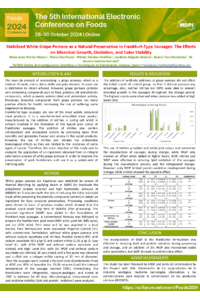
The main byproduct of winemaking is grape pomace, which comprises seeds, skins, stems, and remains of grape pulp. Its main use is for distillation to obtain ethanol. However, grape pomace contains interesting compounds (fiber, proteins, fat, phenolic compounds) with health benefits. For this reason, white grape pomace (Cayetana cv) was stabilized by means of thermal blanching (to inactivate the polyphenoloxidase enzyme) and high hydrostatic pressure (with the aim of reducing the initial microbial loads while preserving the phenolic compound content) to obtain an ingredient for food product preservation. The valorized ingredient (WGP) was added to the formulation of Frankfurt-type sausages. Four formulations were evaluated: Negative Control (NC: without white grape pomace and without sodium ascorbate and nitrites), Positive Control (PC: with sodium ascorbate and nitrites), Low Level (LL: with 0.5% WGP and without sodium ascorbate and nitrites) and High Level (HL: with 3% WGP and without sodium ascorbate and nitrites). Immediately, the frankfurters were refrigerated, vacuum-packaged, and stored at +5ºC in darkness. Microbiological, color, and oxidation parameters were analyzed. Neither nitrites nor WPG were able to prevent microbial growth in the sausages throughout the storage period. Additionally, the highest counts were observed when the pomace was added at high levels (3%). The use of nitrites provided and initial pink colour and prevented the discoloration of the sausages during storage, while WGP only showed an effect when added at higher levels. Both nitrites and WGP were effective in reducing lipid oxidation of the sausages during the manufacturing process and the refrigerated storage. However, only WGP limited protein oxidation development during storage, while nitrites showed the opposite effect. Therefore, the incorporation of WGP in the frankfurter formulation was effective in reducing lipid and protein oxidation during processing and storage, and an addition of 3% WGP also maintained stable color parameters, but WGP showed no antimicrobial effect.
Keywords
white grape pomace
by-products
valorized ingredient
preservation
Frankfurt-type sausages
lipid and protein oxidation
Poster
Póster FOODs.pdf
Safety of organic herbs and spices – overview of rasff notifications
Recent advancements in the commercial production of synthetic food for global food security: Future prospectives and challenges