Event submissions
Published
This submission belongs to the session S2. Food Nutrition and Functional Foods of the event The 5th International Electronic Conference on Foods
Published date
25 Oct, 2024
Academic Editor
'%3e%3cpath%20d='M12.6657%2010.9104C12.4185%2010.325%2012.0599%209.79327%2011.6097%209.34482C11.1609%208.89508%2010.6293%208.5365%2010.0442%208.28888C10.0389%208.28626%2010.0337%208.28495%2010.0285%208.28233C10.8446%207.69279%2011.3752%206.73249%2011.3752%205.64904C11.3752%203.8542%209.92103%202.39999%208.1262%202.39999C6.33136%202.39999%204.87715%203.8542%204.87715%205.64904C4.87715%206.73249%205.40774%207.69279%206.22393%208.28364C6.21869%208.28626%206.21345%208.28757%206.20821%208.29019C5.62129%208.5378%205.09463%208.89284%204.64265%209.34613C4.1929%209.79493%203.83432%2010.3266%203.58671%2010.9117C3.34345%2011.4845%203.21226%2012.0987%203.20023%2012.7209C3.19988%2012.7349%203.20233%2012.7488%203.20744%2012.7619C3.21255%2012.7749%203.22022%2012.7867%203.22998%2012.7968C3.23975%2012.8068%203.25142%2012.8147%203.26431%2012.8202C3.2772%2012.8256%203.29105%2012.8284%203.30504%2012.8284H4.09109C4.14874%2012.8284%204.19459%2012.7825%204.1959%2012.7262C4.2221%2011.7148%204.62823%2010.7676%205.34617%2010.0497C6.08899%209.30683%207.0755%208.89808%208.1262%208.89808C9.17689%208.89808%2010.1634%209.30683%2010.9062%2010.0497C11.6242%2010.7676%2012.0303%2011.7148%2012.0565%2012.7262C12.0578%2012.7838%2012.1037%2012.8284%2012.1613%2012.8284H12.9474C12.9613%2012.8284%2012.9752%2012.8256%2012.9881%2012.8202C13.001%2012.8147%2013.0126%2012.8068%2013.0224%2012.7968C13.0322%2012.7867%2013.0398%2012.7749%2013.0449%2012.7619C13.0501%2012.7488%2013.0525%2012.7349%2013.0522%2012.7209C13.0391%2012.0947%2012.9094%2011.4855%2012.6657%2010.9104ZM8.1262%207.9024C7.52486%207.9024%206.9589%207.6679%206.53312%207.24211C6.10733%206.81633%205.87283%206.25037%205.87283%205.64904C5.87283%205.0477%206.10733%204.48174%206.53312%204.05596C6.9589%203.63018%207.52486%203.39567%208.1262%203.39567C8.72753%203.39567%209.29349%203.63018%209.71927%204.05596C10.1451%204.48174%2010.3796%205.0477%2010.3796%205.64904C10.3796%206.25037%2010.1451%206.81633%209.71927%207.24211C9.29349%207.6679%208.72753%207.9024%208.1262%207.9024Z'%20fill='%235D1EE1'/%3e%3c/g%3e%3c/svg%3e) Antonello Santini
Antonello SantiniCitation
Chong Feng, Maral Seididamyeh, Dharini Sivakumar, Lactic acid fermentation of papaya and mint: physicochemical parameters and bioactive compounds, in Proceedings of The 5th International Electronic Conference on Foods, 28 October–30 October 2024, MDPI: Basel, Switzerland
Share
Email
Facebook
Twitter
LinkedIn
Lactic acid fermentation of papaya and mint: physicochemical parameters and bioactive compounds
'%3e%3cpath%20d='M12.6647%2010.9104C12.4176%2010.325%2012.0589%209.7933%2011.6088%209.34485C11.16%208.89511%2010.6283%208.53653%2010.0432%208.28891C10.038%208.28629%2010.0327%208.28498%2010.0275%208.28236C10.8437%207.69282%2011.3743%206.73252%2011.3743%205.64907C11.3743%203.85423%209.92005%202.40002%208.12522%202.40002C6.33038%202.40002%204.87618%203.85423%204.87618%205.64907C4.87618%206.73252%205.40677%207.69282%206.22296%208.28367C6.21772%208.28629%206.21248%208.2876%206.20724%208.29022C5.62031%208.53783%205.09365%208.89287%204.64167%209.34616C4.19192%209.79496%203.83334%2010.3266%203.58573%2010.9117C3.34247%2011.4846%203.21128%2012.0987%203.19925%2012.721C3.1989%2012.735%203.20135%2012.7489%203.20646%2012.7619C3.21157%2012.7749%203.21924%2012.7868%203.22901%2012.7968C3.23877%2012.8068%203.25045%2012.8148%203.26334%2012.8202C3.27623%2012.8256%203.29007%2012.8284%203.30406%2012.8284H4.09012C4.14776%2012.8284%204.19362%2012.7825%204.19493%2012.7262C4.22113%2011.7148%204.62726%2010.7676%205.34519%2010.0497C6.08802%209.30686%207.07452%208.89811%208.12522%208.89811C9.17592%208.89811%2010.1624%209.30686%2010.9052%2010.0497C11.6232%2010.7676%2012.0293%2011.7148%2012.0555%2012.7262C12.0568%2012.7839%2012.1027%2012.8284%2012.1603%2012.8284H12.9464C12.9604%2012.8284%2012.9742%2012.8256%2012.9871%2012.8202C13%2012.8148%2013.0117%2012.8068%2013.0214%2012.7968C13.0312%2012.7868%2013.0389%2012.7749%2013.044%2012.7619C13.0491%2012.7489%2013.0515%2012.735%2013.0512%2012.721C13.0381%2012.0947%2012.9084%2011.4856%2012.6647%2010.9104ZM8.12522%207.90243C7.52388%207.90243%206.95792%207.66793%206.53214%207.24215C6.10636%206.81636%205.87185%206.2504%205.87185%205.64907C5.87185%205.04773%206.10636%204.48177%206.53214%204.05599C6.95792%203.63021%207.52388%203.3957%208.12522%203.3957C8.72655%203.3957%209.29252%203.63021%209.7183%204.05599C10.1441%204.48177%2010.3786%205.04773%2010.3786%205.64907C10.3786%206.2504%2010.1441%206.81636%209.7183%207.24215C9.29252%207.66793%208.72655%207.90243%208.12522%207.90243Z'%20fill='%235D1EE1'/%3e%3c/g%3e%3c/svg%3e)
Chong Feng 1
Maral Seididamyeh 1

Dharini Sivakumar 1,2
1. Centre for Nutrition and Food Sciences, Queensland Alliance for Agriculture and Food Innovation, The University of Queensland, St. Lucia, QLD 4072, Australia
2. Phytochemial Food Network Research Group, Department of Crop Sciences, Tshwane University of Technology, Pretoria West 0001, South Africa
Abstract
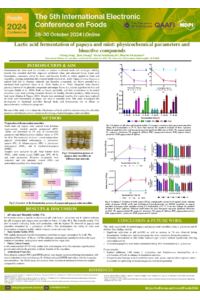
Papaya (Carica papaya) is a nutrient-rich fruit with significant bioactive compounds, presenting substantial potential for the development of functional beverages. This study explores the impact of lactic acid fermentation on the physicochemical parameters, bioactive compounds, and color stability of papaya and mint (Mentha piperita) smoothies. An optimal mixing ratio of 64:1 (w/w) for papaya to mint was established through preliminary experiments. Fermentation was conducted using Lactiplantibacillus plantarum and Bifidobacterium bifidum at 37°C, with a smoothie-to-water ratio of 2:1 (w/w).
The results showed that both strains proliferated rapidly in the smoothies, with colony counts increasing from approximately 6 × 10⁴ CFU/g to 8 × 10⁷CFU/g within 24 hours, followed by a stationary phase and slight decrease by 48 hours due to pH inhibition. Lactic acid fermentation significantly decreased the pH and titratable acidity (TA) of the smoothies, with the pH dropping to 3.51-3.56 and TA reaching 0.559%-0.553% after 24 h. After 48 h, TA increased further to 0.799%-0.743%. The otal soluble solids (TSS) also decreased significantly, falling to 5.58-5.53°Bx after 48 h of fermentation.
Furthermore, lactic acid fermentation preserved the total phenolic content (TPC) and ferric reducing antioxidant power (FRAP) in both papaya and papaya–mint smoothies, while enhancing the DPPH (2,2-Diphenyl-1-picrylhydrazyl) radical scavenging activity in the papaya–mint smoothie. Color analysis indicated that fermentation maintained or improved the color stability of the smoothies, with lightness (L*), chroma (C*), and hue (H*) parameters being preserved or slightly enhanced, contributing to the visual appeal of the final product. This study underscores the potential of lactic acid fermentation in creating functional beverages from papaya and mint, promoting health benefits, enhancing color stability, and extending shelf life. The findings suggest that fermenting papaya smoothies with L. plantarum for 48 h offers optimal results, providing a novel beverage option that preserves nutritional content, improves visual attributes, and reduces food waste.
Keywords
Antioxidant properties
Bifidobacterium bifidum
fruit smoothies
Lactobacillus plantarum
Poster
MDPI Poster_Chong_FENG.pdf
Evaluating the aroma compounds and structural properties of Plant-based seafood Analogues using Pea (Pisum sativum L.) and Faba bean (Vicia faba) Protein Isolates
Comparative analysis of flavor characterization in duck meat prepared by sous vide and conventional cooking methods